



Question: Its economics solve it all 1 . Consider two players A and B that bargain for no more than two periods on the division of
Its economics solve it all
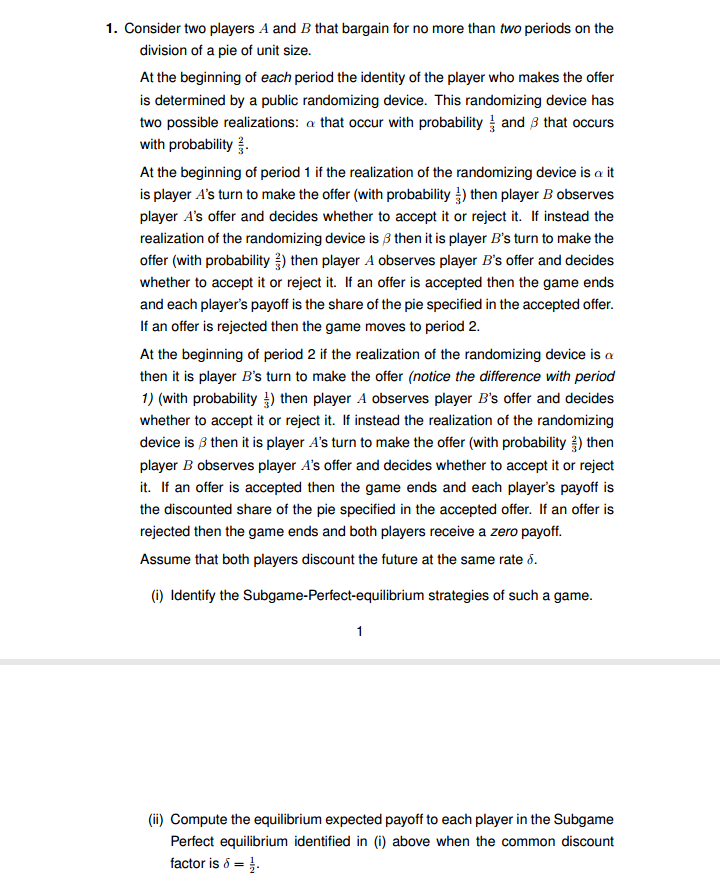
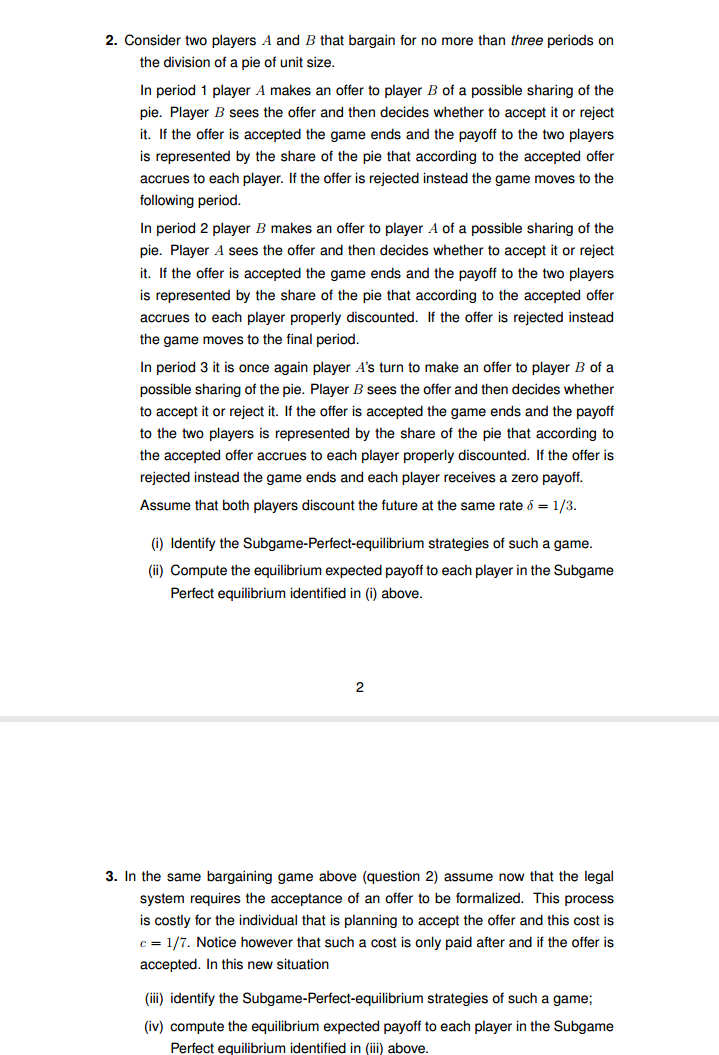
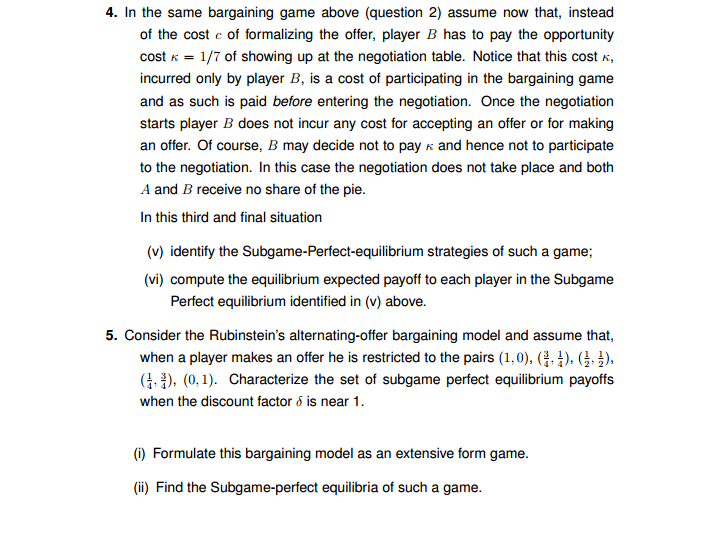
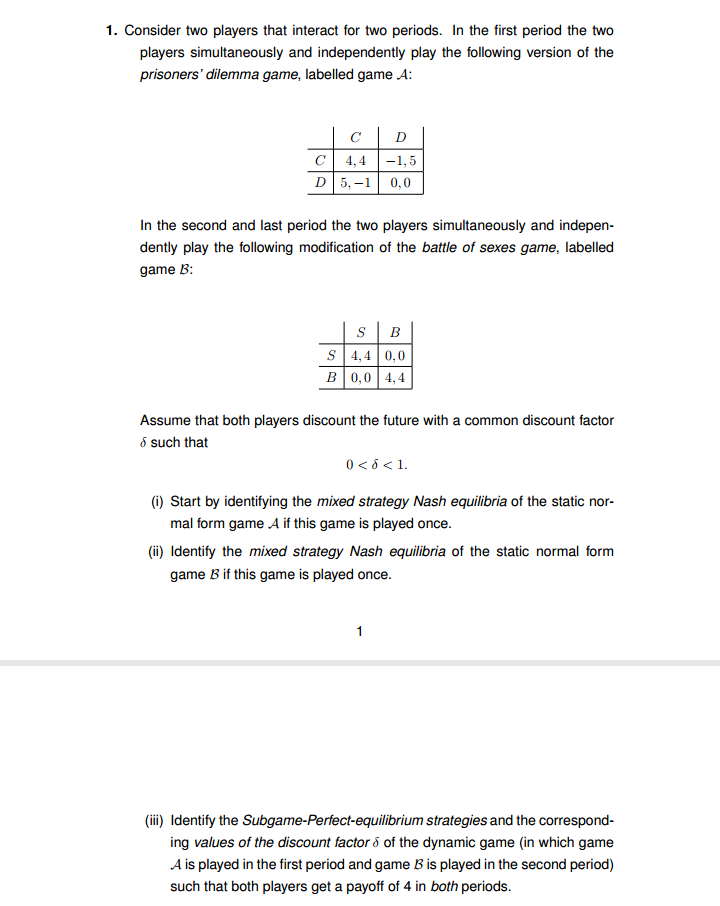
1 . Consider two players A and B that bargain for no more than two periods on the division of a pie of unit size. At the beginning of each period the identity of the player who makes the offer is determined by a public randomizing device. This randomizing device has two possble realizations: e that occur with probability g and ,8 that occurs with probability 5. At the beginning of period 1 ifthe realization of the randomizing device is o it is player A's turn in make the offer {with prcbabillty :1 then player B observes player as offer and decides whether to accept it or reject it. If instead the realization of the randomizing device is if then it is player B's turn to make the offer [with probability 3} then player A observes player It's offer and decides whether to accept it or reject it. if an offer is accepted then the game ends and each player's payoff is the share of the pie specied in the accepted offer. If an offer is rejected then the game moves to period 2. At the beginning of period 2 if the realization of the randomizing device is a then it is player B's turn to make the offer {notice the difference pith pencd t; [with probability ] then player A observes player B's offer and decides whether to accept it or reject it. If instead the realization of the randomizing device is i3 then it is player A's turn to make the offer {with probability El then player 3 observes player A's offer and decides whether to accept it or reject it. If an offer is accepted then the game ends and each player's payoff is the discounted share of the pie specified in the accepted offer. If an offer is rejected then the game ends and both players receive a zero payoff. Assume that both players discount the future at the same rate ii. {i} Identify the Subgame-Perfect-eguilbrium strategies of such a game. 1 {ii} Compute the equilibrium expected payoff to each player in the subgame Perfect equilibrium identified in {i} above when the common discount factor is 5 = g. 2. Consider two players A and B that bargain for no more than three periods on the division of a pie of unit size. In period 1 player A makes an offer to player B of a possible sharing of the pie. Player B sees the offer and then decides whether to accept it or reject it. If the offer is accepted the game ends and the payoff to the two players is represented by the share of the pie that according to the accepted offer accrues to each player. If the offer is rejected instead the game moves to the following period. In period 2 player B makes an offer to player A of a possible sharing of the pie. Player A sees the offer and then decides whether to accept it or reject it. If the offer is accepted the game ends and the payoff to the two players is represented by the share of the pie that according to the accepted offer accrues to each player properly discounted. If the offer is rejected instead the game moves to the final period. In period 3 it is once again player A's turn to make an offer to player B of a possible sharing of the pie. Player B sees the offer and then decides whether to accept it or reject it. If the offer is accepted the game ends and the payoff to the two players is represented by the share of the pie that according to the accepted offer accrues to each player properly discounted. If the offer is rejected instead the game ends and each player receives a zero payoff. Assume that both players discount the future at the same rate o = 1/3. (i) Identify the Subgame-Perfect-equilibrium strategies of such a game. (ii) Compute the equilibrium expected payoff to each player in the Subgame Perfect equilibrium identified in (i) above. 2 3. In the same bargaining game above (question 2) assume now that the legal system requires the acceptance of an offer to be formalized. This process is costly for the individual that is planning to accept the offer and this cost is c = 1/7. Notice however that such a cost is only paid after and if the offer is accepted. In this new situation (ii) identify the Subgame-Perfect-equilibrium strategies of such a game; (iv) compute the equilibrium expected payoff to each player in the Subgame Perfect equilibrium identified in (iii) above.4. In the same bargaining game above [question 2} assume now that. instead of the cost r: of formalizing the offer. player B has to pay the opportunityr cost it = 1;? of showing no at the negotiation table. Notice that this cost or. incurred only by player It. is a cost of participating in the bargaining game and as such is paid before entering the negotiation. Once the negotiation starts player It does net incur any cost for accepting an offer or for making an offer. Of course. 3 may decide not to pay is and hence not to participate to the negotiation. In this case the negotiation does not take place and both A and .8 receive no share of the pie. In this third and final situation {y} identityr the Subgame-F'edect-eguilibrium strategies of such a game: [vii compute the eguilbrium expected payoff to each player in the Subgame Perfect eguilibrium identied in {or} above. 5. Consider the Ftthinstein's alternating-offer bargaining model and assume that. when a player makes an offer he is restricted to the pairs {1,0}. [3} .[%,% . [iii . [i111]. Characterize the set of sub-game perfect equilibrium payoffs when the discount factor .5 is near 1. {it Formulate this bargaining model as an extensive form game. {it} Find the Subgame-perlect equilibria of such a game. 1. Consider two players that interact for two periods. In the first period the two players simultaneously and independently play the following version of the prisoners' dilemma game, labelled game A: D 4. 4 -1, 5 5. -1 0.0 In the second and last period the two players simultaneously and indepen dently play the following modification of the battle of sexes game, labelled game B: S B 4.4 0,0 B 0,0 4,4 Assume that both players discount the future with a common discount factor 6 such that 0
Step by Step Solution
There are 3 Steps involved in it

Get step-by-step solutions from verified subject matter experts