







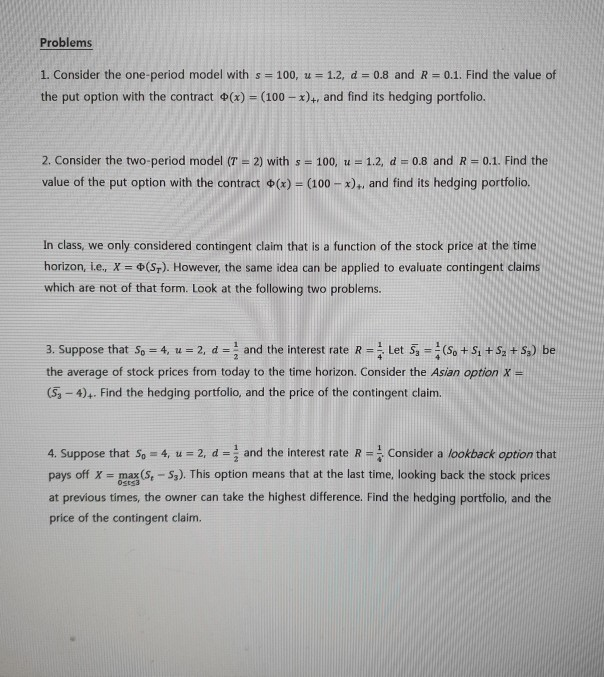
Question: Its Financial Mathematics Problems 1. Consider the one-period model with s = 100, u = 1.2, d = 0.8 and R = 0.1. Find the
Its Financial Mathematics
Problems 1. Consider the one-period model with s = 100, u = 1.2, d = 0.8 and R = 0.1. Find the value of the put option with the contract *(x) = (100 x)+, and find its hedging portfolio. 2. Consider the two-period model (T = 2) with s = 100, u = 1.2, d = 0.8 and R = 0.1. Find the value of the put option with the contract $(x) = (100 - x)., and find its hedging portfolio. In class, we only considered contingent claim that is a function of the stock price at the time horizon, i.e. X = $(S). However, the same idea can be applied to evaluate contingent claims which are not of that form. Look at the following two problems. 3. Suppose that so = 4, u = 2, d = and the interest rate R = Let 53 = (S0+S+S2 + S) be the average of stock prices from today to the time horizon. Consider the Asian option X = (53 - 4). Find the hedging portfolio, and the price of the contingent claim. pays off x 4. Suppose that so = 4, u = 2, d = and the interest rate R = Consider a lookback option that max (S. - S3). This option means that at the last time, looking back the stock prices at previous times, the owner can take the highest difference. Find the hedging portfolio, and the price of the contingent claim. Problems 1. Consider the one-period model with s = 100, u = 1.2, d = 0.8 and R = 0.1. Find the value of the put option with the contract *(x) = (100 x)+, and find its hedging portfolio. 2. Consider the two-period model (T = 2) with s = 100, u = 1.2, d = 0.8 and R = 0.1. Find the value of the put option with the contract $(x) = (100 - x)., and find its hedging portfolio. In class, we only considered contingent claim that is a function of the stock price at the time horizon, i.e. X = $(S). However, the same idea can be applied to evaluate contingent claims which are not of that form. Look at the following two problems. 3. Suppose that so = 4, u = 2, d = and the interest rate R = Let 53 = (S0+S+S2 + S) be the average of stock prices from today to the time horizon. Consider the Asian option X = (53 - 4). Find the hedging portfolio, and the price of the contingent claim. pays off x 4. Suppose that so = 4, u = 2, d = and the interest rate R = Consider a lookback option that max (S. - S3). This option means that at the last time, looking back the stock prices at previous times, the owner can take the highest difference. Find the hedging portfolio, and the price of the contingent claim
Step by Step Solution
There are 3 Steps involved in it

Get step-by-step solutions from verified subject matter experts
 Study Help