







Question: Its for Python b^2 - 4ac is called the discriminant of the quadratic equation. If it is positive, the equation has two real roots. If
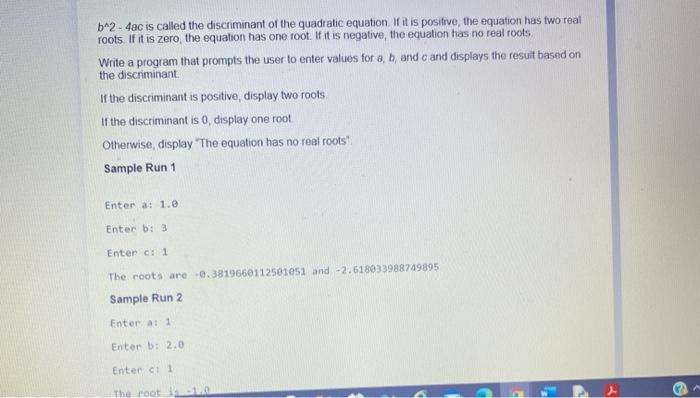
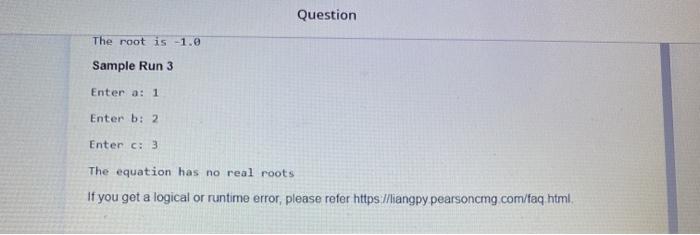
b^2 - 4ac is called the discriminant of the quadratic equation. If it is positive, the equation has two real roots. If it is zero the equation has one root. If it is negative, the equation has no real roots Write a program that prompts the user to enter values for a, b, and c and displays the result based on the discriminant If the discriminant is positive, display two roots of the discriminant is 0 display one root Otherwise, display "The equation has no real roots Sample Run 1 Enter a: 1.0 Enter b: 3 Enter c: 1 The roots are +0.3819660112501851 and -2.618033988749895 Sample Run 2 Enter at 1 Enter b: 2.0 Enter ct The root Question The root is -1.0 Sample Run 3 Enter a: 1 Enter b: 2 Enter c: 3 The equation has no real roots If you get a logical or runtime error, please refer https://angpy pearsoncmg.com/faq html
Step by Step Solution
There are 3 Steps involved in it

Get step-by-step solutions from verified subject matter experts
 Study Help