







Question: Its macro analysis Problem 1 Consider an exchange economy in which there are only two agents, Robinson and Friday, and two goods, 1 and 2.

Its macro analysis
![positive.]Q.2 Assume that Robinson's endowment is (wp, w? ) = (2, 0),](https://s3.amazonaws.com/si.experts.images/answers/2024/06/6677bbf465754_9326677bbf44ba5f.jpg)
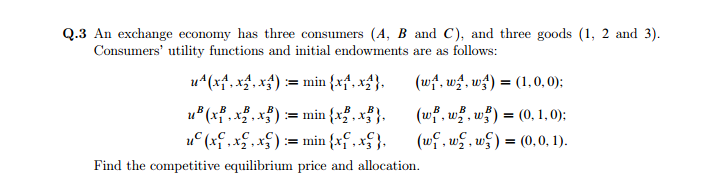
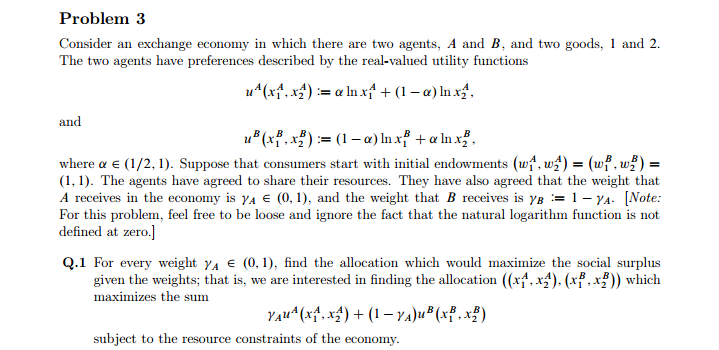

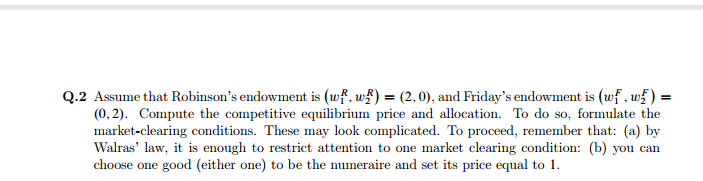
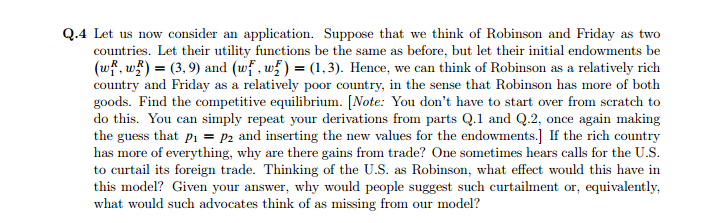
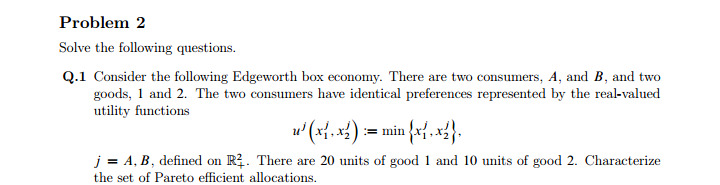
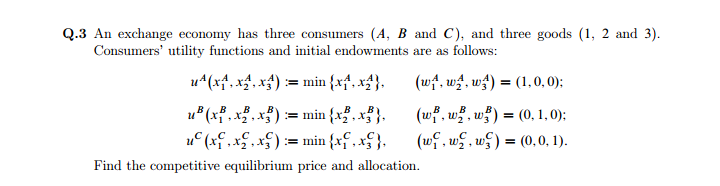
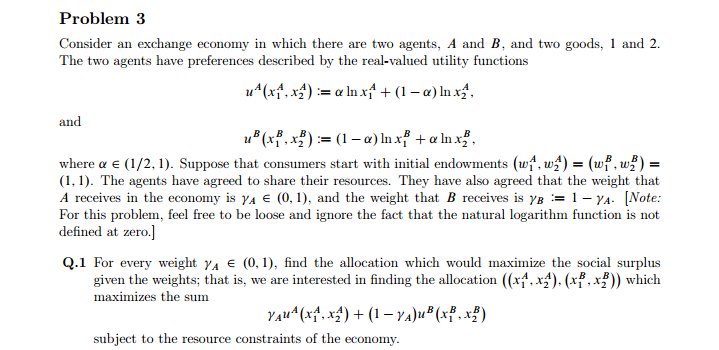
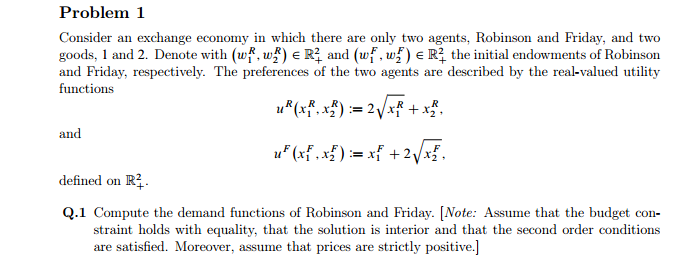
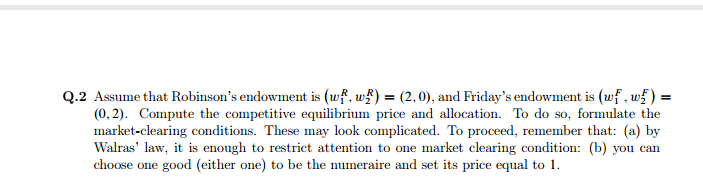
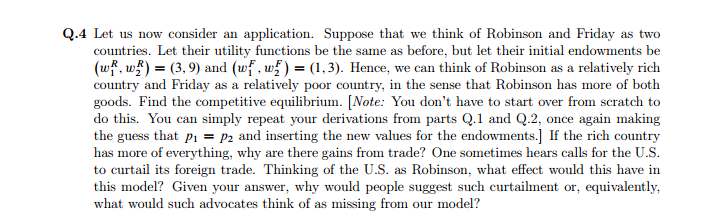
Problem 1 Consider an exchange economy in which there are only two agents, Robinson and Friday, and two goods, 1 and 2. Denote with (wp, w?) e R? and (wf, w? ) e R? the initial endowments of Robinson and Friday, respectively. The preferences of the two agents are described by the real-valued utility functions and uf (xf , x/ ) = x7+2Vx5 defined on R?. Q.1 Compute the demand functions of Robinson and Friday. [Note: Assume that the budget con- straint holds with equality, that the solution is interior and that the second order conditions are satisfied. Moreover, assume that prices are strictly positive.]Q.2 Assume that Robinson's endowment is (wp, w? ) = (2, 0), and Friday's endowment is (wf . w; ) = (0,2). Compute the competitive equilibrium price and allocation. To do so, formulate the market-clearing conditions. These may look complicated. To proceed, remember that: (a) by Walras' law, it is enough to restrict attention to one market clearing condition: (b) you can choose one good (either one) to be the numeraire and set its price equal to 1.Q.4 Let us now consider an application. Suppose that we think of Robinson and Friday as two countries. Let their utility functions be the same as before, but let their initial endowments be DR, WR) = (3,9) and (wf , w, ) = (1,3). Hence, we can think of Robinson as a relatively rich country and Friday as a relatively poor country, in the sense that Robinson has more of both goods. Find the competitive equilibrium. [Note: You don't have to start over from scratch to do this. You can simply repeat your derivations from parts Q.1 and Q.2, once again making the guess that p1 = p2 and inserting the new values for the endowments.] If the rich country has more of everything, why are there gains from trade? One sometimes hears calls for the U.S. to curtail its foreign trade. Thinking of the U.S. as Robinson, what effect would this have in this model? Given your answer, why would people suggest such curtailment or, equivalently, what would such advocates think of as missing from our model?Problem 2 Solve the following questions. Q.1 Consider the following Edgeworth box economy. There are two consumers, A, and B, and two goods, 1 and 2. The two consumers have identical preferences represented by the real-valued utility functions w'(x x2) := min (x], x2). j = A, B, defined on R3. There are 20 units of good 1 and 10 units of good 2. Characterize the set of Pareto efficient allocations.Q.3 An exchange economy has three consumers (A, B and C), and three goods (1, 2 and 3). Consumers' utility functions and initial endowments are as follows: ud (xA, x4, x4) := min (x1,x4 ), (wi, wa, wa) = (1,0,0); u(x1. x2 . . xB x5) := min (x2 , *3 ), (w , w2, w;) = (0, 1, 0); u"( x , x5, x5) : = min (x1, x3 ), (wf, w, w;) = (0,0, 1). Find the competitive equilibrium price and allocation.Problem 3 Consider an exchange economy in which there are two agents, A and B, and two goods, 1 and 2. The two agents have preferences described by the real-valued utility functions u" ( x x) =alexi + (1 -@) Inx2. and u B(x1, x5) := (1 -@) Inx, +alnx2, where a e (1/2, 1). Suppose that consumers start with initial endowments (wi , w; ) = (wf , w;) = (1, 1). The agents have agreed to share their resources. They have also agreed that the weight that A receives in the economy is yA E (0, 1), and the weight that B receives is y8 := 1 - YA. Note: For this problem, feel free to be loose and ignore the fact that the natural logarithm function is not defined at zero.] Q.1 For every weight yA 6 (0, 1), find the allocation which would maximize the social surplus given the weights; that is, we are interested in finding the allocation ((xA, x4). (xP, x;)) which maximizes the sum YAU (x4, x4 ) + (1 - YA)UB( xP. x2 ) subject to the resource constraints of the economy.PA(I - @) + (1 - YA)Q Q.2 For every weight yA E (0, 1), find initial endowments of goods 1 and 2 among agents A and B and a pair of prices such that the Pareto efficient allocation actually constitutes an equilibrium of the market. [Here we decentralize the Pareto efficient allocation via a market equilibrium.]
Step by Step Solution
There are 3 Steps involved in it

Get step-by-step solutions from verified subject matter experts
 Study Help