







Question: IV. Counting, Combination and Permutation: Read and analyze the problem, find what is asked and show your solution. Express your answer in fraction or decimal.
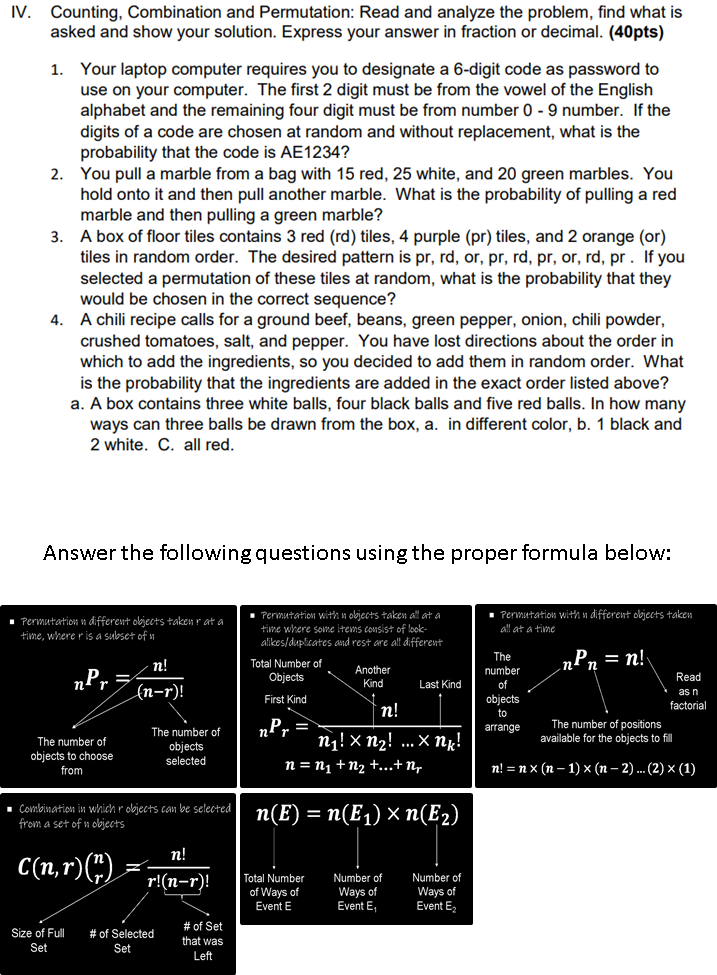
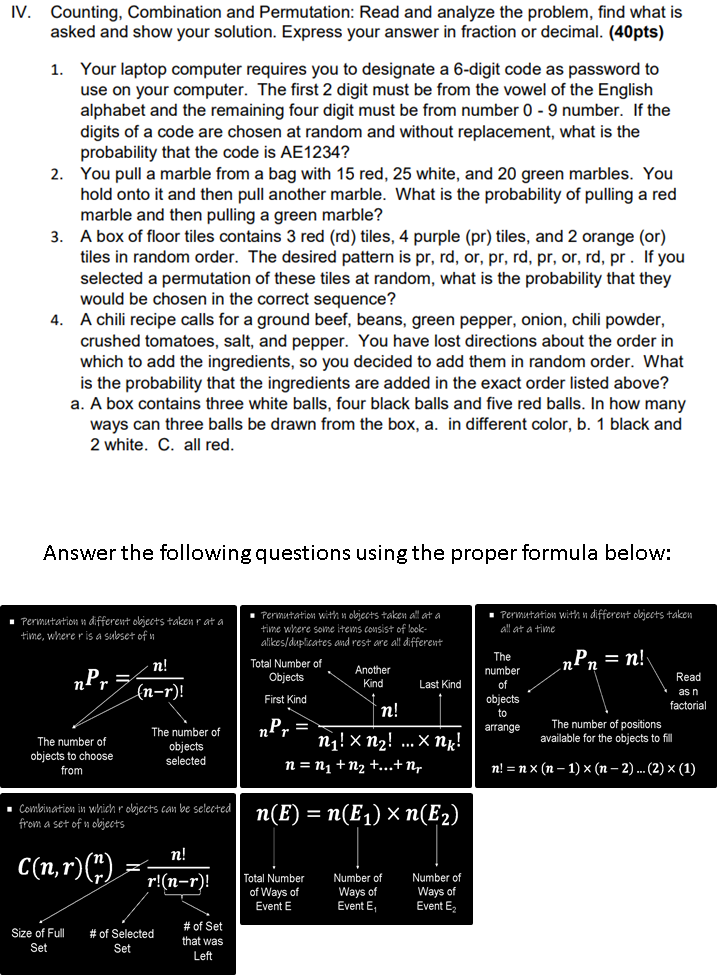
IV. Counting, Combination and Permutation: Read and analyze the problem, find what is asked and show your solution. Express your answer in fraction or decimal. (40pts) 1. Your laptop computer requires you to designate a 6-digit code as password to use on your computer. The first 2 digit must be from the vowel of the English alphabet and the remaining four digit must be from number 0 - 9 number. If the digits of a code are chosen at random and without replacement, what is the probability that the code is AE1234? 2. You pull a marble from a bag with 15 red, 25 white, and 20 green marbles. You hold onto it and then pull another marble. What is the probability of pulling a red marble and then pulling a green marble? 3. A box of floor tiles contains 3 red (rd) tiles, 4 purple (pr) tiles, and 2 orange (or) tiles in random order. The desired pattern is pr, rd, or, pr, rd, pr, or, rd, pr . If you selected a permutation of these tiles at random, what is the probability that they would be chosen in the correct sequence? 4. A chili recipe calls for a ground beef, beans, green pepper, onion, chili powder, crushed tomatoes, salt, and pepper. You have lost directions about the order in which to add the ingredients, so you decided to add them in random order. What is the probability that the ingredients are added in the exact order listed above? a. A box contains three white balls, four black balls and five red balls. In how many ways can three balls be drawn from the box, a. in different color, b. 1 black and 2 white. C. all red. Answer the following questions using the proper formula below: Permutation n different objects taken r at a . pervatation with n objects takes all at a Permutation with a different objects taken time, where r is a subset of " time where some items consist of look- all at a time alikes/duplicates and rest are all different The n! Total Number of nPn = n! Objects Another number Kind Read (n-r)! Last Kind of First Kind as n objects n! factorial to The number of n F arrange The number of positions The number of n1! X n2! ... Xnk available for the objects to fill objects objects to choose selected from n = n1 + n2 +...+n, n! = nx (n -1) x (n -2) ... (2) x (1) Combination in which r objects can be selected from a set of n dojects n(E) = n(E1) x n(E2) C(n, r) (") n! r!(n-r)! Total Number Number of Number of of Ways of Ways of Ways of Event E Event E, Event Ez Size of Full # of Selected # of Set Set Set that was Left
Step by Step Solution
There are 3 Steps involved in it

Get step-by-step solutions from verified subject matter experts
 Study Help