







Question: IX V fx A B C D E F G H Given: Current period Overhead Direct labor Direct labor hours Machine hours Assembly Finishing Total
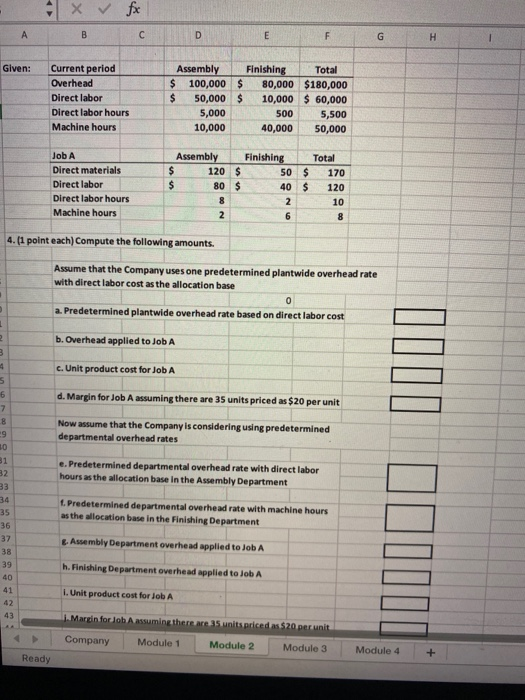
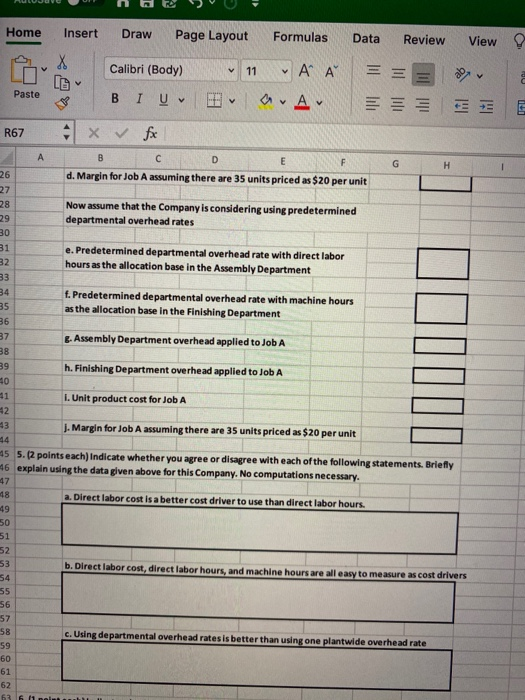
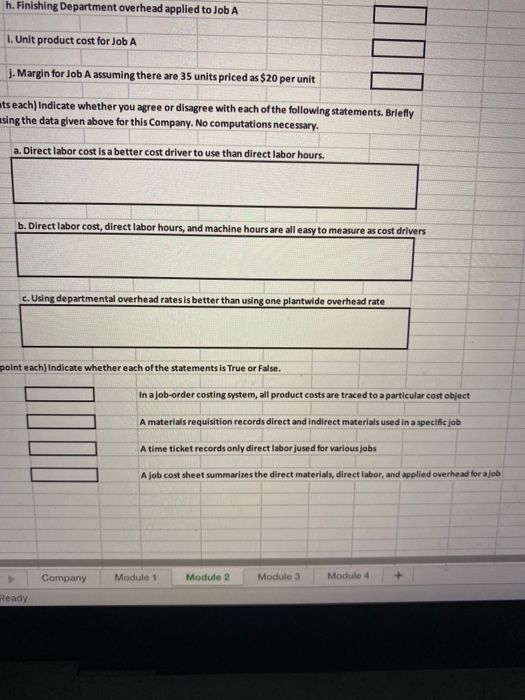
IX V fx A B C D E F G H Given: Current period Overhead Direct labor Direct labor hours Machine hours Assembly Finishing Total $ 100,000 $ 80,000 $180,000 $ 50,000 $ 10,000 $ 60,000 5,000 500 5,500 10,000 40,000 50,000 $ JobA Direct materials Direct labor Direct labor hours Machine hours Assembly 120 $ $ 80 $ 8 2 Finishing 50 $ 40 $ 2 6 Total 170 120 10 8 4. (1 point each) Compute the following amounts. Assume that the Company uses one predetermined plantwide overhead rate with direct labor cost as the allocation base 0 a. Predetermined plantwide overhead rate based on direct labor cost b. Overhead applied to JobA m IODO 4 5 c. Unit product cost for JobA 6 7 d. Margin for Job A assuming there are 35 units priced as $20 per unit Now assume that the Company is considering using predetermined departmental overhead rates e. Predetermined departmental overhead rate with direct labor hours as the allocation base in the Assembly Department 8 9 10 31 32 33 34 35 36 37 38 39 40 41 42 43 1. Predetermined departmental overhead rate with machine hours as the allocation base in the Finishing Department Assembly Department overhead applied to JobA h. Finishing Department overhead applied to Job A I.Unit product cost for JobA 1. Marcin for lob A assuming there are 3 units priced as 520 per unit Company Module 1 Module 2 Module 3 Module 4 + Ready Home Insert Draw Page Layout Formulas Data Review View Calibri (Body) v 11 ' == V Paste BIU v v A ITU R67 G H B C D E F 26 d. Margin for Job A assuming there are 35 units priced as $20 per unit 27 28 Now assume that the Company is considering using predetermined 29 departmental overhead rates 30 81 e. Predetermined departmental overhead rate with direct labor 32 hours as the allocation base in the Assembly Department 33 34 f. Predetermined departmental overhead rate with machine hours 35 as the allocation base in the Finishing Department 86 37 8. Assembly Department overhead applied to JobA 38 39 h. Finishing Department overhead applied to Job A 40 1 1. Unit product cost for Job A 42 43 J. Margin for Job A assuming there are 35 units priced as $20 per unit 45 5.12 points each) Indicate whether you agree or disagree with each of the following statements. Briefly 46 explain using the data given above for this Company. No computations necessary. 11001 47 18 a. Direct labor cost is a better cost driver to use than direct labor hours. b. Direct labor cost, direct labor hours, and machine hours are all easy to measure as cost drivers 49 SO 51 52 53 54 55 56 57 58 59 60 61 62 63 c. Using departmental overhead rates is better than using one plantwide overhead rate h. Finishing Department overhead applied to Job A 1. Unit product cost for Job A J. Margin for Job A assuming there are 35 units priced as $20 per unit ats each) Indicate whether you agree or disagree with each of the following statements. Briefly asing the data given above for this Company. No computations necessary. a. Direct labor cost is a better cost driver to use than direct labor hours. b. Direct labor cost, direct labor hours, and machine hours are all easy to measure as cost drivers c. Using departmental overhead rates is better than using one plantwide overhead rate point each) Indicate whether each of the statements is True or False. In a job-order costing system, all product costs are traced to a particular cost object A materials requisition records direct and indirect materials used in a specific job A time ticket records only direct laborjused for various jobs A job cost sheet summarizes the direct materials, direct labor, and applied overhead for a job Company Module 1 Module 2 Module 3 Module 4 Ready
Step by Step Solution
There are 3 Steps involved in it

Get step-by-step solutions from verified subject matter experts
 Study Help