







Question: J (a) does not exist i J () doesn't exist or both exist, but don't match f(2) = (2 -1) +2) + 2 f (
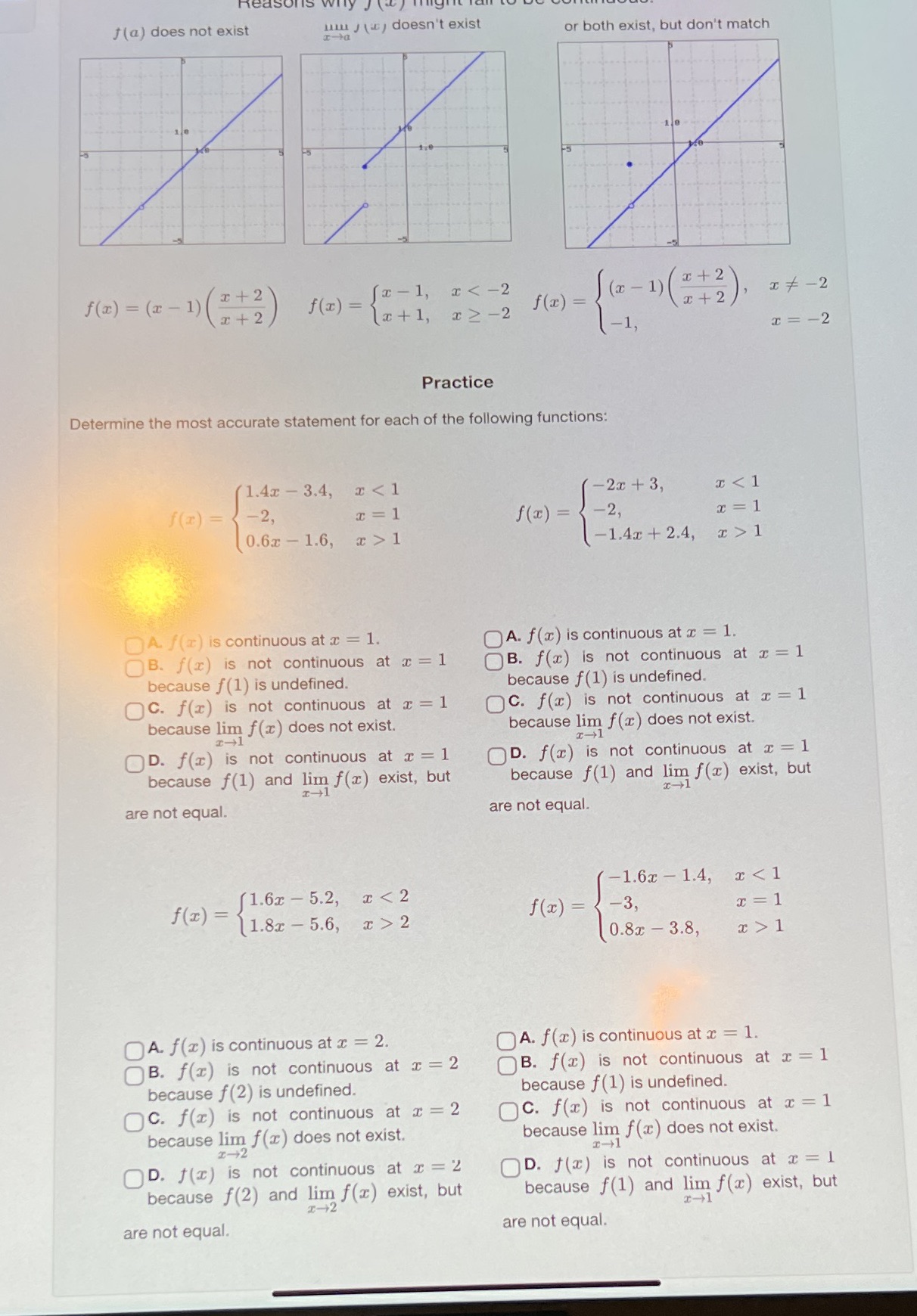
J (a) does not exist i J () doesn't exist or both exist, but don't match f(2) = (2 -1) +2) + 2 f ( I ) = 12 + 1 7 3 2 1( 1 ) = (2 - 1 2+2 ), 87 - 2 -1 , x = -2 Practice Determine the most accurate statement for each of the following functions: 1.4x - 3.4, -2x + 3, f(z) = - 2, * = 1 f (* ) = - 2 , x = 1 0.6x - 1.6, x > 1 -1.4x + 2.4, > 1 A. f (a) is continuous at x = 1. A. f(x) is continuous at r = 1. B. f(x) is not continuous at x = 1 B. f(x) is not continuous at I = 1 because f(1) is undefined. because f(1) is undefined. Oc. f(x) is not continuous at x = 1 c. f(x) is not continuous at x = 1 because lim f(x) does not exist. because lim f(x ) does not exist. 1- 1 OD. f(x) is not continuous at x = 1 D. f(x) is not continuous at a = 1 because f(1) and lim f(x) exist, but because f(1) and lim f(x) exist, but are not equal. are not equal. -1.6x - 1.4, f(I) = 1.6x - 5.2, 2 f(x) = - 3, * = 0.8x - 3.8, I > OA. f(x) is continuous at I = 2. OA. f(x) is continuous at x = 1. (B. f(x) is not continuous at r = 2 OB. f(x) is not continuous at = = 1 because f(2) is undefined. because f (1) is undefined. c. f(x) is not continuous at x = 2 Oc. f(x) is not continuous at a = 1 because lim f(x) does not exist. because lim f(x) does not exist. I-+2 OD. J(I) is not continuous at x = 2 OD. J(x) is not continuous at z = 1 because f(2) and lim f(x) exist, but because f(1) and lim f(x) exist, but are not equal. are not equal
Step by Step Solution
There are 3 Steps involved in it

Get step-by-step solutions from verified subject matter experts
 Study Help