







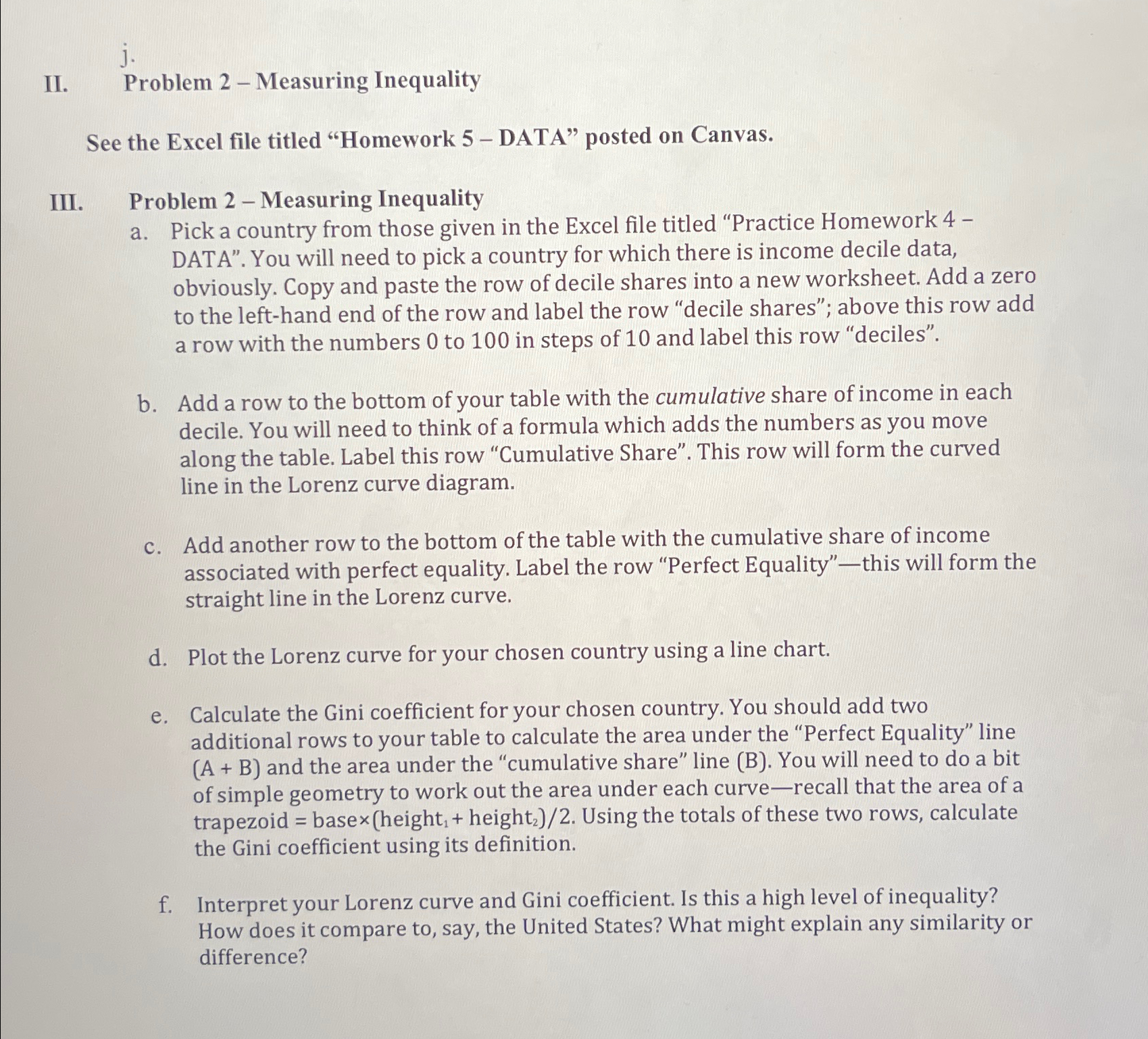
Question: j . II . Problem 2 - Measuring Inequality See the Excel file titled Homework 5 - DATA posted on Canvas. III. Problem 2 -
j
II Problem Measuring Inequality
See the Excel file titled "Homework DATA" posted on Canvas.
III. Problem Measuring Inequality
a Pick a country from those given in the Excel file titled "Practice Homework DATA". You will need to pick a country for which there is income decile data, obviously. Copy and paste the row of decile shares into a new worksheet. Add a zero to the lefthand end of the row and label the row "decile shares"; above this row add a row with the numbers to in steps of and label this row "deciles".
b Add a row to the bottom of your table with the cumulative share of income in each decile. You will need to think of a formula which adds the numbers as you move along the table. Label this row "Cumulative Share". This row will form the curved line in the Lorenz curve diagram.
c Add another row to the bottom of the table with the cumulative share of income associated with perfect equality. Label the row "Perfect Equality"this will form the straight line in the Lorenz curve.
d Plot the Lorenz curve for your chosen country using a line chart.
e Calculate the Gini coefficient for your chosen country. You should add two additional rows to your table to calculate the area under the "Perfect Equality" line and the area under the "cumulative share" line B You will need to do a bit of simple geometry to work out the area under each curverecall that the area of a trapezoid base height height Using the totals of these two rows, calculate the Gini coefficient using its definition.
f Interpret your Lorenz curve and Gini coefficient. Is this a high level of inequality? How does it compare to say, the United States? What might explain any similarity or difference?
Step by Step Solution
There are 3 Steps involved in it
1 Expert Approved Answer
Step: 1 Unlock

Question Has Been Solved by an Expert!
Get step-by-step solutions from verified subject matter experts
Step: 2 Unlock
Step: 3 Unlock
 Study Help