



Question: J. Suppose Caroline develops a new and much more efficient production process, so her firm's total factor productivity increases to 2 = 128. All else
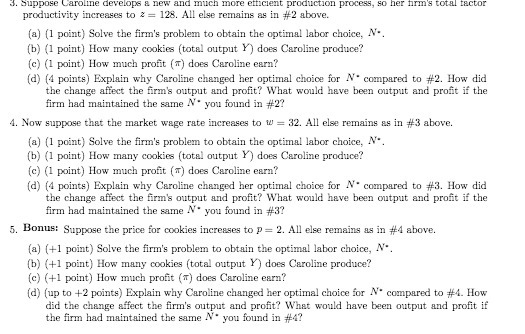
J. Suppose Caroline develops a new and much more efficient production process, so her firm's total factor productivity increases to 2 = 128. All else remains as in #2 above. (a) (1 point) Solve the firm's problem to obtain the optimal labor choice, N-. (b) (1 point) How many cookies (total output )) does Caroline produce? (c) (1 point) How much profit (@) does Caroline earn? (d) (4 points) Explain why Caroline changed her optimal choice for N' compared to #2. How did the change affect the firm's output and profit? What would have been output and profit if the firm had maintained the same N* you found in #2? 4. Now suppose that the market wage rate increases to w = 32. All else remains as in #3 above. (a) (1 point) Solve the firm's problem to obtain the optimal labor choice, N". (b) (1 point) How many cookies (total output )) does Caroline produce? (c) (1 point) How much profit (#) does Caroline earn? (d) (4 points) Explain why Caroline changed her optimal choice for N* compared to #3. How did the change affect the firm's output and profit? What would have been output and profit if the firm had maintained the same N* you found in #3? 5. Bonus: Suppose the price for cookies increases to p = 2. All else remains as in #4 above. (a) (+1 point) Solve the firm's problem to obtain the optimal labor choice, N". (b) (+1 point) How many cookies (total output )) does Caroline produce? (c) (+1 point) How much profit (") does Caroline earn? (d) (up to +2 points) Explain why Caroline changed her optimal choice for N* compared to #4. How did the change affect the firm's output and profit? What would have been output and profit if the firm had maintained the same N* you found in #4
Step by Step Solution
There are 3 Steps involved in it

Get step-by-step solutions from verified subject matter experts