







Question: Jamie does not own a computer or an iPhone, but he has now decided to buy one or the other--- that is, he will
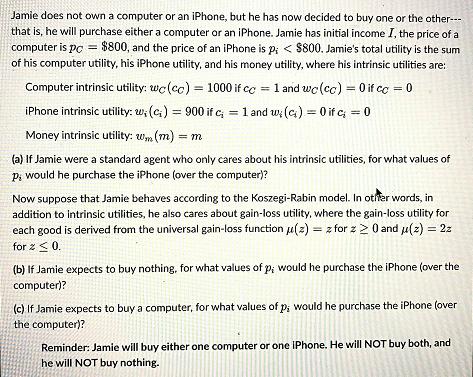
Jamie does not own a computer or an iPhone, but he has now decided to buy one or the other--- that is, he will purchase either a computer or an iPhone. Jamie has initial income I, the price of a computer is pc = $800, and the price of an iPhone is p; < $800. Jamie's total utility is the sum of his computer utility, his iPhone utility, and his money utility, where his intrinsic utilities are: Computer intrinsic utility: wc (cc) = 1000 if cc = 1 and wc (cc) = 0 if cc = 0 iPhone intrinsic utility: w; (c) = 900 if c; = 1 and w; (c) = 0 if c = 0 Money intrinsic utility: wm (m) = m (a) If Jamie were a standard agent who only cares about his intrinsic utilities, for what values of P, would he purchase the iPhone (over the computer)? Now suppose that Jamie behaves according to the Koszegi-Rabin model. In other words, in addition to intrinsic utilities, he also cares about gain-loss utility, where the gain-loss utility for each good is derived from the universal gain-loss function (z) = z for z 20 and (z) = 2z for z 0. (b) If Jamie expects to buy nothing, for what values of p; would he purchase the iPhone (over the computer)? (c) If Jamie expects to buy a computer, for what values of p; would he purchase the iPhone (over the computer)? Reminder: Jamie will buy either one computer or one iPhone. He will NOT buy both, and he will NOT buy nothing.
Step by Step Solution
3.50 Rating (157 Votes )
There are 3 Steps involved in it
a Jamie wou... View full answer

Get step-by-step solutions from verified subject matter experts
 Study Help