







Question: Jared wanted to find three consecutive even integers whose sum was 4 times the first of those integers. He let k represent the first
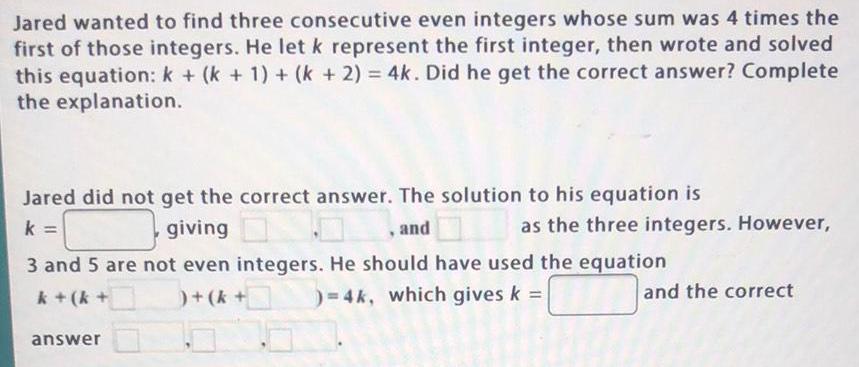
Jared wanted to find three consecutive even integers whose sum was 4 times the first of those integers. He let k represent the first integer, then wrote and solved this equation: k+(k+1) + (k + 2) = 4k. Did he get the correct answer? Complete the explanation. Jared did not get the correct answer. The solution to his equation is k = giving and as the three integers. However, 3 and 5 are not even integers. He should have used the equation k+(k+ answer )+(k+ )=4k, which gives k = and the correct
Step by Step Solution
There are 3 Steps involved in it
1 Expert Approved Answer
Step: 1 Unlock

Question Has Been Solved by an Expert!
Get step-by-step solutions from verified subject matter experts
Step: 2 Unlock
Step: 3 Unlock
 Study Help