







Question: Java 6. (15 points) (a) Snailsort is a recursive sorting method finds the maximum of the sorted array, places that maximum at the end and
Java
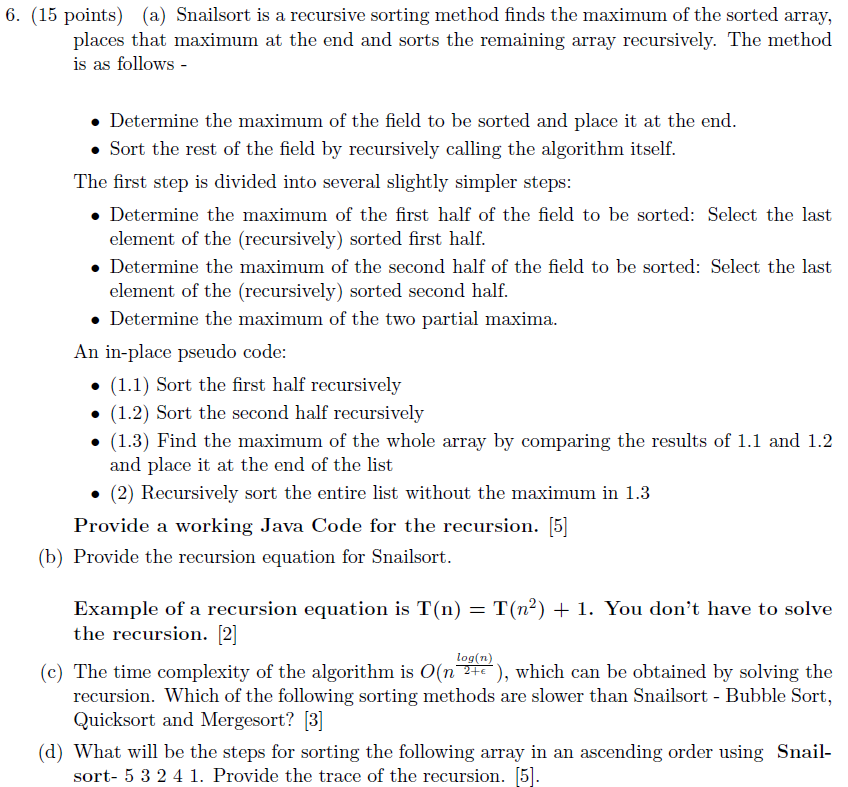
6. (15 points) (a) Snailsort is a recursive sorting method finds the maximum of the sorted array, places that maximum at the end and sorts the remaining array recursively. The method is as follows - . Determine the maximum of the field to be sorted and place it at the end . Sort the rest of the field by recursively calling the algorithm itself. The first step is divided into several slightly simpler steps Determine the maximum of the first half of the field to be sorted: Select the last element of the (recursively) sorted first half Determine the maximum of the second half of the field to be sorted: Select the last element of the (recursively) sorted second half. . Determine the maximum of the two partial maxima. An in-place pseudo code: (1.1) Sort the first half recursively (1.2) Sort the second half recursively . (1.3) Find the maximum of the whole array by comparing the results of 1.1 and 1.2 and place it at the end of the list (2) Recursively sort the entire list without the maximum in 1.3 Provide a working Java Code for the recursion. [5] (b) Provide the recursion equation for Snailsort Example of a recursion equation is T(n) - T(n2) + 1. You don't have to solve the recursion. 2 log(n) (c) The time complexity of the algorithm is O(n), which can be obtained by solving the recursion. Which of the following sorting methods are slower than Snailsort - Bubble Sort Quicksort and Mergesort? [3] (d) What will be the steps for sorting the following array in an ascending order using Snail- sort- 5 3 2 4 1. Provide the trace of the recursion. [5
Step by Step Solution
There are 3 Steps involved in it

Get step-by-step solutions from verified subject matter experts
 Study Help