







Question: JAVA A common assumption when doing a analysis is that you can just look at loops. One may assume that a single loop would be
JAVA
A common assumption when doing a analysis is that you can just look at loops. One may assume that a single loop would be (n), a nested loop (n2) and so for. However, there is much more to itthan that: we need to precisely understand what the loops do! This function will serve as example (code below) 1) Copy mystery into Eclipse. Edit its code so that it returns both the answer and the number of times that the loop runs. (Hint: use a Pair)In your main function, call mystery on arrays of different sizes and show how many times the loop runs for each array size. In comments below your main function, interpret the results and conclude about the of mystery.
2) The function mystery had a single loop, yet it did not have the complexity that you may have expected from a single loop. Explain which tricks were used in the function such that its complexity was not as it may have seemed from a cursory look.
3) Use the same tricks as you learned from mystery to write a function trickyhobbitses that has a single for loop but runs in (n3).
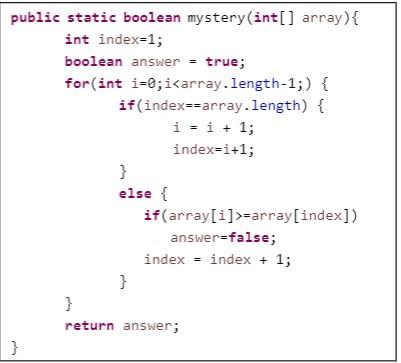
public static boolean mystery(int[] array) { int index=1; boolean answer = true; for(int i=0;i
Step by Step Solution
There are 3 Steps involved in it

Get step-by-step solutions from verified subject matter experts
 Study Help