







Question: Java Class: In NetBeans The first constructor, TextBook(), doesn't have a parameter. lt assigns to title, 0.0 to price, 0 to courselD; . The
Java Class: In NetBeans
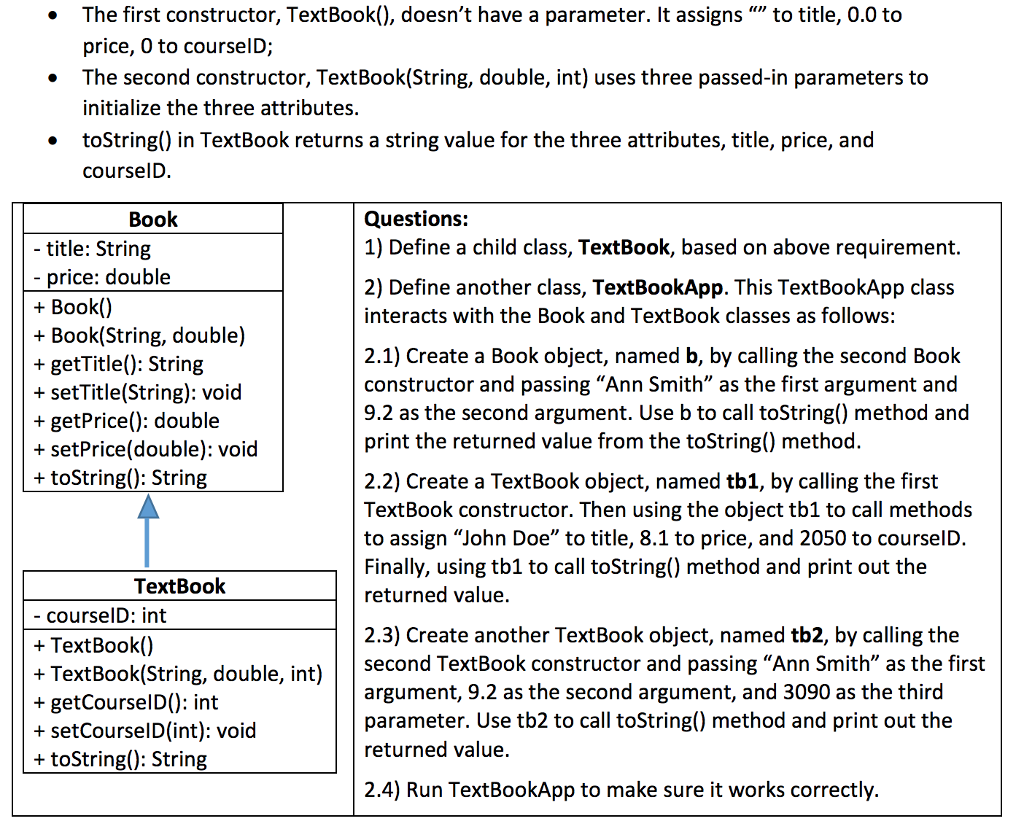
The first constructor, TextBook(), doesn't have a parameter. lt assigns "" to title, 0.0 to price, 0 to courselD; . The second constructor, TextBook(String, double, int) uses three passed-in parameters to initialize the three attributes. * toString() in TextBook returns a string value for the three attributes, title, price, and courselD Book Questions: 1) Define a child class, TextBook, based on above requirement. - title: String price: double + Book() + Book(String, double) + getTitle(): String + setTitle(String): void + getPrice(): double + setPrice(double): void + toString(): String 2) Define another class, TextBookApp. This TextBookApp class interacts with the Book and TextBook classes as follows: 2.1) Create a Book object, named b, by calling the second Book constructor and passing "Ann Smith" as the first argument and 9.2 as the second argument. Use b to call toString() method and print the returned value from the toString() method. 2.2) Create a TextBook object, named tb1, by calling the first TextBook constructor. Then using the object tb1 to call methods to assign "John Doe" to title, 8.1 to price, and 2050 to courselD. Finally, using tb1 to call toString() method and print out the returned value, TextBook - courseID: int + TextBook() + TextBook(String, double, int) + getCourselD(): int + setCourselD(int): void + toString(): String 2.3) Create another TextBook object, named tb2, by calling the second TextBook constructor and passing "Ann Smith" as the first argument, 9.2 as the second argument, and 3090 as the third parameter. Use tb2 to call toString() method and print out the returned value. 2.4) Run TextBookApp to make sure it works correctly
Step by Step Solution
There are 3 Steps involved in it

Get step-by-step solutions from verified subject matter experts
 Study Help