







Question: JAVA Coding Please modify the FastDefaultList.java file as the guides in the code so it can fits the requirements. thank you! Here is the FastDefaultList.java
JAVA Coding
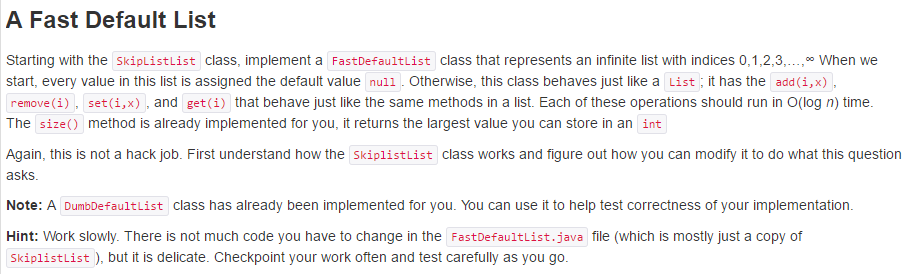
Please modify the FastDefaultList.java file as the guides in the code so it can fits the requirements.
thank you!
Here is the FastDefaultList.java file:
package comp2402a3; import java.lang.reflect.Array; import java.lang.IllegalStateException; import java.util.AbstractList; import java.util.Arrays; import java.util.Iterator; import java.util.List; import java.util.NoSuchElementException; import java.util.Random; /** * Implements the List interface as a skiplist so that all the * standard operations take O(log n) time * * TODO: Modify this so that it creates a DefaultList, which is basically * an infinitely long list whose values start out as null * */ public class FastDefaultListextends AbstractList { class Node { T x; Node[] next; int[] length; @SuppressWarnings("unchecked") public Node(T ix, int h) { x = ix; next = (Node[])Array.newInstance(Node.class, h+1); length = new int[h+1]; } public int height() { return next.length - 1; } } /** * This node sits on the left side of the skiplist */ protected Node sentinel; /** * The maximum height of any element */ int h; /** * The number of elements stored in the skiplist */ int n; // Hint: You don't need this anymore! /** * A source of random numbers */ Random rand; public FastDefaultList() { n = 0; sentinel = new Node(null, 32); h = 0; rand = new Random(0); } /** * Find the node that precedes list index i in the skiplist. * * @param x - the value to search for * @return the predecessor of the node at index i or the final * node if i exceeds size() - 1. */ protected Node findPred(int i) { // Hint: It's not enough to know u, you also need the value j, // maybe return the pair (u,j) Node u = sentinel; int r = h; int j = -1; // index of the current node in list 0 while (r >= 0) { while (u.next[r] != null && j + u.length[r] n-1) throw new IndexOutOfBoundsException(); // Hint: Are you sure findPred(i).next is the node you're looking for? return findPred(i).next[0].x; } public T set(int i, T x) { // Hint: this is too restrictive any non-negative i is allowed if (i n-1) throw new IndexOutOfBoundsException(); // Hint: Are you sure findPred(i).next is the node you're looking for? // If it's not, you'd better add a new node, maybe get everything // else working and come back to this later. Node u = findPred(i).next[0]; T y = u.x; u.x = x; return y; } /** * Insert a new node into the skiplist * @param i the index of the new node * @param w the node to insert * @return the node u that precedes v in the skiplist */ protected Node add(int i, Node w) { Node u = sentinel; int k = w.height(); int r = h; int j = -1; // index of u while (r >= 0) { while (u.next[r] != null && j+u.length[r] /** * Simulate repeatedly tossing a coin until it comes up tails. * Note, this code will never generate a height greater than 32 * @return the number of coin tosses - 1 */ protected int pickHeight() { int z = rand.nextInt(); int k = 0; int m = 1; while ((z & m) != 0) { k++; m n) throw new IndexOutOfBoundsException(); Node w = new Node(x, pickHeight()); if (w.height() > h) h = w.height(); add(i, w); } public T remove(int i) { // Hint: bounds checking again! if (i n-1) throw new IndexOutOfBoundsException(); T x = null; Node u = sentinel; int r = h; int j = -1; // index of node u while (r >= 0) { while (u.next[r] != null && j+u.length[r] MAX_VALUE; } public String toString() { // This is just here to help you a bit with debugging StringBuilder sb = new StringBuilder(); int i = -1; Node u = sentinel; while (u.next[0] != null) { i += u.length[0]; u = u.next[0]; sb.append(" " + i + "=>" + u.x); } return sb.toString(); } public static void main(String[] args) { Tester.testDefaultList(new FastDefaultList ()); } }
A Fast Default List Starting with the skipListlist class, implement a FastDefaultlist class that represents an infinite list with indices 0,1,2,3,.., When we start, every value in this list is assigned the default value null. Otherwise, this class behaves just like a List ; it has the add(i,x) remove(i) set(i,x), and get(i) that behave just like the same methods in a list. Each of these operations should run in O(log n) time. The size() method is already implemented for you, it returns the largest value you can store in an int Again, this is not a hack job. First understand how the skiplistlist class works and figure out how you can modify it to do what this question asks Note: A DumbDefaultlist class has already been implemented for you. You can use it to help test correctness of your implementation Hint: Work slowly. There is not much code you have to change in the FastDefaultlist.java file (which is mostly just a copy of Skiplistlist), but it is delicate. Checkpoint your work often and test carefully as you go
Step by Step Solution
There are 3 Steps involved in it

Get step-by-step solutions from verified subject matter experts
 Study Help