







Question: java homework help please Part 3: Filter End result of Part 3 pass all tests in these files o Filter Test java run the following
java homework help please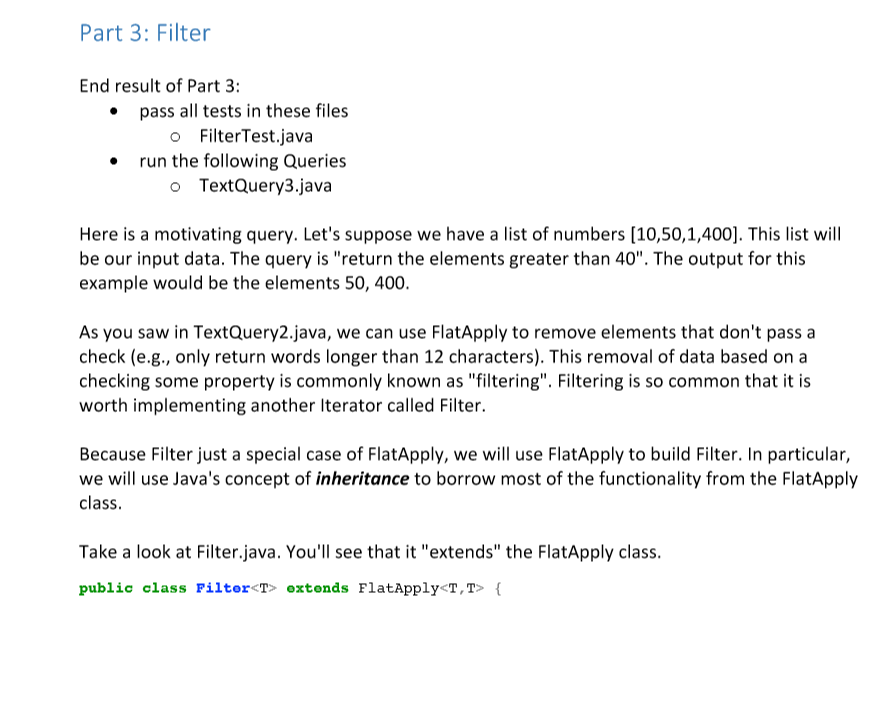
![have a list of numbers [10,50,1,400]. This list will be our input](https://dsd5zvtm8ll6.cloudfront.net/si.experts.images/questions/2024/09/66f3ea19df932_20966f3ea194bf0f.jpg)
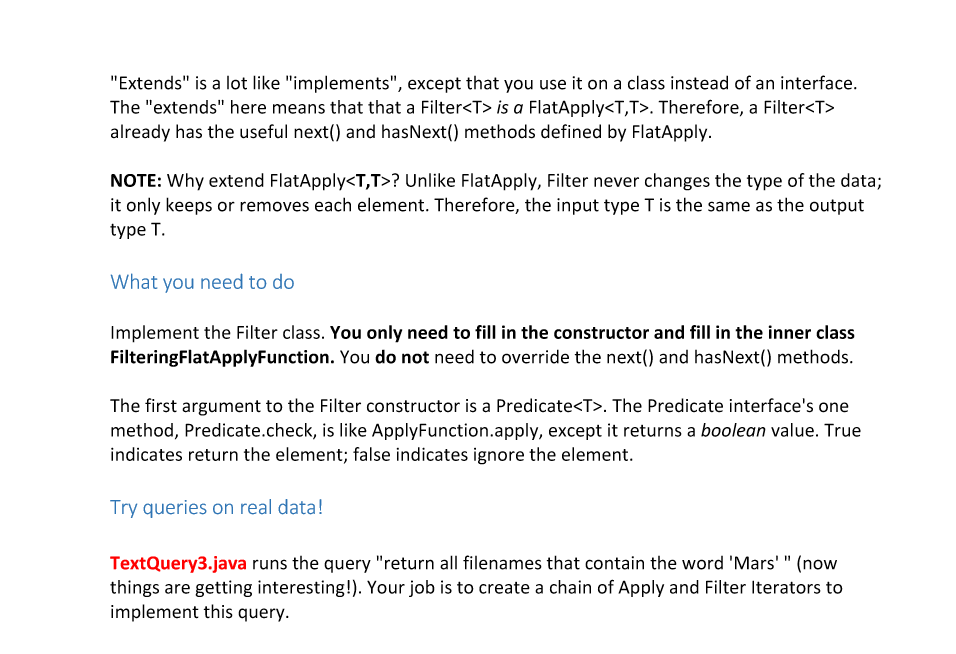
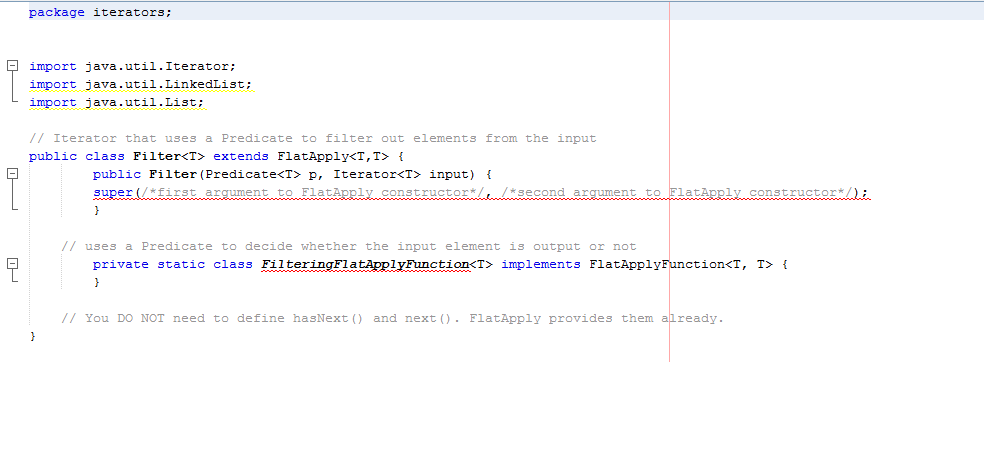
Part 3: Filter End result of Part 3 pass all tests in these files o Filter Test java run the following Queries o TextQuery3.java Here is a motivating query. Let's suppose we have a list of numbers [10,50,1,400]. This list will be our input data. The query is "return the elements greater than 40". The output for this example would be the elements 50, 400. As you saw in TextQuery2.java, we can use FlatApply to remove elements that don't pass a check (e.g., only return words longer than 12 characters). This removal of data based on a checking some property is commonly known as "filtering". Filtering is so common that it is worth implementing another lterator called Filter. Because Filter just a special case of FlatApply, we will use FlatApply to build Filter. In particular, we will use Java's concept of inheritance to borrow most of the functionality from the FlatApply class. Take a look at Filter.java. You'll see that it "extends" the FlatApply class. public class Filter T> extends FlatApply T,T Part 3: Filter End result of Part 3 pass all tests in these files o Filter Test java run the following Queries o TextQuery3.java Here is a motivating query. Let's suppose we have a list of numbers [10,50,1,400]. This list will be our input data. The query is "return the elements greater than 40". The output for this example would be the elements 50, 400. As you saw in TextQuery2.java, we can use FlatApply to remove elements that don't pass a check (e.g., only return words longer than 12 characters). This removal of data based on a checking some property is commonly known as "filtering". Filtering is so common that it is worth implementing another lterator called Filter. Because Filter just a special case of FlatApply, we will use FlatApply to build Filter. In particular, we will use Java's concept of inheritance to borrow most of the functionality from the FlatApply class. Take a look at Filter.java. You'll see that it "extends" the FlatApply class. public class Filter T> extends FlatApply T,T
Step by Step Solution
There are 3 Steps involved in it

Get step-by-step solutions from verified subject matter experts
 Study Help