







Question: JAVA Implement a toString method for the WeightedGraph class. Test the method in the UseGraph.java file. Package Link: https://pastebin.com/KVWhNsyJ ***** WeightedGraph.java ***** public class WeightedGraph
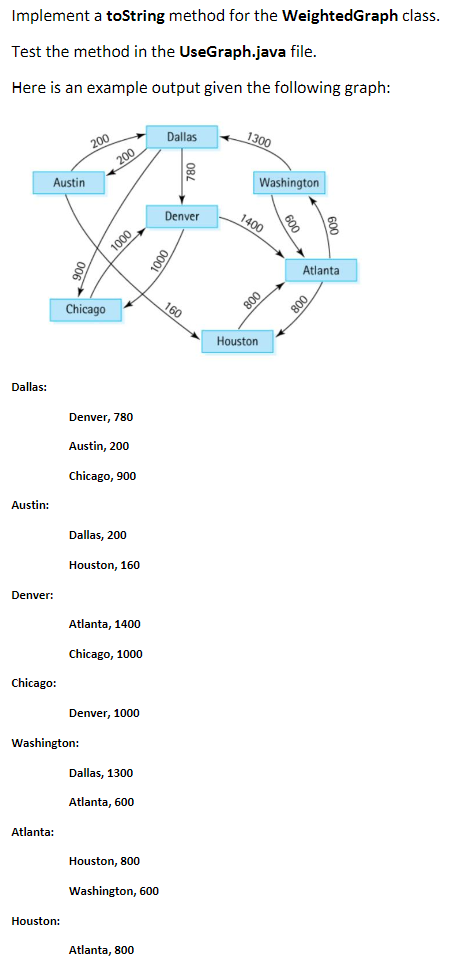
JAVA
Implement a toString method for the WeightedGraph class. Test the method in the UseGraph.java file.
Package Link: https://pastebin.com/KVWhNsyJ
***** WeightedGraph.java *****
public class WeightedGraph
public static final int NULL_EDGE = 0;
private static final int DEFCAP = 50; // default capacity
private int numVertices;
private int maxVertices;
private T[] vertices;
private int[][] edges;
private boolean[] marks; // marks[i] is mark for vertices[i]
public WeightedGraph()
// Instantiates a graph with capacity DEFCAP vertices.
{
numVertices = 0;
maxVertices = DEFCAP;
vertices = (T[]) new Object[DEFCAP];
marks = new boolean[DEFCAP];
edges = new int[DEFCAP][DEFCAP];
}
public WeightedGraph(int maxV)
// Instantiates a graph with capacity maxV.
{
numVertices = 0;
maxVertices = maxV;
vertices = (T[]) new Object[maxV];
marks = new boolean[maxV];
edges = new int[maxV][maxV];
}
public boolean isEmpty()
// Returns true if this graph is empty; otherwise, returns false.
{
return (numVertices == 0);
}
public boolean isFull()
// Returns true if this graph is full; otherwise, returns false.
{
return (numVertices == maxVertices);
}
public void addVertex(T vertex)
// Preconditions: This graph is not full.
// Vertex is not already in this graph.
// Vertex is not null.
//
// Adds vertex to this graph.
{
vertices[numVertices] = vertex;
for (int index = 0; index
edges[numVertices][index] = NULL_EDGE;
edges[index][numVertices] = NULL_EDGE;
}
numVertices++;
}
public boolean hasVertex(T vertex)
// Returns true if this graph contains vertex; otherwise, returns false.
{
for (int i = 0; i
if (vertices[i].equals(vertex)) // has a vertex
return true;
}
// does not have a vertex
return false;
}
private int indexIs(T vertex)
// Returns the index of vertex in vertices.
{
int index = 0;
while (!vertex.equals(vertices[index]))
index++;
return index;
}
public void addEdge(T fromVertex, T toVertex, int weight)
// Adds an edge with the specified weight from fromVertex to toVertex.
{
int row;
int column;
row = indexIs(fromVertex);
column = indexIs(toVertex);
edges[row][column] = weight;
}
public int weightIs(T fromVertex, T toVertex)
// If edge from fromVertex to toVertex exists, returns the weight of edge;
// otherwise, returns a special null-edge value.
{
int row;
int column;
row = indexIs(fromVertex);
column = indexIs(toVertex);
return edges[row][column];
}
public QueueInterface
// Returns a queue of the vertices that vertex is adjacent to.
{
QueueInterface
int fromIndex;
int toIndex;
fromIndex = indexIs(vertex);
for (toIndex = 0; toIndex
if (edges[fromIndex][toIndex] != NULL_EDGE)
adjVertices.enqueue(vertices[toIndex]);
return adjVertices;
}
public void clearMarks()
// Sets marks for all vertices to false.
{
for (int i = 0; i
marks[i] = false;
}
public void markVertex(T vertex)
// Sets mark for vertex to true.
{
marks[indexIs(vertex)] = true;
}
public boolean isMarked(T vertex)
// Returns true if vertex is marked; otherwise, returns false.
{
return marks[indexIs(vertex)];
}
public T getUnmarked()
// Returns an unmarked vertex if any exist; otherwise, returns null.
{
for (int i = 0; i
if (marks[i] == false) // check for unmarked vertex
return vertices[i];
// no unmarked vertices
return null;
}
public boolean edgeExists(T vertex1, T vertex2)
// Preconditions: vertex1 and vertex2 are in the set of vertices
//
// Return value = (vertex1, vertex2) is in the set of edges
{
return (edges[indexIs(vertex1)][indexIs(vertex2)] != NULL_EDGE);
}
public boolean removeEdge(T vertex1, T vertex2)
// Preconditions: vertex1 and vertex2 are in the set of vertices
//
// Return value = true if edge was in the graph (and has been removed)
// = false if edge was not in the graph
{
boolean existed = edgeExists(vertex1, vertex2);
edges[indexIs(vertex1)][indexIs(vertex2)] = NULL_EDGE;
return existed;
}
public String toString() {
return "";
}
}
Implement a toString method for the WeightedGraph class Test the method in the UseGraph.java file Here is an example output given the following graph Dallas Austin Washington Denver Atlanta Chicago Houston Dallas: Denver, 780 Austin, 200 Chicago, 900 Austin: Dallas, 200 Houston, 160 Denver: Atlanta, 1400 Chicago, 1000 Chicago: Denver, 1000 Washington: Dallas, 1300 Atlanta, 600 Atlanta: Houston, 800 Washington, 600 Houston: Atlanta, 800 Implement a toString method for the WeightedGraph class Test the method in the UseGraph.java file Here is an example output given the following graph Dallas Austin Washington Denver Atlanta Chicago Houston Dallas: Denver, 780 Austin, 200 Chicago, 900 Austin: Dallas, 200 Houston, 160 Denver: Atlanta, 1400 Chicago, 1000 Chicago: Denver, 1000 Washington: Dallas, 1300 Atlanta, 600 Atlanta: Houston, 800 Washington, 600 Houston: Atlanta, 800
Step by Step Solution
There are 3 Steps involved in it

Get step-by-step solutions from verified subject matter experts
 Study Help