







Question: java lang /* * Copyright 2014, Michael T. Goodrich, Roberto Tamassia, Michael H. Goldwasser * * Developed for use with the book: * * Data
java lang 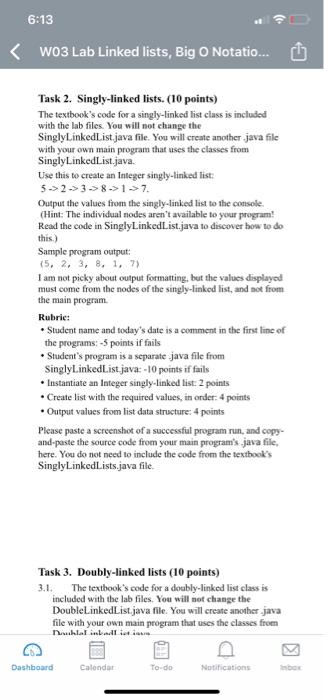
/* * Copyright 2014, Michael T. Goodrich, Roberto Tamassia, Michael H. Goldwasser * * Developed for use with the book: * * Data Structures and Algorithms in Java, Sixth Edition * Michael T. Goodrich, Roberto Tamassia, and Michael H. Goldwasser * John Wiley & Sons, 2014 * * This program is free software: you can redistribute it and/or modify * it under the terms of the GNU General Public License as published by * the Free Software Foundation, either version 3 of the License, or * (at your option) any later version. * * This program is distributed in the hope that it will be useful, * but WITHOUT ANY WARRANTY; without even the implied warranty of * MERCHANTABILITY or FITNESS FOR A PARTICULAR PURPOSE. See the * GNU General Public License for more details. * * You should have received a copy of the GNU General Public License * along with this program. If not, see
// package net.datastructures;
/** * A basic singly linked list implementation. * * @author Michael T. Goodrich * @author Roberto Tamassia * @author Michael H. Goldwasser */ public class SinglyLinkedList
/** The element stored at this node */ private E element; // reference to the element stored at this node
/** A reference to the subsequent node in the list */ private Node
/** * Creates a node with the given element and next node. * * @param e the element to be stored * @param n reference to a node that should follow the new node */ public Node(E e, Node
// Accessor methods /** * Returns the element stored at the node. * @return the element stored at the node */ public E getElement() { return element; }
/** * Returns the node that follows this one (or null if no such node). * @return the following node */ public Node
// Modifier methods /** * Sets the node's next reference to point to Node n. * @param n the node that should follow this one */ public void setNext(Node
// instance variables of the SinglyLinkedList /** The head node of the list */ private Node
/** The last node of the list */ private Node
/** Number of nodes in the list */ private int size = 0; // number of nodes in the list
/** Constructs an initially empty list. */ public SinglyLinkedList() { } // constructs an initially empty list
// access methods /** * Returns the number of elements in the linked list. * @return number of elements in the linked list */ public int size() { return size; }
/** * Tests whether the linked list is empty. * @return true if the linked list is empty, false otherwise */ public boolean isEmpty() { return size == 0; }
/** * Returns (but does not remove) the first element of the list * @return element at the front of the list (or null if empty) */ public E first() { // returns (but does not remove) the first element if (isEmpty()) return null; return head.getElement(); }
/** * Returns (but does not remove) the last element of the list. * @return element at the end of the list (or null if empty) */ public E last() { // returns (but does not remove) the last element if (isEmpty()) return null; return tail.getElement(); }
// update methods /** * Adds an element to the front of the list. * @param e the new element to add */ public void addFirst(E e) { // adds element e to the front of the list head = new Node(e, head); // create and link a new node if (size == 0) tail = head; // special case: new node becomes tail also size++; }
/** * Adds an element to the end of the list. * @param e the new element to add */ public void addLast(E e) { // adds element e to the end of the list Node
/** * Removes and returns the first element of the list. * @return the removed element (or null if empty) */ public E removeFirst() { // removes and returns the first element if (isEmpty()) return null; // nothing to remove E answer = head.getElement(); head = head.getNext(); // will become null if list had only one node size--; if (size == 0) tail = null; // special case as list is now empty return answer; }
@SuppressWarnings({"unchecked"}) public boolean equals(Object o) { if (o == null) return false; if (getClass() != o.getClass()) return false; SinglyLinkedList other = (SinglyLinkedList) o; // use nonparameterized type if (size != other.size) return false; Node walkA = head; // traverse the primary list Node walkB = other.head; // traverse the secondary list while (walkA != null) { if (!walkA.getElement().equals(walkB.getElement())) return false; //mismatch walkA = walkA.getNext(); walkB = walkB.getNext(); } return true; // if we reach this, everything matched successfully }
@SuppressWarnings({"unchecked"}) public SinglyLinkedList
public int hashCode() { int h = 0; for (Node walk=head; walk != null; walk = walk.getNext()) { h ^= walk.getElement().hashCode(); // bitwise exclusive-or with element's code h = (h >> 27); // 5-bit cyclic shift of composite code } return h; }
/** * Produces a string representation of the contents of the list. * This exists for debugging purposes only. */ public String toString() { StringBuilder sb = new StringBuilder("("); Node
6:13 2->3->8->1->7. Output the values from the singly-linked list to the console (Hint: The individual nodes aren't available to your program! Read the code in SinglyLinkedList.java to discover how to do Sample program output: (5, 2, 3, 8. 1. 7) I am not picky about output formatting, but the values displayed must come from the nodes of the singly-linked list, and not from the main program Rubrie: Student name and today's date is a comment in the first line of the programs: -5 points if fails Student's program is a separate java file from SinglyLinkedList.java: -10 points if fails Instantiate an Integer singly linked list: 2 points Create list with the required values, in order. 4 points Output values from list data structure: 4 points Please paste a screenshot of a successful program run, and copy and-paste the source code from your main program's java file, here. You do not need to include the code from the textbook's SinglyLinkedLists.java file. . 3.1. Task 3. Doubly-linked lists (10 points) The textbook's code for a doubly-linked list class is included with the lab files. You will not change the Doublelinked List java file. You will create another java file with your own main program that uses the classes from Dashboard Calendar To-do Notifications
Step by Step Solution
There are 3 Steps involved in it

Get step-by-step solutions from verified subject matter experts
 Study Help