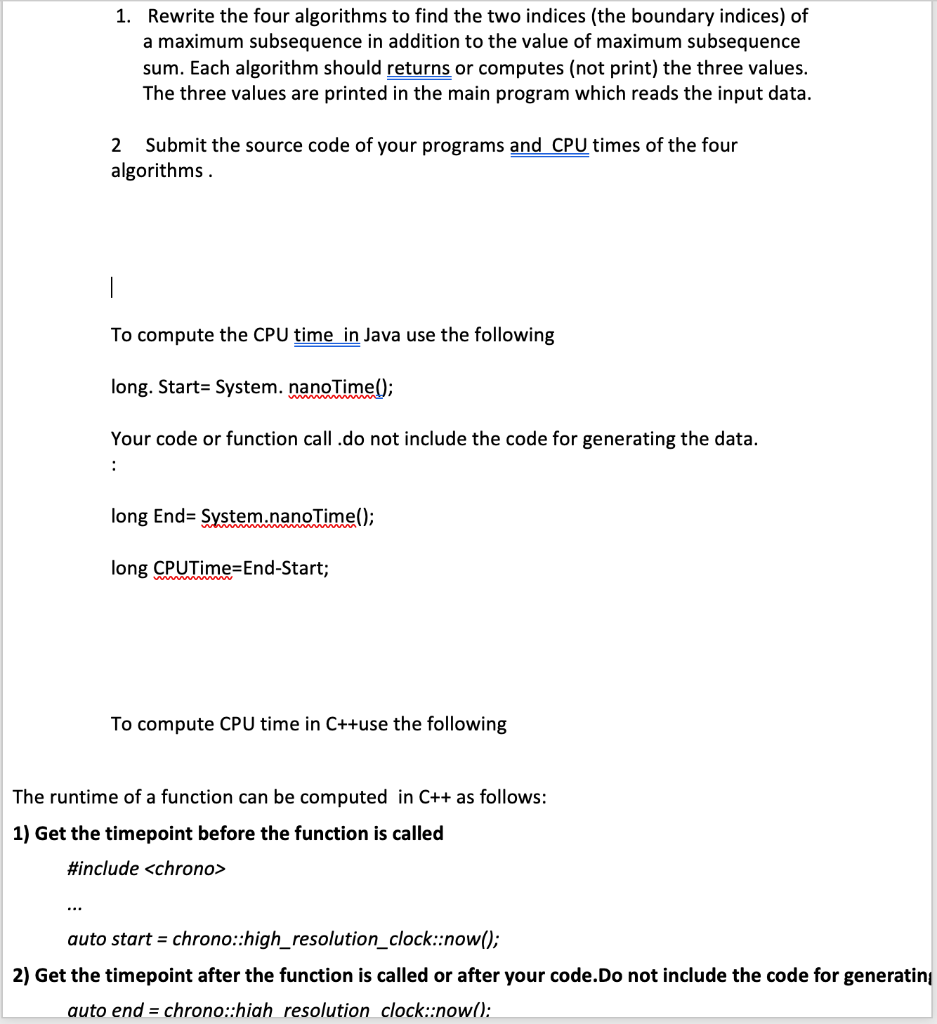
Question: Java Language Data Set for these Program: (use this Data set) 1. Rewrite the four algorithms to find the two indices (the boundary indices) of
Java Language
Data Set for these Program: (use this Data set)
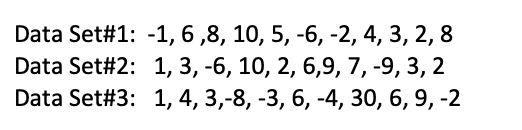
1. Rewrite the four algorithms to find the two indices (the boundary indices) of a maximum subsequence in addition to the value of maximum subsequence sum. Each algorithm should returns or computes (not print) the three values. The three values are printed in the main program which reads the input data. 2 Submit the source code of your programs and CPU times of the four algorithms. To compute the CPU time in Java use the following long. Start= System. nanoTime(); Your code or function call.do not include the code for generating the data. : long End= System.nanoTime(); long CPUTime=End-Start; To compute CPU time in C++use the following The runtime of a function can be computed in C++ as follows: 1) Get the timepoint before the function is called #include auto start = chrono::high_resolution_clock::now(); 2) Get the timepoint after the function is called or after your code.Do not include the code for generating auto end = chrono::hiah resolution clock::now(): Data Set#1: -1,6,8, 10, 5, -6, -2, 4, 3, 2,8 Data Set#2: 1, 3, -6, 10, 2, 6,9, 7,-9, 3,2 Data Set#3: 1,4,3,-8, -3, 6,-4, 30, 6, 9, -2 1. Rewrite the four algorithms to find the two indices (the boundary indices) of a maximum subsequence in addition to the value of maximum subsequence sum. Each algorithm should returns or computes (not print) the three values. The three values are printed in the main program which reads the input data. 2 Submit the source code of your programs and CPU times of the four algorithms. To compute the CPU time in Java use the following long. Start= System. nanoTime(); Your code or function call.do not include the code for generating the data. : long End= System.nanoTime(); long CPUTime=End-Start; To compute CPU time in C++use the following The runtime of a function can be computed in C++ as follows: 1) Get the timepoint before the function is called #include auto start = chrono::high_resolution_clock::now(); 2) Get the timepoint after the function is called or after your code.Do not include the code for generating auto end = chrono::hiah resolution clock::now(): Data Set#1: -1,6,8, 10, 5, -6, -2, 4, 3, 2,8 Data Set#2: 1, 3, -6, 10, 2, 6,9, 7,-9, 3,2 Data Set#3: 1,4,3,-8, -3, 6,-4, 30, 6, 9, -2









 Study Help