







Question: Java Language Problem 3: (Points 10) 1) Describe the most time-efficient way to implement the operations listed below. Assume no duplicate values and that you
Java Language
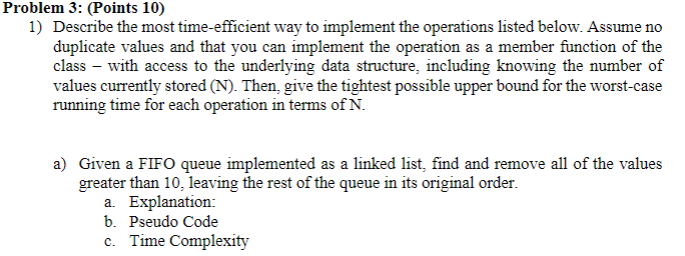
Problem 3: (Points 10) 1) Describe the most time-efficient way to implement the operations listed below. Assume no duplicate values and that you can implement the operation as a member function of the class with access to the underlying data structure, including knowing the number of values currently stored (N). Then, give the tightest possible upper bound for the worst-case running time for each operation in terms of N. a) Given a FIFO queue implemented as a linked list, find and remove all of the values greater than 10, leaving the rest of the queue in its original order. a. Explanation: b. Pseudo Code c. Time Complexity Problem 3: (Points 10) 1) Describe the most time-efficient way to implement the operations listed below. Assume no duplicate values and that you can implement the operation as a member function of the class with access to the underlying data structure, including knowing the number of values currently stored (N). Then, give the tightest possible upper bound for the worst-case running time for each operation in terms of N. a) Given a FIFO queue implemented as a linked list, find and remove all of the values greater than 10, leaving the rest of the queue in its original order. a. Explanation: b. Pseudo Code c. Time Complexity
Step by Step Solution
There are 3 Steps involved in it

Get step-by-step solutions from verified subject matter experts
 Study Help