







Question: Java - OOP The Application Domain: Prepare some classes to support statistical analyses of baseball players in a hypothetical team'. This could be used for
Java - OOP
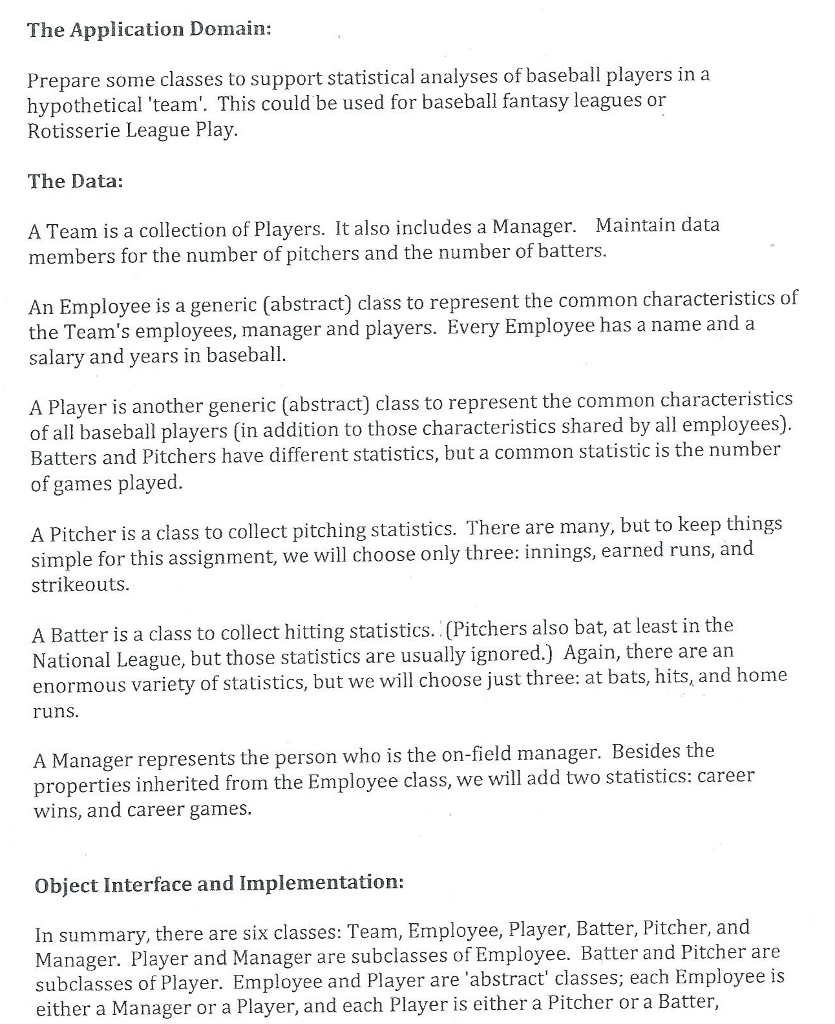
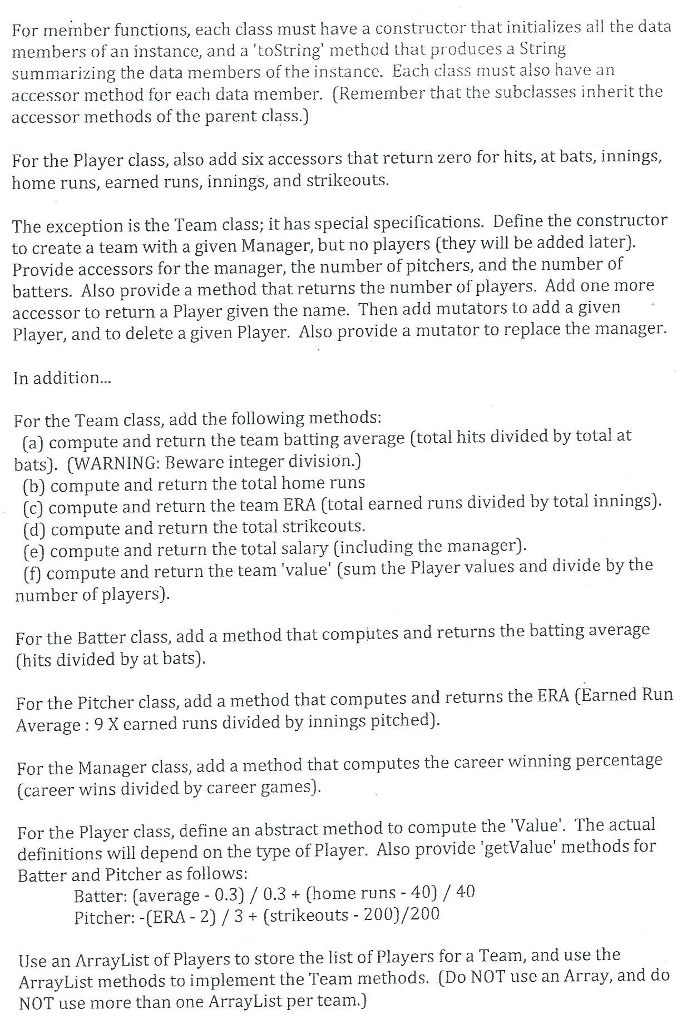
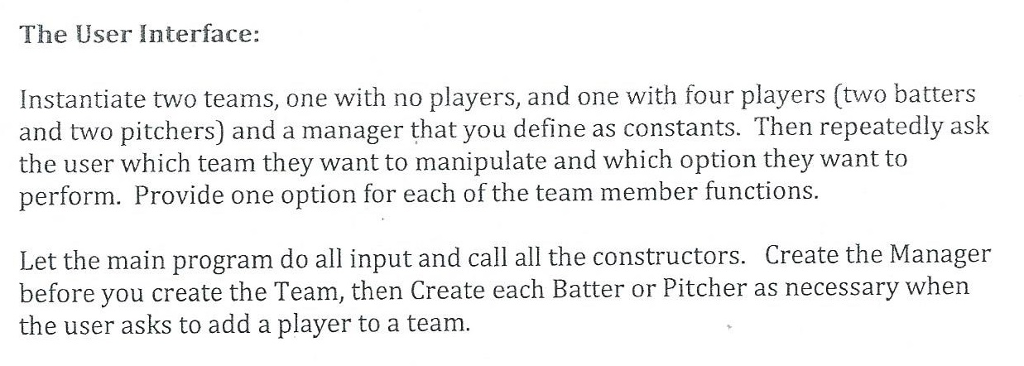
The Application Domain: Prepare some classes to support statistical analyses of baseball players in a hypothetical team'. This could be used for baseball fantasy leagues or Rotisserie League Play The Data: A Team is a collection of Players. It also includes a Manager. Maintain data members for the number of pitchers and the number of batters. An Employee generic (abstract) class to represent the common characteristics of the Team's employees, manager and players. Every Employee has a name and a salary and years in baseball A Player is another generic (abstract) class to represent the common characteristics baseball players Cin addition to those characteristics shared by all employees) Batters and Pitchers have different statistics, but a common statistic is the number of games played Pitcher is a class to collect pitching statistics. There are many, but to keep things simple for this assignment, we will choose only three: innings, earned runs, and strikeouts. A Batter is a class to collect hitting statistics. Pitchers also bat, at least in the National League, but those statistics are usually ignored) Again, there are an enormous variety of statistics, but we will choose just three: at bats, hits, and home runs A Manager represents the person who is the on-field manager. Besides the properties inherited from the Employee class, we will add two statistics: career wins, and career games. object Interface and Implementation: In summary, there are six classes: Team, Employee, Player, Batter, Pitcher, and Manager. Player and Manager are subclasses of Employee. Batter and Pitcher are subclasses of Player. Employee and Player are 'abstract' classes; each Employee is either a Manager or a Player, and each Player is either a Pitcher or a Batter, The Application Domain: Prepare some classes to support statistical analyses of baseball players in a hypothetical team'. This could be used for baseball fantasy leagues or Rotisserie League Play The Data: A Team is a collection of Players. It also includes a Manager. Maintain data members for the number of pitchers and the number of batters. An Employee generic (abstract) class to represent the common characteristics of the Team's employees, manager and players. Every Employee has a name and a salary and years in baseball A Player is another generic (abstract) class to represent the common characteristics baseball players Cin addition to those characteristics shared by all employees) Batters and Pitchers have different statistics, but a common statistic is the number of games played Pitcher is a class to collect pitching statistics. There are many, but to keep things simple for this assignment, we will choose only three: innings, earned runs, and strikeouts. A Batter is a class to collect hitting statistics. Pitchers also bat, at least in the National League, but those statistics are usually ignored) Again, there are an enormous variety of statistics, but we will choose just three: at bats, hits, and home runs A Manager represents the person who is the on-field manager. Besides the properties inherited from the Employee class, we will add two statistics: career wins, and career games. object Interface and Implementation: In summary, there are six classes: Team, Employee, Player, Batter, Pitcher, and Manager. Player and Manager are subclasses of Employee. Batter and Pitcher are subclasses of Player. Employee and Player are 'abstract' classes; each Employee is either a Manager or a Player, and each Player is either a Pitcher or a Batter
Step by Step Solution
There are 3 Steps involved in it

Get step-by-step solutions from verified subject matter experts
 Study Help