







Question: Java or C would work 1. Implement the A5/1 algorithm. Suppose that, after a particular step, the values in the registers are X = (10,
Java or C would work
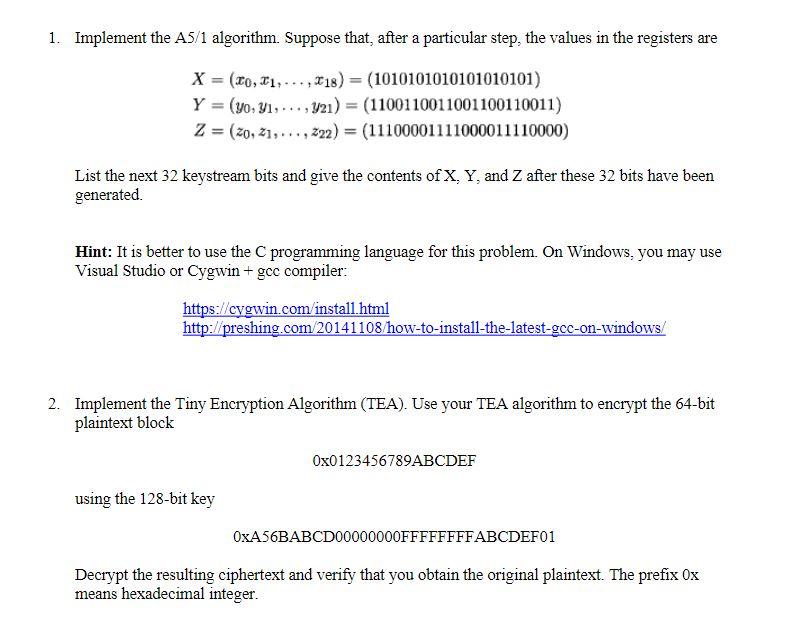
1. Implement the A5/1 algorithm. Suppose that, after a particular step, the values in the registers are X = (10, 11,...,118)= (1010101010101010101) Y = (y0, y1,...,421) = (1100110011001100110011) Z = (20,21,...,222) = (11100001111000011110000) List the next 32 keystream bits and give the contents of X, Y, and Z after these 32 bits have been generated Hint: It is better to use the programming language for this problem. On Windows, you may use Visual Studio or Cygwin + goc compiler: https://cygwin.com/install.html http://preshing.com/20141108 how-to-install-the-latest-gcc-on-windows/ 2. Implement the Tiny Encryption Algorithm (TEA). Use your TEA algorithm to encrypt the 64-bit plaintext block Ox0123456789ABCDEF using the 128-bit key OxA56BABCD00000000FFFFFFFFABCDEF01 Decrypt the resulting ciphertext and verify that you obtain the original plaintext. The prefix Ox means hexadecimal integer
Step by Step Solution
There are 3 Steps involved in it

Get step-by-step solutions from verified subject matter experts
 Study Help