







Question: JAVA. Please follow the guidelines below. Question is below guidelines Each problem will indicate what kind of structure to use as auxiliary storage. You should
JAVA. Please follow the guidelines below. Question is below guidelines
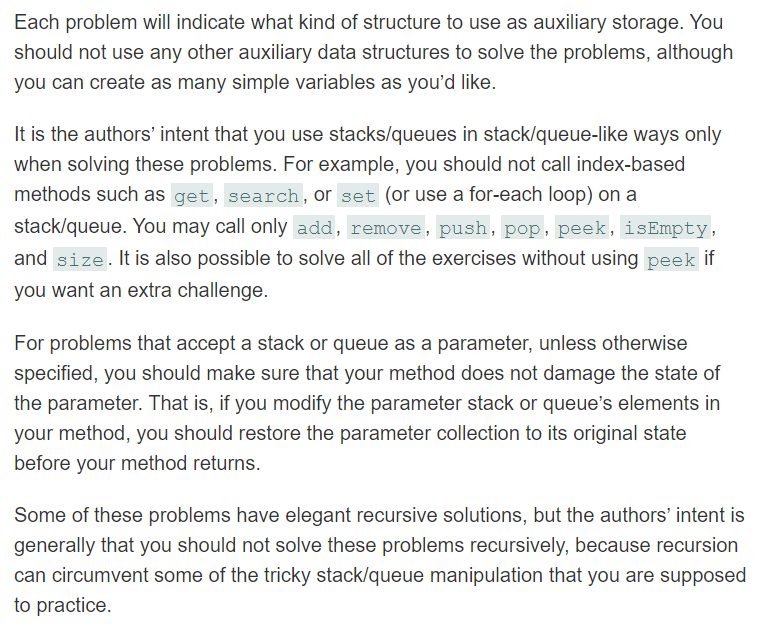
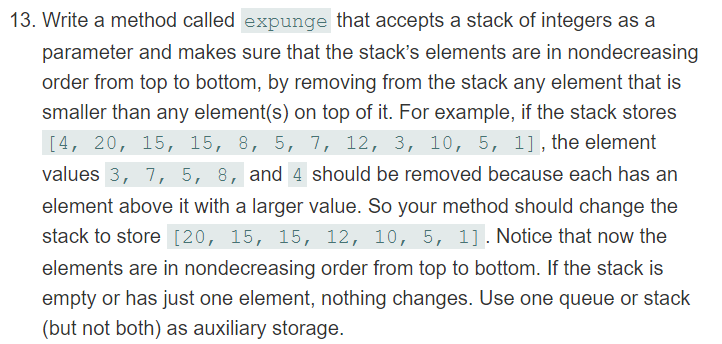
Each problem will indicate what kind of structure to use as auxiliary storage. You should not use any other auxiliary data structures to solve the problems, although you can create as many simple variables as you'd like. It is the authors' intent that you use stacks/queues in stack/queue-like ways only when solving these problems. For example, you should not call index-based methods such as get, search, or set (or use a for-each loop) on a stack/queue. You may call only add, remove, push, pop, peek, isEmpty, . , and size. It is also possible to solve all of the exercises without using peek if you want an extra challenge. For problems that accept a stack or queue as a parameter, unless otherwise specified, you should make sure that your method does not damage the state of the parameter. That is, if you modify the parameter stack or queue's elements in your method, you should restore the parameter collection to its original state before your method returns. . Some of these problems have elegant recursive solutions, but the authors' intent is generally that you should not solve these problems recursively, because recursion can circumvent some of the tricky stack/queue manipulation that you are supposed to practice. 13. Write a method called expunge that accepts a stack of integers as a parameter and makes sure that the stack's elements are in nondecreasing order from top to bottom, by removing from the stack any element that is smaller than any element(s) on top of it. For example, if the stack stores [4, 20, 15, 15, 8, 5, 7, 12, 3, 10, 5, 1], the element values 3, 7, 5, 8, and 4 should be removed because each has an element above it with a larger value. So your method should change the stack to store [20, 15, 15, 12, 10, 5, 1] . Notice that now the elements are in nondecreasing order from top to bottom. If the stack is empty or has just one element, nothing changes. Use one queue or stack (but not both) as auxiliary storage
Step by Step Solution
There are 3 Steps involved in it

Get step-by-step solutions from verified subject matter experts
 Study Help