







Question: JAVA PLZ An emirp (prime spelled backwards) is a nonpalindromic prime number whose reversal is also a prime. For example, 17 is a prime and
JAVA PLZ
An emirp (prime spelled backwards) is a nonpalindromic prime number whose reversal is also a prime. For example, 17 is a prime and 71 is a prime, so 17 and 71 are emirps. 131 is a prime, but it is also a palindromic prime, so it is not an emirp. Write a program that displays the first 100 emirps. Display 10 numbers per line, separated by exactly one space. Sample output:
13 17 31 37 71 73 79 97 107 113 149 157 167 179 199 311 337 347 359 389 . . .
Make use of the methods reverse and isPalindrome that you wrote in the previous assignment PalindromeInteger.java. See the hints in the coding template.
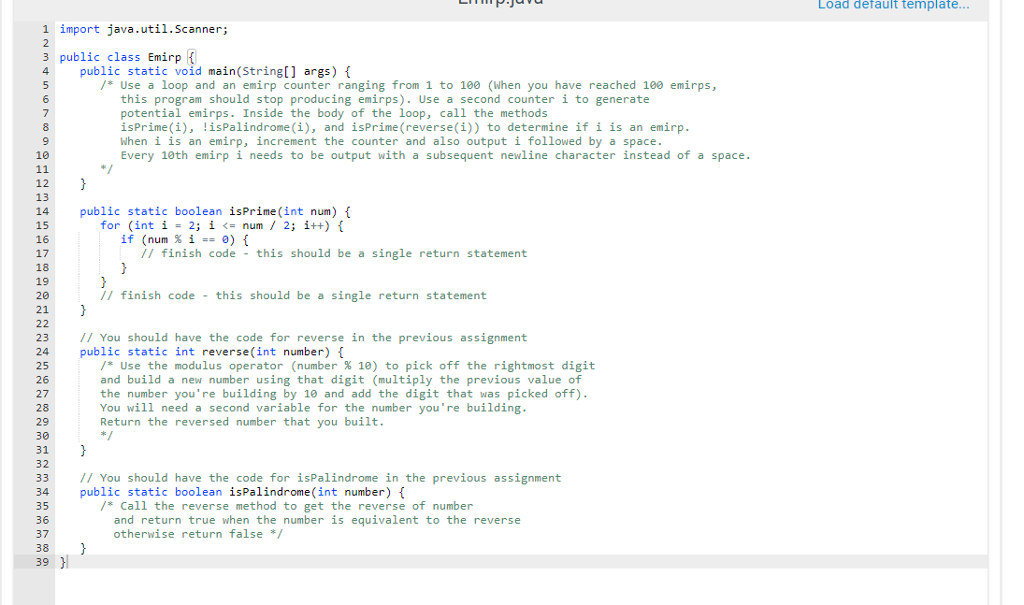
Load detault template... 1 import java.util.scanner; 3 public class Emirp 4 public static void main(String[] args) f Use a loop and an emirp counter ranging from 1 to 100 (When you have reached 100 emirps this program should stop producing emirps). Use a second counteri to generate potential emirps. Inside the body of the loop, call the methods ?SPrine(i), !isPalndrome(1), and ?sPrime(reverse(i)) to determine if i is an emirp When i is an emirp, increment the counter and also output i followed by a space. Every 10th emirp i needs to be output with a subsequent newline character instead of a space 6 7 10 public static boolean isPrime(int num) { 14 15 16 17 18 19 20 21 for (int i 2; i
Step by Step Solution
There are 3 Steps involved in it

Get step-by-step solutions from verified subject matter experts
 Study Help