







Question: Java Programming 3-4: Basics of Input and Output Practice Activities Lesson Objectives: Describe the basics of input and output in Java Read data from and
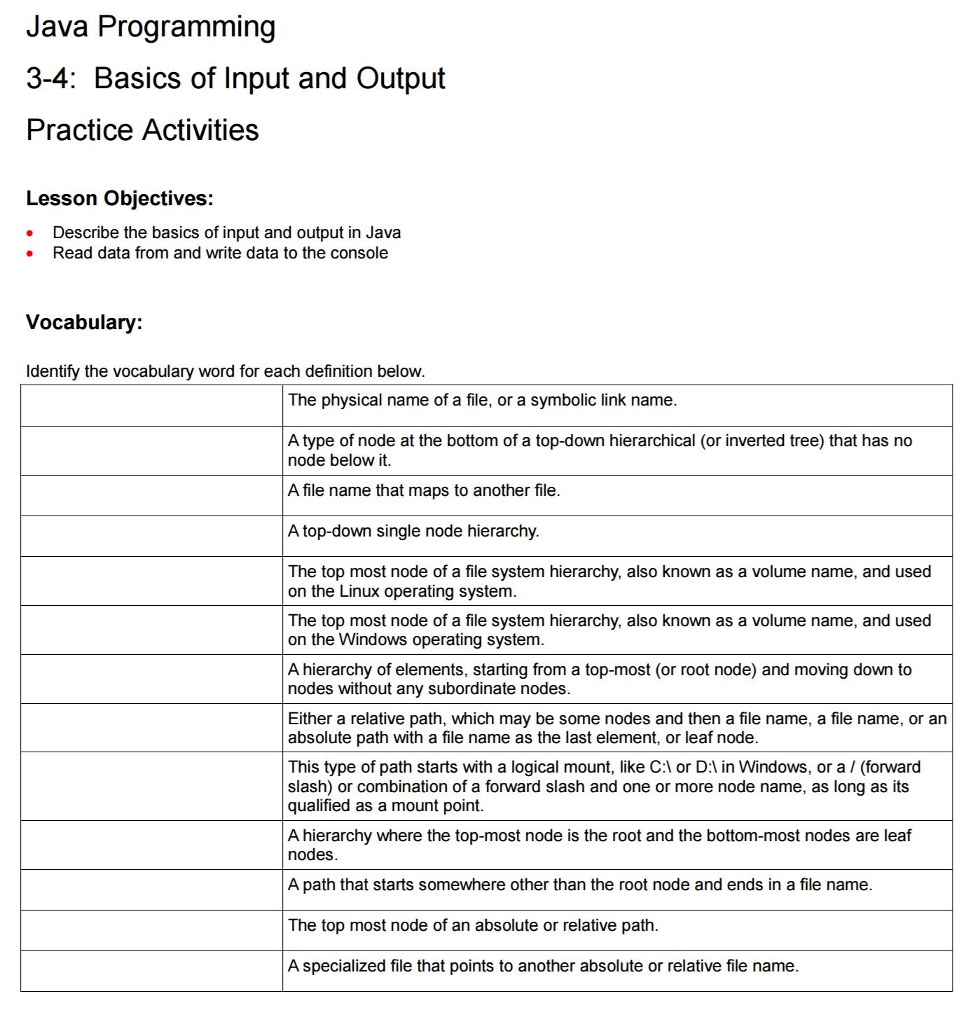
Java Programming 3-4: Basics of Input and Output Practice Activities Lesson Objectives: Describe the basics of input and output in Java Read data from and write data to the console Vocabulary: Identify the vocabulary word for each definition below. The physical name of a file, or a symbolic link name. A type of node at the bottom of a top-down hierarchical (or inverted tree) that has no node below it. A file name that maps to another file. A top-down single node hierarchy. The top most node of a file system hierarchy, also known as a volume name, and used on the Linux operating system. The top most node of a file system hierarchy, also known as a volume name, and used on the Windows operating system. A hierarchy of elements, starting from a top-most (or root node) and moving down to nodes without any subordinate nodes. Either a relative path, which may be some nodes and then a file name, a file name, or an absolute path with a file name as the last element, or leaf node. This type of path starts with a logical mount, like C:l or D: in Windows, or a / (forward slash) or combination of a forward slash and one or more node name, as long as its qualified as a mount point A hierarchy where the top-most node is the root and the bottom-most nodes are leaf nodes A path that starts somewhere other than the root node and ends in a file name. The top most node of an absolute or relative path. A specialized file that points to another absolute or relative file name
Step by Step Solution
There are 3 Steps involved in it

Get step-by-step solutions from verified subject matter experts
 Study Help