







Question: Java Programming (4.28a) (4.28b) (4.28c) (4.28d) If we assume that the reverse reactions are negligible and A and B are held constant by an external
Java Programming
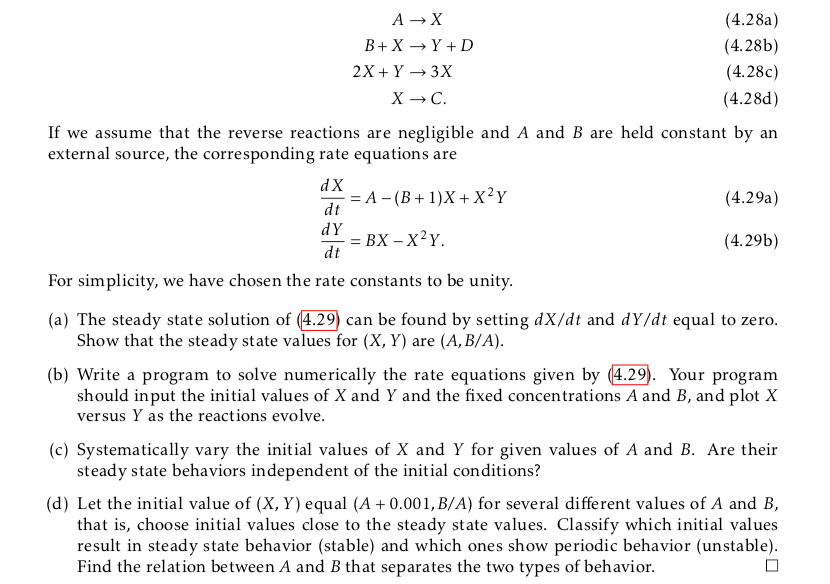
(4.28a) (4.28b) (4.28c) (4.28d) If we assume that the reverse reactions are negligible and A and B are held constant by an external source, the corresponding rate equations are d X dt dY dt (4.29a) (4.29b) For simplicity, we have chosen the rate constants to be unity (a) The steady state solution of (4.29) can be found by setting dX/dt and dY/dt equal to zero (b) Write a program to solve numerically the rate equations given by 4.29). Your program Show that the steady state values for (X, Y) are (A, B/A) should input the initial values of X and Y and the fixed concentrations A and B, and plot X versus Y as the reactions evolve (c) Systematically vary the initial values of X and Y for given values of A and B. Are their steady state behaviors independent of the initial conditions? (d) Let the initial value of (X, Y) equal (A+0.001, B/A) for several different values of A and B, that is, choose initial values close to the steady state values. Classify which initial values result in steady state behavior (stable) and which ones show periodic behavior (unstable) Find the relation between A and B that separates the two types of behavior (4.28a) (4.28b) (4.28c) (4.28d) If we assume that the reverse reactions are negligible and A and B are held constant by an external source, the corresponding rate equations are d X dt dY dt (4.29a) (4.29b) For simplicity, we have chosen the rate constants to be unity (a) The steady state solution of (4.29) can be found by setting dX/dt and dY/dt equal to zero (b) Write a program to solve numerically the rate equations given by 4.29). Your program Show that the steady state values for (X, Y) are (A, B/A) should input the initial values of X and Y and the fixed concentrations A and B, and plot X versus Y as the reactions evolve (c) Systematically vary the initial values of X and Y for given values of A and B. Are their steady state behaviors independent of the initial conditions? (d) Let the initial value of (X, Y) equal (A+0.001, B/A) for several different values of A and B, that is, choose initial values close to the steady state values. Classify which initial values result in steady state behavior (stable) and which ones show periodic behavior (unstable) Find the relation between A and B that separates the two types of behavior
Step by Step Solution
There are 3 Steps involved in it

Get step-by-step solutions from verified subject matter experts
 Study Help