







Question: java Question 3 (Algebra: solve quadratic equations) The two roots of a quadratic equation ax + bx + c = 0 can be obtained using
java
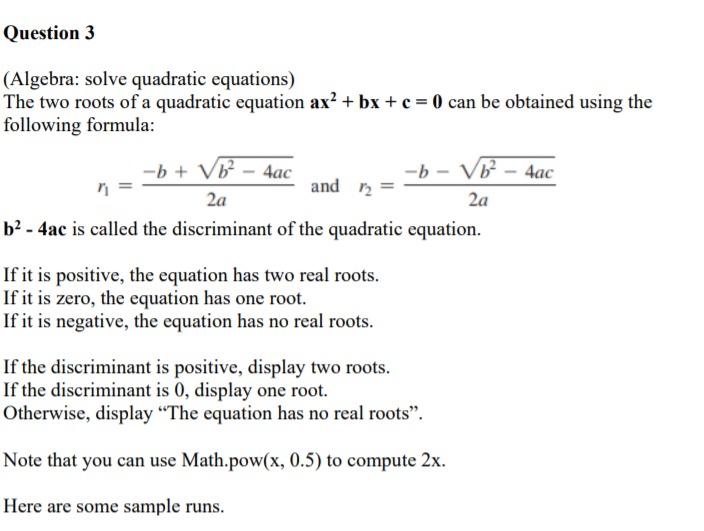
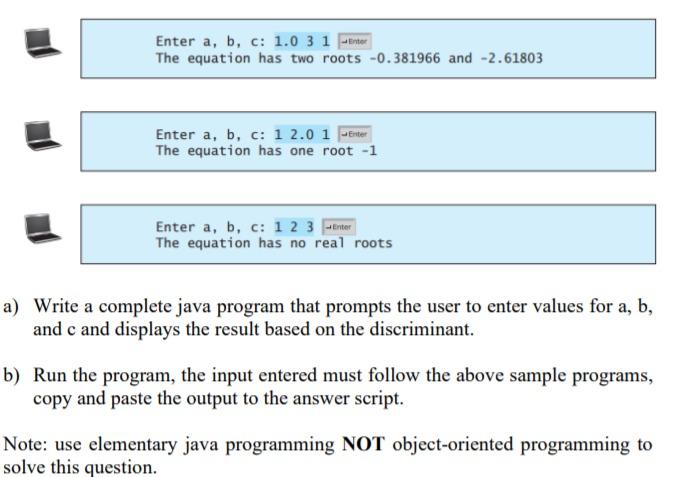
Question 3 (Algebra: solve quadratic equations) The two roots of a quadratic equation ax + bx + c = 0 can be obtained using the following formula: -b + Vb2 - 4ac -b-V6 - 4ac and 12 2a 2a b2 - 4ac is called the discriminant of the quadratic equation. If it is positive, the equation has two real roots. If it is zero, the equation has one root. If it is negative, the equation has no real roots. If the discriminant is positive, display two roots. If the discriminant is 0, display one root. Otherwise, display "The equation has no real roots. Note that you can use Math.pow(x, 0.5) to compute 2x. Here are some sample runs. Enter a, b, c: 1.0 3 1 Enter The equation has two roots -0.381966 and -2.61803 Enter a, b, c: 1 2.0 1 penter The equation has one root -1 Enter a, b, c 1 2 3 Enter The equation has no real roots a) Write a complete java program that prompts the user to enter values for a, b, and c and displays the result based on the discriminant. b) Run the program, the input entered must follow the above sample programs, copy and paste the output to the answer script. Note: use elementary java programming NOT object-oriented programming to solve this
Step by Step Solution
There are 3 Steps involved in it

Get step-by-step solutions from verified subject matter experts
 Study Help