







Question: Java. Rank the three algorithms in terms of expected running time (for large n) and give an explanation to justify your ranking. Thank you! Suppose
Java. Rank the three algorithms in terms of expected running time (for large n) and give an explanation to justify your ranking. Thank you!
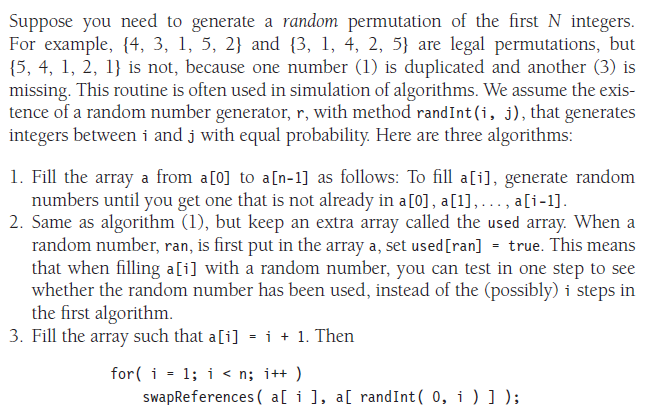
Suppose you need to generate a random permutation of the first N integers For example, 14, 3, 1, 52) and {3, 1, 4, 2, 5} are legal permutations, but [5, 4, 1, 2, 1 is not, because one number () is duplicated and another (3) is missing. This routine is often used in simulation of algorithms. We assume the exis- tence of a random number generator, r, with method randInt (i, j), that generates integers between i and j with equal probability. Here are three algorithms 1. Fill the array a from a[O] to a[n-1 as follows: To fill ai], generate random numbers until you get one that is not already in a [0], a[i],... , ali-1] 2. Same as algorithm (1), but keep an extra array called the used array. When a random number, ran, is first put in the array a, set used [ran] - true. This means that when filling ali] with a random number, you can test in one step to see whether the random number has been used, instead of the (possibly) i steps in the first algorithm. 3. Fill the array such that a[i] = i + 1 . Then for( i = 1; i
Step by Step Solution
There are 3 Steps involved in it

Get step-by-step solutions from verified subject matter experts
 Study Help