



Question: Jeff, Alan, and Katie all face the same hourly wage rate of w-$20. All three of them have T=100 hours of time endowment and
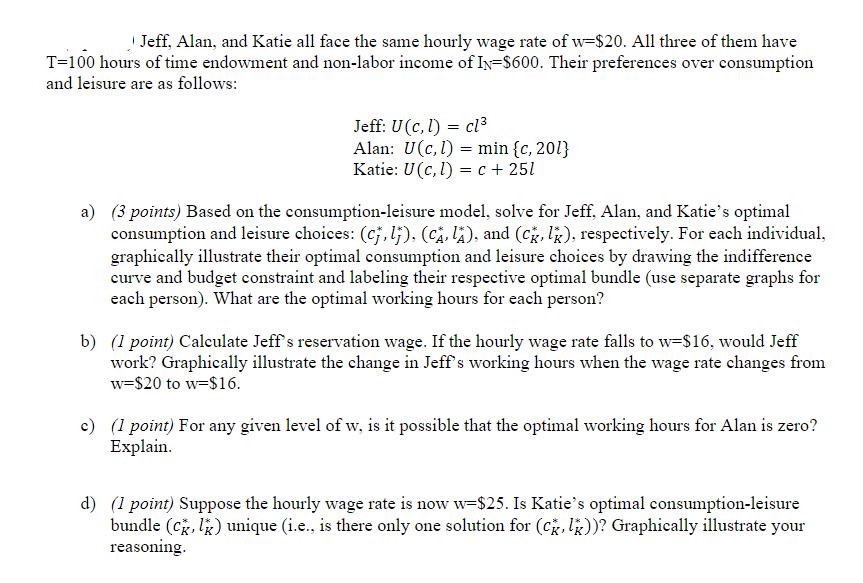
Jeff, Alan, and Katie all face the same hourly wage rate of w-$20. All three of them have T=100 hours of time endowment and non-labor income of IN-$600. Their preferences over consumption and leisure are as follows: Jeff: U (c, l) = cl Alan: U(C, 1) = min {c, 201} Katie: U (c,l) = c + 25l a) (3 points) Based on the consumption-leisure model, solve for Jeff, Alan, and Katie's optimal consumption and leisure choices: (cf, lj), (C, lA), and (C, lk), respectively. For each individual, graphically illustrate their optimal consumption and leisure choices by drawing the indifference curve and budget constraint and labeling their respective optimal bundle (use separate graphs for each person). What are the optimal working hours for each person? b) (1 point) Calculate Jeff's reservation wage. If the hourly wage rate falls to w=$16, would Jeff work? Graphically illustrate the change in Jeff's working hours when the wage rate changes from w=$20 to w-$16. c) (1 point) For any given level of w, is it possible that the optimal working hours for Alan is zero? Explain. d) (1 point) Suppose the hourly wage rate is now w-$25. Is Katie's optimal consumption-leisure bundle (C, lk) unique (i.e., is there only one solution for (ck, lk))? Graphically illustrate your reasoning.
Step by Step Solution
3.39 Rating (158 Votes )
There are 3 Steps involved in it

Get step-by-step solutions from verified subject matter experts