







Question: JMP Table in comments Question 6 0.8 pts Open the seasonal demand JMP file. Perform (1) seasonal forecasting without trend (.e., do not include a
JMP Table in comments
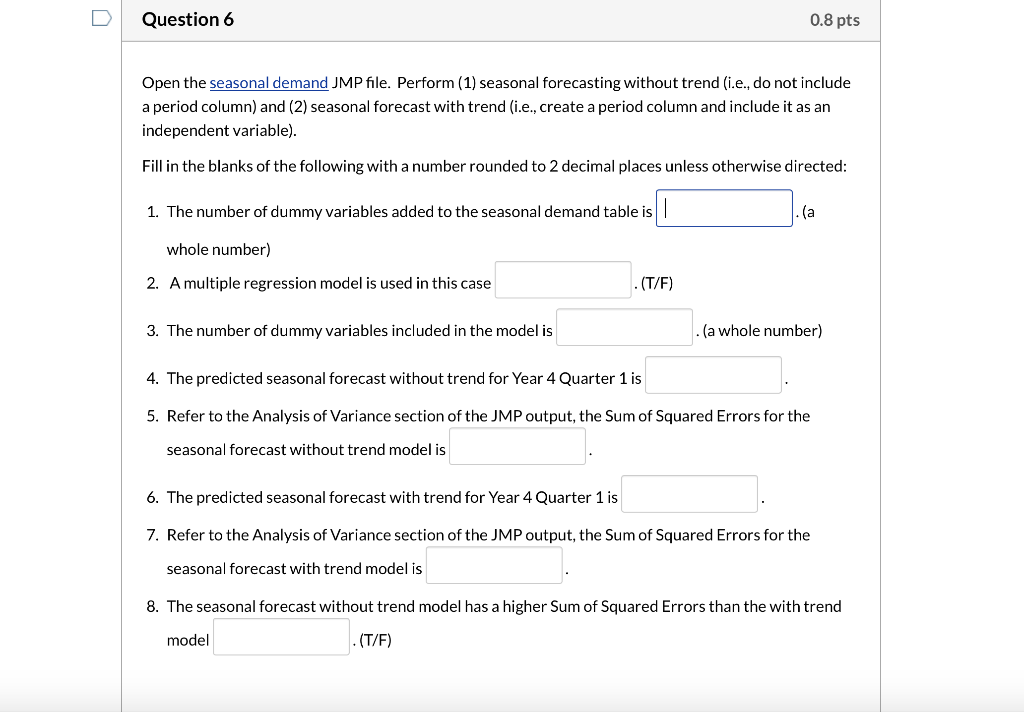
Question 6 0.8 pts Open the seasonal demand JMP file. Perform (1) seasonal forecasting without trend (.e., do not include a period column) and (2) seasonal forecast with trend (i.e., create a period column and include it as an independent variable). Fill in the blanks of the following with a number rounded to 2 decimal places unless otherwise directed: 1. The number of dummy variables added to the seasonal demand table is (a whole number) 2. A multiple regression model is used in this case .(T/F) 3. The number of dummy variables included in the model is .(a whole number) 4. The predicted seasonal forecast without trend for Year 4 Quarter 1 is 5. Refer to the Analysis of Variance section of the JMP output, the Sum of Squared Errors for the seasonal forecast without trend model is 6. The predicted seasonal forecast with trend for Year 4 Quarter 1 is 7. Refer to the Analysis of Variance section of the JMP output, the Sum of Squared Errors for the seasonal forecast with trend model is 8. The seasonal forecast without trend model has a higher Sum of Squared Errors than the with trend model (T/F) Question 6 0.8 pts Open the seasonal demand JMP file. Perform (1) seasonal forecasting without trend (.e., do not include a period column) and (2) seasonal forecast with trend (i.e., create a period column and include it as an independent variable). Fill in the blanks of the following with a number rounded to 2 decimal places unless otherwise directed: 1. The number of dummy variables added to the seasonal demand table is (a whole number) 2. A multiple regression model is used in this case .(T/F) 3. The number of dummy variables included in the model is .(a whole number) 4. The predicted seasonal forecast without trend for Year 4 Quarter 1 is 5. Refer to the Analysis of Variance section of the JMP output, the Sum of Squared Errors for the seasonal forecast without trend model is 6. The predicted seasonal forecast with trend for Year 4 Quarter 1 is 7. Refer to the Analysis of Variance section of the JMP output, the Sum of Squared Errors for the seasonal forecast with trend model is 8. The seasonal forecast without trend model has a higher Sum of Squared Errors than the with trend model (T/F)
Step by Step Solution
There are 3 Steps involved in it

Get step-by-step solutions from verified subject matter experts
 Study Help