


Question: John Alderete , Simon Fraser University Data: five distinct phonological alternations arise from the attachment of the derivational verbal suffixes -in and -an in the
John Alderete , Simon Fraser University Data:
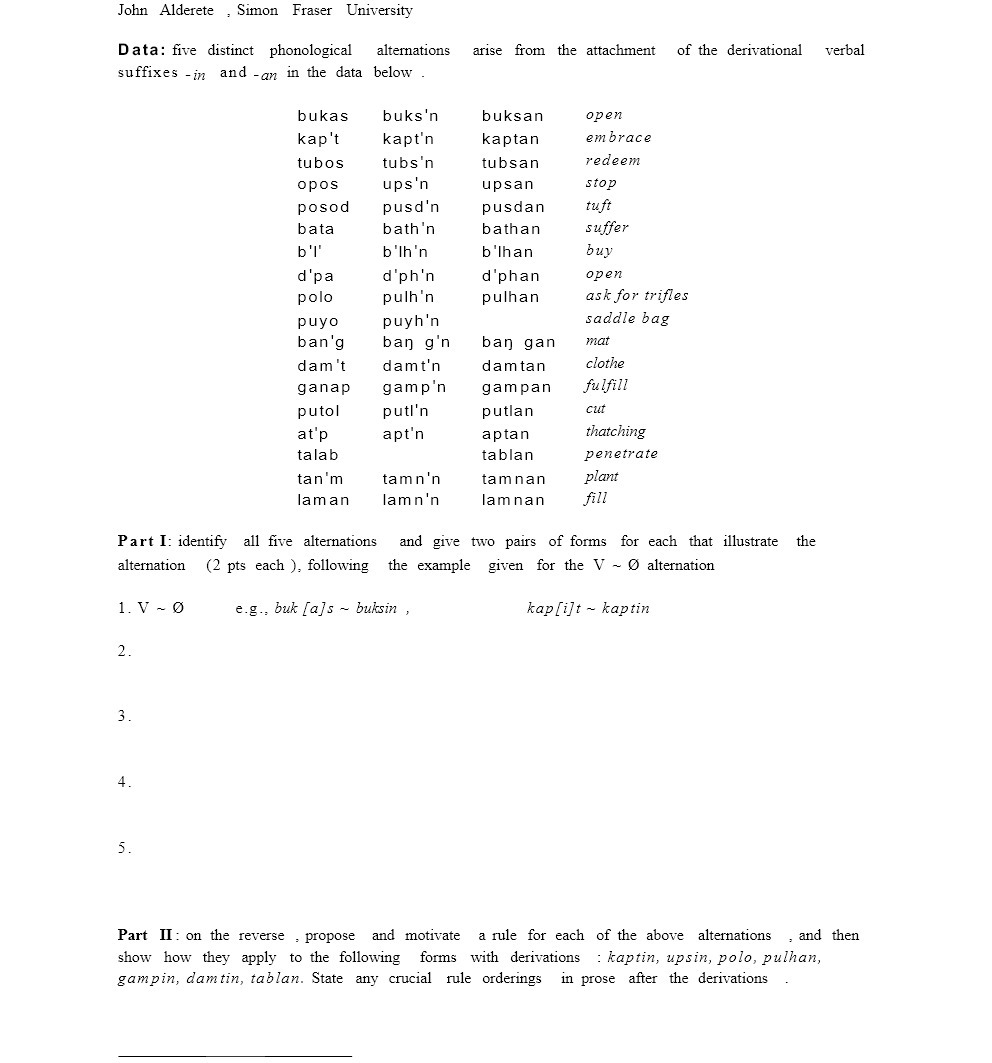
John Alderete , Simon Fraser University Data: five distinct phonological alternations arise from the attachment of the derivational verbal suffixes -in and -an in the data below . bukas buks'n buksan pen kap't kapt'n kaptan embrace tubos tubs'n tubsan redeem opos ups'n upsan stop posod pusd'n pusdan tuft bata bath'n bathan suffer b'l' b'lh'n b'lhan buy d'pa d'ph'n d'phan open polo pulh'n pulhan ask for trifles puyo puyh'n saddle bag ban'g ban g'n ban gan mat dam't damt'n damtan clothe ganap gamp'n gampan fulfill putol putl'n putlan cut at'p apt'n aptan thatching talab tablan penetrate tan'm tamn'n tamnan plan laman lamn'n lamnan fill Part I: identify all five alternations and give two pairs of forms for each that illustrate the alternation (2 pts each ), following the example given for the V - O alternation 1 . V - O e.g.: buk [a]s - buksin , kap [i]t ~ kaptin 2. 3 . 4 5. Part II : on the reverse , propose and motivate a rule for each of the above alternations , and then show how they apply to the following forms with derivations : kaptin, upsin, polo, pulhan, gampin, damtin, tablan. State any crucial rule orderings in prose after the derivations

Step by Step Solution

There are 3 Steps involved in it

1 Expert Approved Answer
Step: 1 Unlock blur-text-image

Question Has Been Solved by an Expert!

Get step-by-step solutions from verified subject matter experts

Step: 2 Unlock
Step: 3 Unlock

Students Have Also Explored These Related Mathematics Questions!