







Question: jp morgan Chase has a scheduling problem. Operators work eight hour shifts and can begin work at midnight, 4am, 8am,noon, 4pm, or 8pm. Operators are
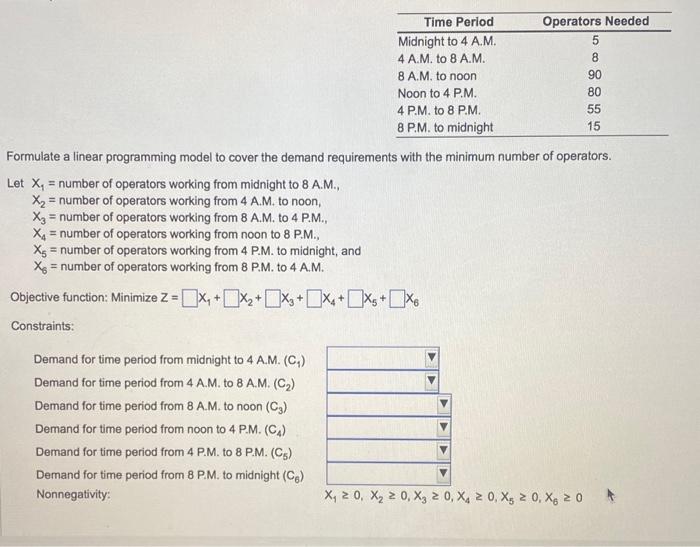
Formulate a linear programming model to cover the demand requirements with the minimum number of operators. Let X1= number of operators working from midnight to 8 A.M., X2= number of operators working from 4 A.M. to noon, X3= number of operators working from 8 A.M. to 4 P.M., X4= number of operators working from noon to 8 P.M., X5= number of operators working from 4 P.M. to midnight, and X6= number of operators working from 8 P.M. to 4 A.M. Objective function: Minimize Z=X1+X2+X3+X4+X5+X6 Constraints: Demand for time period from midnight to 4 A.M. (C1) Demand for time period from 4 A.M. to 8 A.M. (C2) Demand for time period from 8 A.M. to noon (C3) Demand for time period from noon to 4 P.M. (C4) Demand for time period from 4 P.M. to 8 P.M. (C5) Demand for time period from 8 P.M. to midnight (C6) Nonnegativity: x10,x20,x30,x40,x50,x60 Formulate a linear programming model to cover the demand requirements with the minimum number of operators. Let X1= number of operators working from midnight to 8 A.M., X2= number of operators working from 4 A.M. to noon, X3= number of operators working from 8 A.M. to 4 P.M., X4= number of operators working from noon to 8 P.M., X5= number of operators working from 4 P.M. to midnight, and X6= number of operators working from 8 P.M. to 4 A.M. Objective function: Minimize Z=X1+X2+X3+X4+X5+X6 Constraints: Demand for time period from midnight to 4 A.M. (C1) Demand for time period from 4 A.M. to 8 A.M. (C2) Demand for time period from 8 A.M. to noon (C3) Demand for time period from noon to 4 P.M. (C4) Demand for time period from 4 P.M. to 8 P.M. (C5) Demand for time period from 8 P.M. to midnight (C6) Nonnegativity: x10,x20,x30,x40,x50,x60
Step by Step Solution
There are 3 Steps involved in it

Get step-by-step solutions from verified subject matter experts
 Study Help