







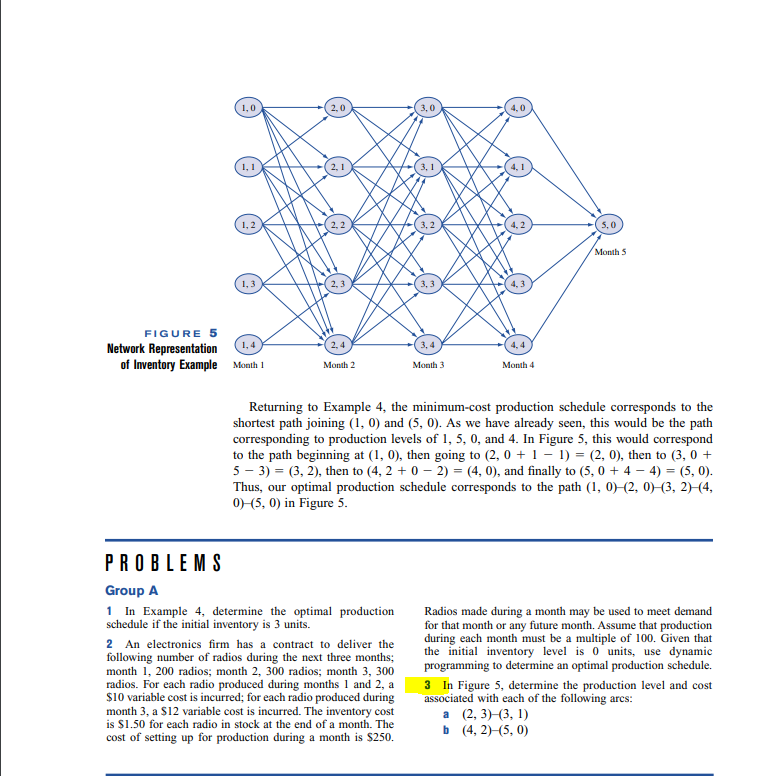
Question: Just #3 please. Returning to Example 4, the minimum-cost production schedule corresponds to the shortest path joining (1,0) and (5,0). As we have already seen,
Just #3 please.
Returning to Example 4, the minimum-cost production schedule corresponds to the shortest path joining (1,0) and (5,0). As we have already seen, this would be the path corresponding to production levels of 1,5,0, and 4 . In Figure 5, this would correspond to the path beginning at (1,0), then going to (2,0+11)=(2,0), then to (3,0+ 53)=(3,2), then to (4,2+02)=(4,0), and finally to (5,0+44)=(5,0). Thus, our optimal production schedule corresponds to the path (1,0)(2,0)(3,2)(4, 0)(5,0) in Figure 5. PR O BLE M S Group A 1 In Example 4, determine the optimal production Radios made during a month may be used to meet demand schedule if the initial inventory is 3 units. for that month or any future month. Assume that production 2 An electronics firm has a contract to deliver the during each month must be a multiple of 100 . Given that following number of radios during the next three months; the initial inventory level is 0 units, use dynamic month 1, 200 radios; month 2, 300 radios; month 3, 300 programming to determine an optimal production schedule. radios. For each radio produced during months 1 and 2, a 3 In Figure 5, determine the production level and cost $10 variable cost is incurred; for each radio produced during associated with each of the following arcs: month 3, a $12 variable cost is incurred. The inventory cost a (2,3)(3,1) is $1.50 for each radio in stock at the end of a month. The cost of setting up for production during a month is $250. b (4,2)(5,0)
Step by Step Solution
There are 3 Steps involved in it

Get step-by-step solutions from verified subject matter experts
 Study Help