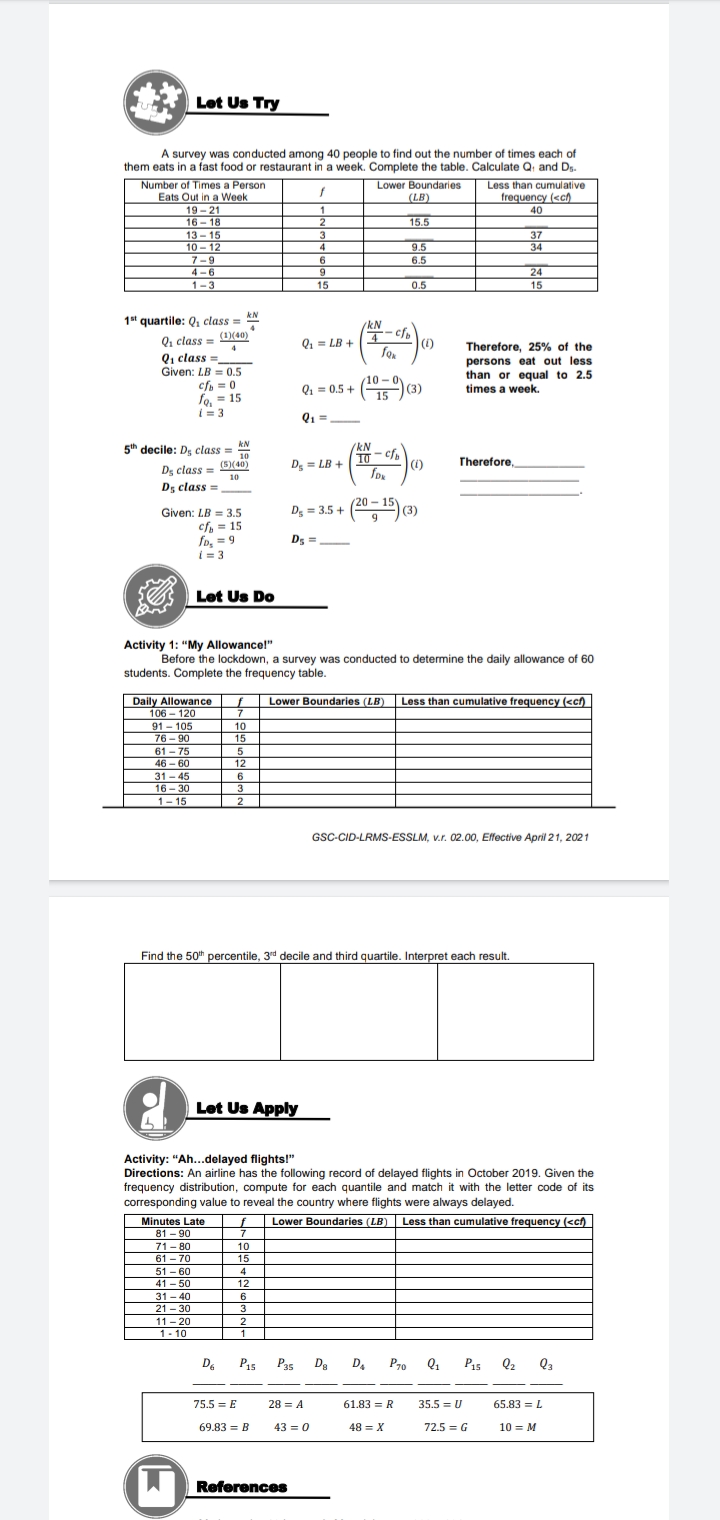
Question: Just Answer Let Us Try, Let Us Do, and Let Us apply. Let Us Discover This Simplified Self-learning Module (SSLM) will help you recognize and

Just Answer Let Us Try, Let Us Do, and Let Us apply.
Just Answer Let Us Try, Let Us Do, and Let UsJust Answer Let Us Try, Let Us Do, and Let Us
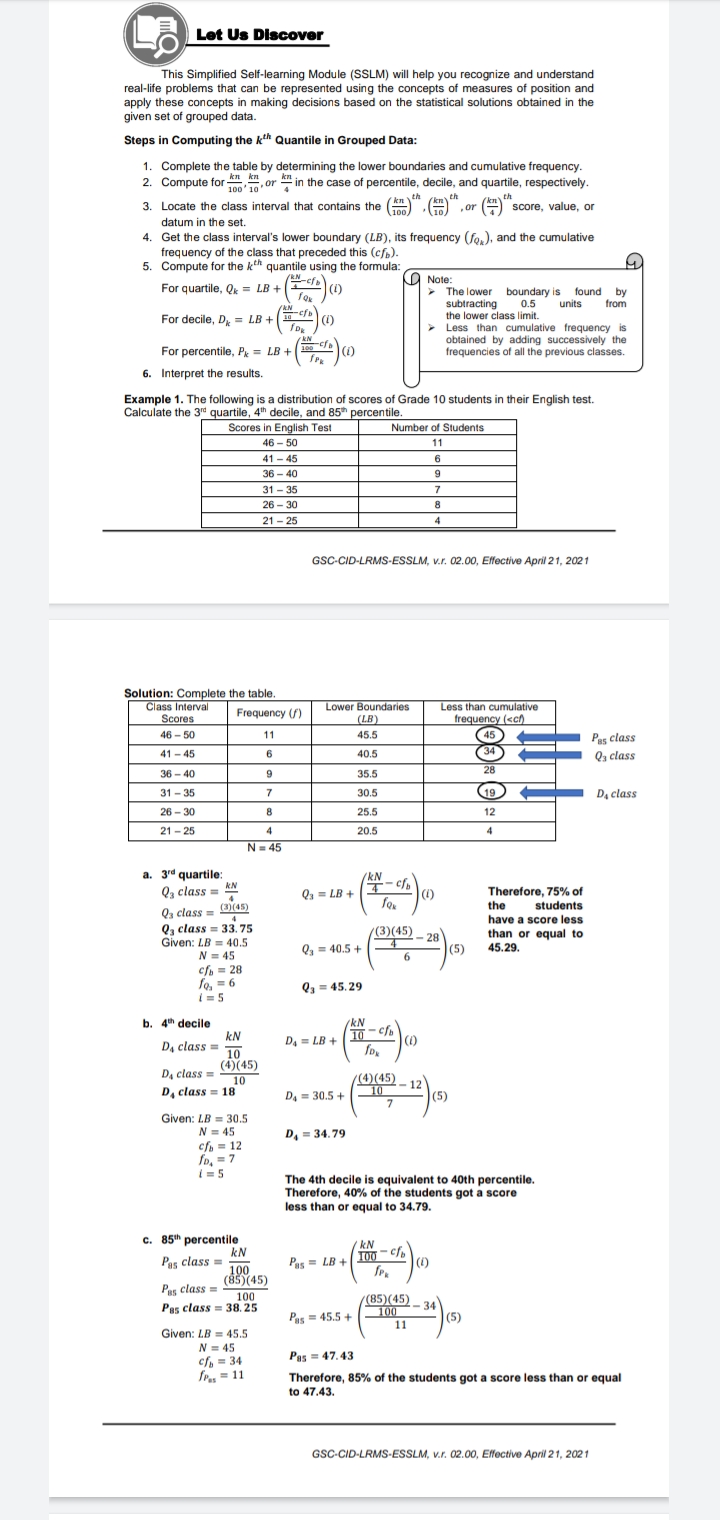
Let Us Discover This Simplified Self-learning Module (SSLM) will help you recognize and understand real-life problems that can be represented using the concepts of measures of position and apply these concepts in making decisions based on the statistical solutions obtained in the given set of grouped data Steps in Computing the k" Quantile in Grouped Data: 1. Complete the table by determining the lower boundaries and cumulative frequency. 2. Compute for kin ka 100. 70 . or - in the case of percentile, decile, and quartile, respectively. 3. Locate the class interval that contains the (15) . (;) . or () score, value, or datum in the set. 4. Get the class interval's lower boundary (LB), its frequency (fox), and the cumulative frequency of the class that preceded this (cf.). 5. Compute for the k" quantile using the formula For quartile, Qk = LB + (1) Note: The lower boundary is found by subtracting 0.5 units from For decile, DR = LB + 10- er)(1) the lower class limit. Less than cumulative frequency is obtained by adding successively the For percentile, Px = LB + 180 ) (1) frequencies of all the previous classes. 6. Interpret the results. Example 1. The following is a distribution of scores of Grade 10 students in their English test. Calculate the 3" quartile, 4" decile, and 85" percentile. Scores in English Test Number of Students 46 - 50 11 41 - 45 36 - 40 31 - 35 26 - 30 8 21 - 25 GSC-CID-LRMS-ESSLM, v.r. 02.00, Effective April 21, 2021 Solution: Complete the table. Class Interva Scores Frequency (f) Lower Boundaries Less than cumulative LB) frequency (

Step by Step Solution

There are 3 Steps involved in it

1 Expert Approved Answer
Step: 1 Unlock blur-text-image

Question Has Been Solved by an Expert!

Get step-by-step solutions from verified subject matter experts

Step: 2 Unlock
Step: 3 Unlock

Students Have Also Explored These Related Mathematics Questions!