







Question: Just answer part d and e please. Sketch the graphs 6. This problem refers to the Goldbeter-Koshland model. Let G(r) be the solution x of
Just answer part d and e please. Sketch the graphs
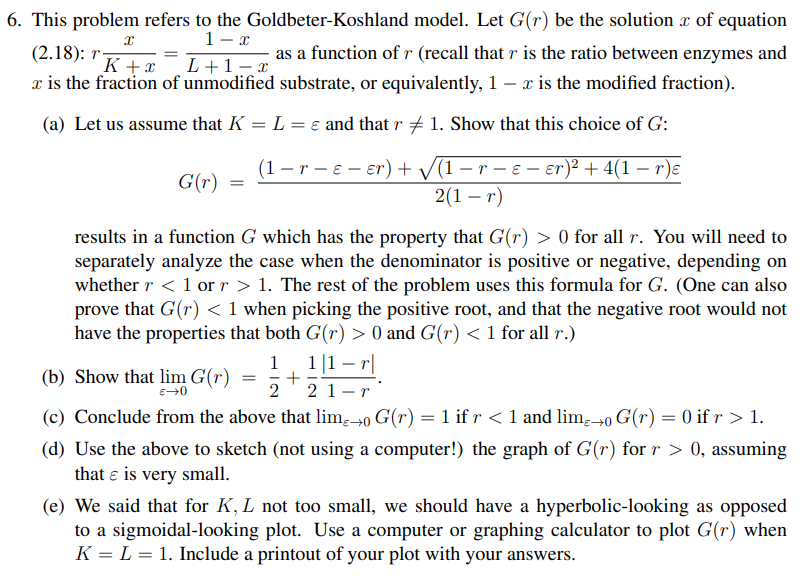
6. This problem refers to the Goldbeter-Koshland model. Let G(r) be the solution x of equation (2.18): rK+xx=L+1x1x as a function of r (recall that r is the ratio between enzymes and x is the fraction of unmodified substrate, or equivalently, 1x is the modified fraction). (a) Let us assume that K=L= and that r=1. Show that this choice of G : G(r)=2(1r)(1rr)+(1rr)2+4(1r) results in a function G which has the property that G(r)>0 for all r. You will need to separately analyze the case when the denominator is positive or negative, depending on whether r1. The rest of the problem uses this formula for G. (One can also prove that G(r)0 and G(r)1. (d) Use the above to sketch (not using a computer!) the graph of G(r) for r>0, assuming that is very small. (e) We said that for K,L not too small, we should have a hyperbolic-looking as opposed to a sigmoidal-looking plot. Use a computer or graphing calculator to plot G(r) when K=L=1. Include a printout of your plot with your answers
Step by Step Solution
There are 3 Steps involved in it

Get step-by-step solutions from verified subject matter experts
 Study Help