



Question: Just answer what you can, for those you dont know you can leave it blank please 1. In Case 17-7 Mesmerizing Marketers, should the TV
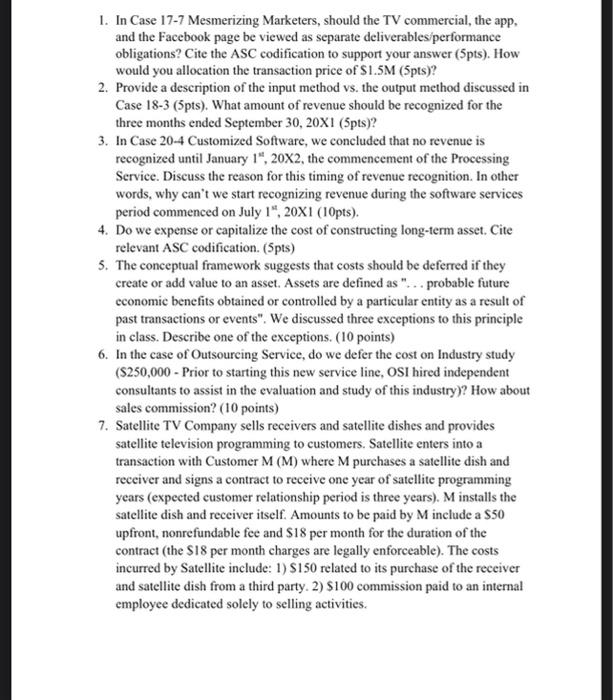
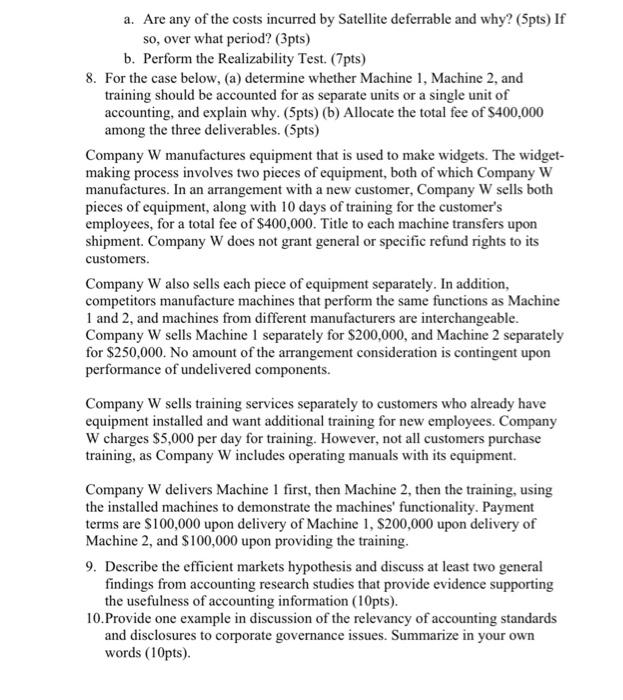
1. In Case 17-7 Mesmerizing Marketers, should the TV commercial, the app, and the Facebook page be viewed as separate deliverables performance obligations? Cite the ASC codification to support your answer (5pts). How would you allocation the transaction price of $1.5M (5pts)? 2. Provide a description of the input method vs. the output method discussed in Case 18-3 (5pts). What amount of revenue should be recognized for the three months ended September 30, 20X1 (5pts)? 3. In Case 20-4 Customized Software, we concluded that no revenue is recognized until January 15, 20X2, the commencement of the Processing Service. Discuss the reason for this timing of revenue recognition. In other words, why can't we start recognizing revenue during the software services period commenced on July 1", 20X1 (10pts). 4. Do we expense or capitalize the cost of constructing long-term asset. Cite relevant ASC codification. (Spts) 5. The conceptual framework suggests that costs should be deferred if they create or add value to an asset. Assets are defined as "... probable future economic benefits obtained or controlled by a particular entity as a result of past transactions or events". We discussed three exceptions to this principle in class. Describe one of the exceptions (10 points) 6. In the case of Outsourcing Service, do we defer the cost on Industry study (S250,000 - Prior to starting this new service line, OSI hired independent consultants to assist in the evaluation and study of this industry)? How about sales commission? (10 points) 7. Satellite TV Company sells receivers and satellite dishes and provides satellite television programming to customers. Satellite enters into a transaction with Customer M (M) where M purchases a satellite dish and receiver and signs a contract to receive one year of satellite programming years (expected customer relationship period is three years). M installs the satellite dish and receiver itself. Amounts to be paid by M include a $50 upfront, nonrefundable fee and S18 per month for the duration of the contract (the $18 per month charges are legally enforceable). The costs incurred by Satellite include: 1) S150 related to its purchase of the receiver and satellite dish from a third party. 2) $100 commission paid to an internal employee dedicated solely to selling activities. a. Are any of the costs incurred by Satellite deferrable and why? (5pts) If so, over what period? (3pts) b. Perform the Realizability Test. (7pts) 8. For the case below, (a) determine whether Machine 1, Machine 2, and training should be accounted for as separate units or a single unit of accounting, and explain why. (5pts) (b) Allocate the total fee of $400,000 among the three deliverables. (5pts) Company W manufactures equipment that is used to make widgets. The widget- making process involves two pieces of equipment, both of which Company W manufactures. In an arrangement with a new customer, Company W sells both pieces of equipment, along with 10 days of training for the customer's employees, for a total fee of $400,000. Title to each machine transfers upon shipment. Company W does not grant general or specific refund rights to its customers. Company W also sells each piece of equipment separately. In addition, competitors manufacture machines that perform the same functions as Machine 1 and 2, and machines from different manufacturers are interchangeable. Company W sells Machine 1 separately for $200,000, and Machine 2 separately for $250,000. No amount of the arrangement consideration is contingent upon performance of undelivered components. Company W sells training services separately to customers who already have equipment installed and want additional training for new employees. Company W charges $5,000 per day for training. However, not all customers purchase training, as Company W includes operating manuals with its equipment. Company W delivers Machine I first, then Machine 2, then the training, using the installed machines to demonstrate the machines' functionality. Payment terms are $100,000 upon delivery of Machine 1, $200,000 upon delivery of Machine 2, and $100,000 upon providing the training. 9. Describe the efficient markets hypothesis and discuss at least two general findings from accounting research studies that provide evidence supporting the usefulness of accounting information (10pts). 10. Provide one example in discussion of the relevancy of accounting standards and disclosures to corporate governance issues. Summarize in your own words (10pts). 1. In Case 17-7 Mesmerizing Marketers, should the TV commercial, the app, and the Facebook page be viewed as separate deliverables performance obligations? Cite the ASC codification to support your answer (5pts). How would you allocation the transaction price of $1.5M (5pts)? 2. Provide a description of the input method vs. the output method discussed in Case 18-3 (5pts). What amount of revenue should be recognized for the three months ended September 30, 20X1 (5pts)? 3. In Case 20-4 Customized Software, we concluded that no revenue is recognized until January 15, 20X2, the commencement of the Processing Service. Discuss the reason for this timing of revenue recognition. In other words, why can't we start recognizing revenue during the software services period commenced on July 1", 20X1 (10pts). 4. Do we expense or capitalize the cost of constructing long-term asset. Cite relevant ASC codification. (Spts) 5. The conceptual framework suggests that costs should be deferred if they create or add value to an asset. Assets are defined as "... probable future economic benefits obtained or controlled by a particular entity as a result of past transactions or events". We discussed three exceptions to this principle in class. Describe one of the exceptions (10 points) 6. In the case of Outsourcing Service, do we defer the cost on Industry study (S250,000 - Prior to starting this new service line, OSI hired independent consultants to assist in the evaluation and study of this industry)? How about sales commission? (10 points) 7. Satellite TV Company sells receivers and satellite dishes and provides satellite television programming to customers. Satellite enters into a transaction with Customer M (M) where M purchases a satellite dish and receiver and signs a contract to receive one year of satellite programming years (expected customer relationship period is three years). M installs the satellite dish and receiver itself. Amounts to be paid by M include a $50 upfront, nonrefundable fee and S18 per month for the duration of the contract (the $18 per month charges are legally enforceable). The costs incurred by Satellite include: 1) S150 related to its purchase of the receiver and satellite dish from a third party. 2) $100 commission paid to an internal employee dedicated solely to selling activities. a. Are any of the costs incurred by Satellite deferrable and why? (5pts) If so, over what period? (3pts) b. Perform the Realizability Test. (7pts) 8. For the case below, (a) determine whether Machine 1, Machine 2, and training should be accounted for as separate units or a single unit of accounting, and explain why. (5pts) (b) Allocate the total fee of $400,000 among the three deliverables. (5pts) Company W manufactures equipment that is used to make widgets. The widget- making process involves two pieces of equipment, both of which Company W manufactures. In an arrangement with a new customer, Company W sells both pieces of equipment, along with 10 days of training for the customer's employees, for a total fee of $400,000. Title to each machine transfers upon shipment. Company W does not grant general or specific refund rights to its customers. Company W also sells each piece of equipment separately. In addition, competitors manufacture machines that perform the same functions as Machine 1 and 2, and machines from different manufacturers are interchangeable. Company W sells Machine 1 separately for $200,000, and Machine 2 separately for $250,000. No amount of the arrangement consideration is contingent upon performance of undelivered components. Company W sells training services separately to customers who already have equipment installed and want additional training for new employees. Company W charges $5,000 per day for training. However, not all customers purchase training, as Company W includes operating manuals with its equipment. Company W delivers Machine I first, then Machine 2, then the training, using the installed machines to demonstrate the machines' functionality. Payment terms are $100,000 upon delivery of Machine 1, $200,000 upon delivery of Machine 2, and $100,000 upon providing the training. 9. Describe the efficient markets hypothesis and discuss at least two general findings from accounting research studies that provide evidence supporting the usefulness of accounting information (10pts). 10. Provide one example in discussion of the relevancy of accounting standards and disclosures to corporate governance issues. Summarize in your own words (10pts)
Step by Step Solution
There are 3 Steps involved in it

Get step-by-step solutions from verified subject matter experts