







Question: Just do part b 9. Background: Call two sets A1, A2 E B equivalent if P(A] AA2) = 0. For a set A E B,
Just do part b
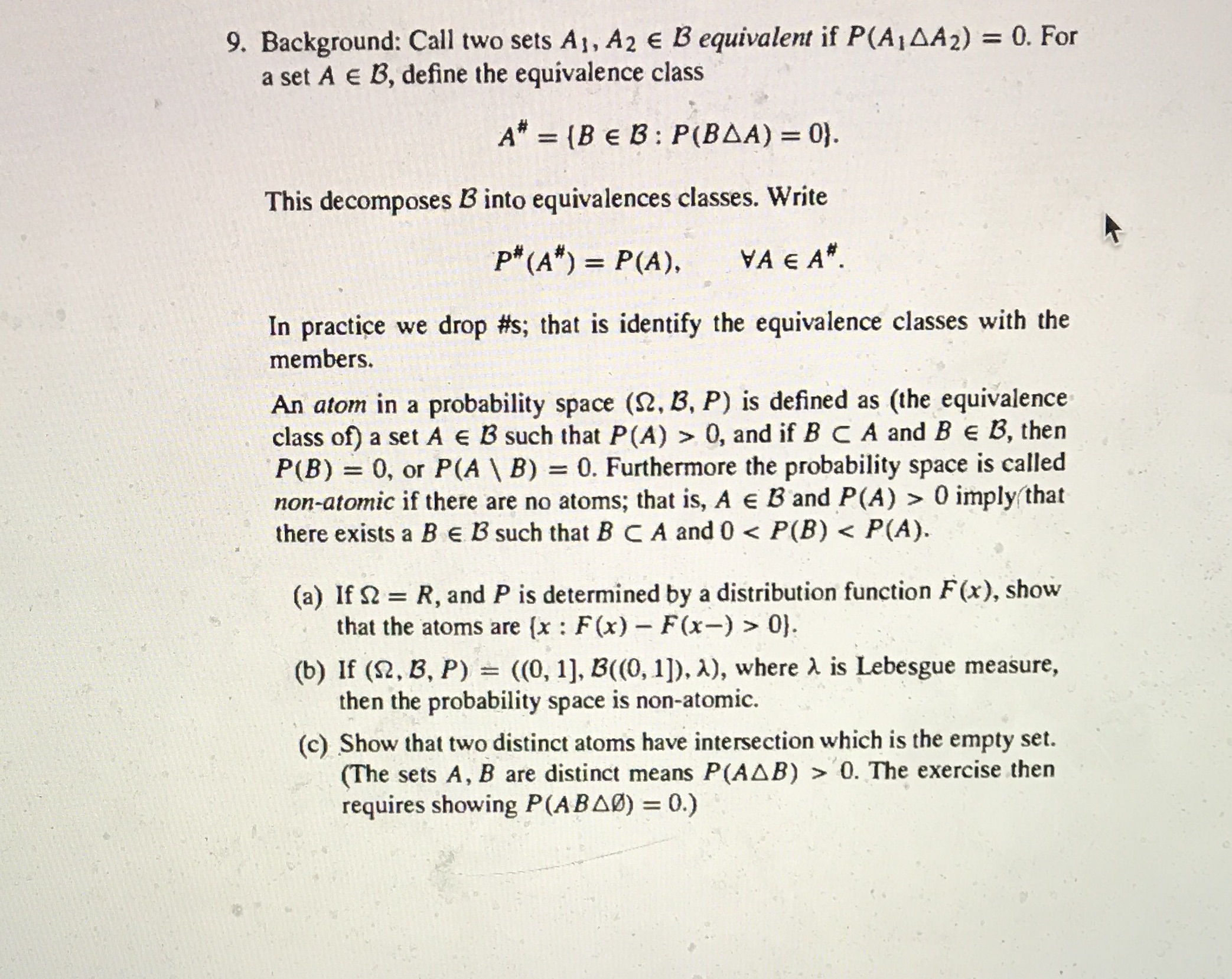
9. Background: Call two sets A1, A2 E B equivalent if P(A] AA2) = 0. For a set A E B, define the equivalence class A" = (B E B : P(BAA) = 0). This decomposes B into equivalences classes. Write P*(A*) = P(A), VAEA". In practice we drop #s; that is identify the equivalence classes with the members. An atom in a probability space ($2, B, P) is defined as (the equivalence class of) a set A E B such that P(A) > 0, and if B C A and B E B, then P(B) = 0, or P(A \\ B) = 0. Furthermore the probability space is called non-atomic if there are no atoms; that is, A e B and P(A) > 0 imply that there exists a B E B such that B C A and 0 0). (b) If ($2, 1, P) = ((0, 1], B((0, 1]), A), where A is Lebesgue measure, then the probability space is non-atomic. (c) Show that two distinct atoms have intersection which is the empty set. (The sets A, B are distinct means P(AAB) > 0. The exercise then requires showing P(ABAO) = 0.)
Step by Step Solution
There are 3 Steps involved in it

Get step-by-step solutions from verified subject matter experts
 Study Help