







Question: Just do some case analysis. Iceberg Construction Company has experienced generally steady growth since its inception in 2000. Management is proud of its record of
Just do some case analysis.
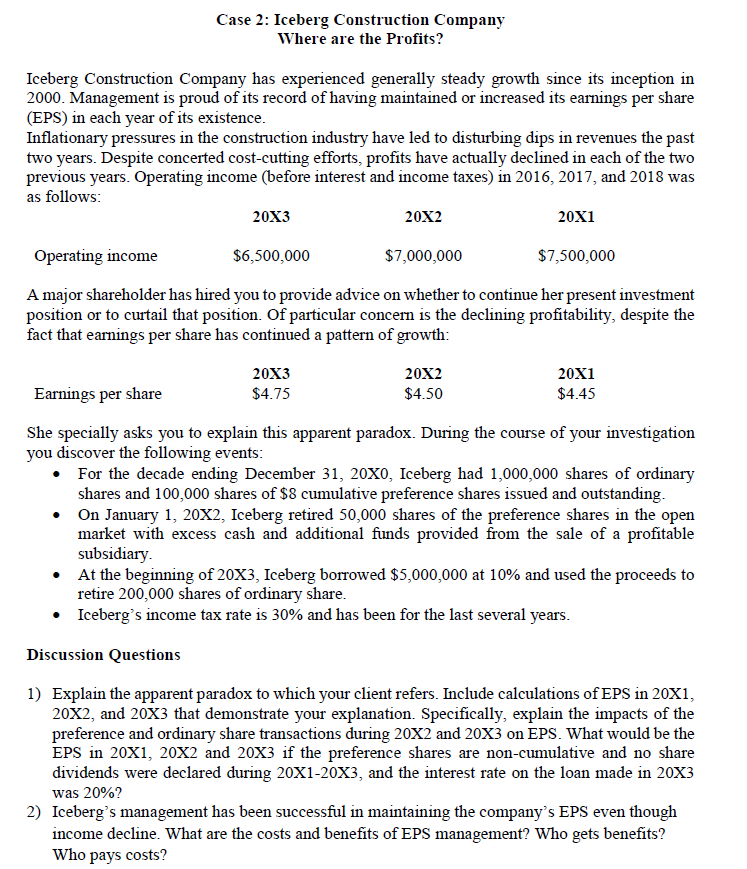
Iceberg Construction Company has experienced generally steady growth since its inception in 2000. Management is proud of its record of having maintained or increased its earnings per share (EPS) in each year of its existence. Inflationary pressures in the construction industry have led to disturbing dips in revenues the past two years. Despite concerted cost-cutting efforts, profits have actually declined in each of the two previous years. Operating income (before interest and income taxes) in 2016, 2017, and 2018 was as follows A major shareholder has hired you to provide advice on whether to continue her present investment position or to curtail that position. Of particular concern is the declining profitability, despite the fact that earnings per share has continued a pattern of growth: She specially asks you to explain this apparent paradox. During the course of your investigation you discover the following events: - For the decade ending December 31, 20X0, Iceberg had 1,000,000 shares of ordinary shares and 100,000 shares of $8 cumulative preference shares issued and outstanding. - On January 1, 20X2, Iceberg retired 50,000 shares of the preference shares in the open market with excess cash and additional funds provided from the sale of a profitable subsidiary. - At the beginning of 20X3, Iceberg borrowed $5,000,000 at 10% and used the proceeds to retire 200,000 shares of ordinary share. - Iceberg's income tax rate is 30% and has been for the last several years. Discussion Questions 1) Explain the apparent paradox to which your client refers. Include calculations of EPS in 20X1, 20X2, and 20X3 that demonstrate your explanation. Specifically, explain the impacts of the preference and ordinary share transactions during 20X2 and 20X3 on EPS. What would be the EPS in 20X1,20X2 and 20X3 if the preference shares are non-cumulative and no share dividends were declared during 20X1-20X3, and the interest rate on the loan made in 20X3 was 20% ? 2) Iceberg's management has been successful in maintaining the company's EPS even though income decline. What are the costs and benefits of EPS management? Who gets benefits? Who pays costs? Iceberg Construction Company has experienced generally steady growth since its inception in 2000. Management is proud of its record of having maintained or increased its earnings per share (EPS) in each year of its existence. Inflationary pressures in the construction industry have led to disturbing dips in revenues the past two years. Despite concerted cost-cutting efforts, profits have actually declined in each of the two previous years. Operating income (before interest and income taxes) in 2016, 2017, and 2018 was as follows A major shareholder has hired you to provide advice on whether to continue her present investment position or to curtail that position. Of particular concern is the declining profitability, despite the fact that earnings per share has continued a pattern of growth: She specially asks you to explain this apparent paradox. During the course of your investigation you discover the following events: - For the decade ending December 31, 20X0, Iceberg had 1,000,000 shares of ordinary shares and 100,000 shares of $8 cumulative preference shares issued and outstanding. - On January 1, 20X2, Iceberg retired 50,000 shares of the preference shares in the open market with excess cash and additional funds provided from the sale of a profitable subsidiary. - At the beginning of 20X3, Iceberg borrowed $5,000,000 at 10% and used the proceeds to retire 200,000 shares of ordinary share. - Iceberg's income tax rate is 30% and has been for the last several years. Discussion Questions 1) Explain the apparent paradox to which your client refers. Include calculations of EPS in 20X1, 20X2, and 20X3 that demonstrate your explanation. Specifically, explain the impacts of the preference and ordinary share transactions during 20X2 and 20X3 on EPS. What would be the EPS in 20X1,20X2 and 20X3 if the preference shares are non-cumulative and no share dividends were declared during 20X1-20X3, and the interest rate on the loan made in 20X3 was 20% ? 2) Iceberg's management has been successful in maintaining the company's EPS even though income decline. What are the costs and benefits of EPS management? Who gets benefits? Who pays costs
Step by Step Solution
There are 3 Steps involved in it

Get step-by-step solutions from verified subject matter experts
 Study Help