







Question: Just final answer will do, no need workings Q11-2 Two ordinary dice are thrown, what is the probability (in simplest fraction) that the numbers of
Just final answer will do, no need workings
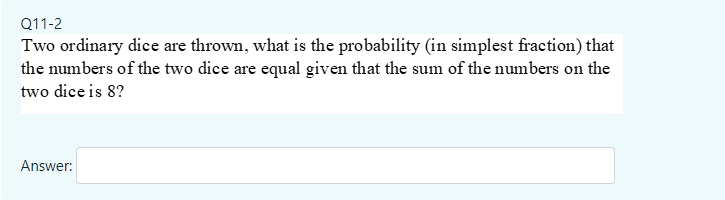
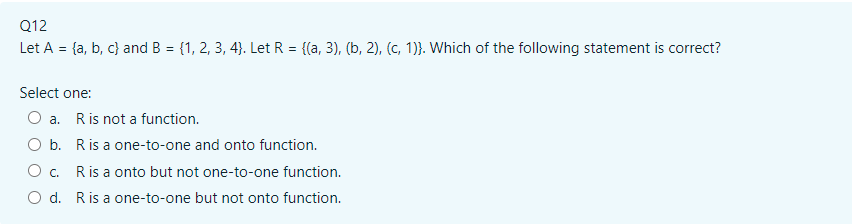

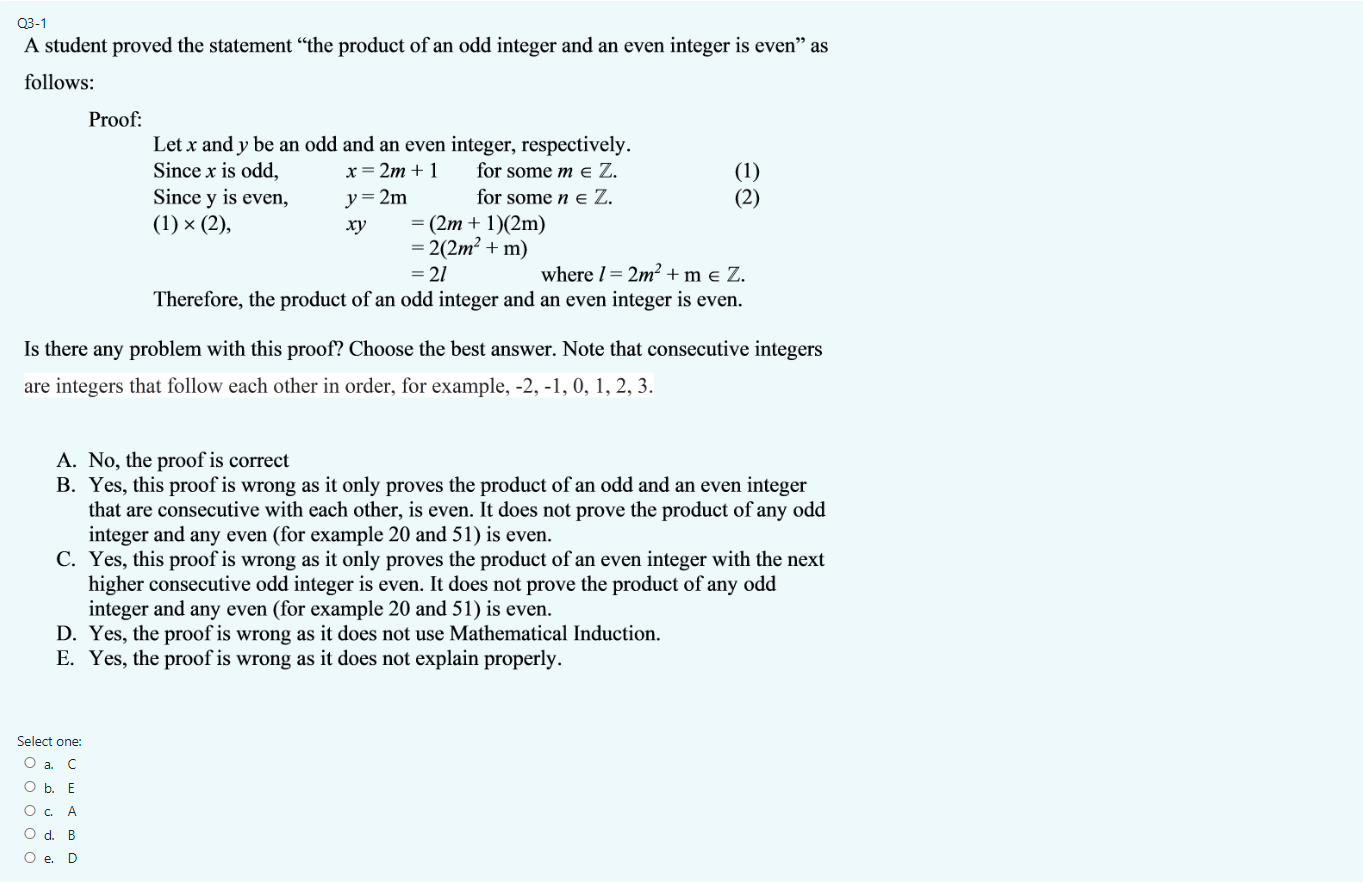
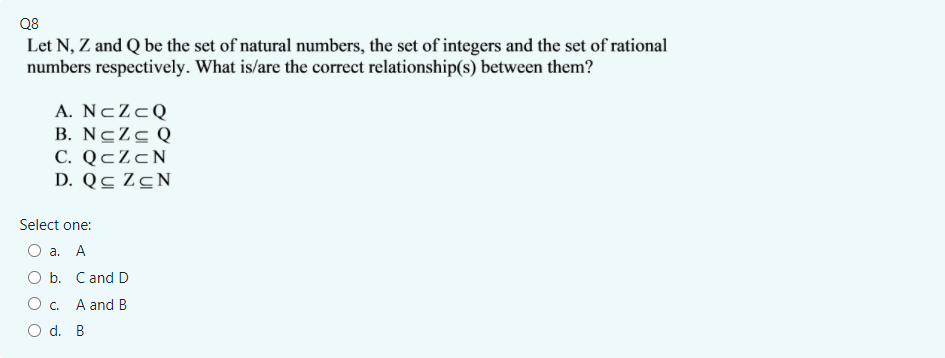
Q11-2 Two ordinary dice are thrown, what is the probability (in simplest fraction) that the numbers of the two dice are equal given that the sum of the numbers on the two dice is 8? Answer: Q12 Let A = {a, b, c} and B = {1, 2, 3, 4}. Let R = {(a, 3), (b, 2), (C, 1)}. Which of the following statement is correct? Select one: O a. R is not a function. O b. Ris a one-to-one and onto function. O c. Ris a onto but not one-to-one function. O d. R is a one-to-one but not onto function. Q14 A ticket is randomly selected from a basket containing 3 green, 4 yellow, and 5 blue tickets. What is the probability of getting a yellow or a blue ticket (in simplest fraction)? Answer: Q3-1 A student proved the statement the product of an odd integer and an even integer is even as follows: Proof: y = 2m Let x and y be an odd and an even integer, respectively. Since x is odd, x= 2m +1 for some me Z. (1) Since y is even, for some n e Z. (2) (1) (2), xy (2m + 1)(2m) = 2(2m + m) = 21 where l = 2m + m e Z. Therefore, the product of an odd integer and an even integer is even. Is there any problem with this proof? Choose the best answer. Note that consecutive integers are integers that follow each other in order, for example, -2, -1, 0, 1, 2, 3. A. No, the proof is correct B. Yes, this proof is wrong as it only proves the product of an odd and an even integer that are consecutive with each other, is even. It does not prove the product of any odd integer and any even (for example 20 and 51) is even. C. Yes, this proof is wrong as it only proves the product of an even integer with the next higher consecutive odd integer is even. It does not prove the product of any odd integer and any even (for example 20 and 51) is even. D. Yes, the proof is wrong as it does not use Mathematical Induction. E. Yes, the proof is wrong as it does not explain properly. Select one: O a. C Ob. E . O d. B O e. D Q8 Let N, Z and Q be the set of natural numbers, the set of integers and the set of rational numbers respectively. What is/are the correct relationship(s) between them? A. NcZcQ B. NcZcQ C. Qc CN D. QCZN Select one: O a. A O b. Cand D Oc. A and B O d. B
Step by Step Solution
There are 3 Steps involved in it

Get step-by-step solutions from verified subject matter experts
 Study Help