







Question: Just need state diagram. Code as below: package org.lsmr.selfcheckout.devices; import java.math.BigDecimal; import java.util.Collections; import java.util.Currency; import java.util.HashMap; import java.util.HashSet; import java.util.List; import java.util.Map; import java.util.Random;
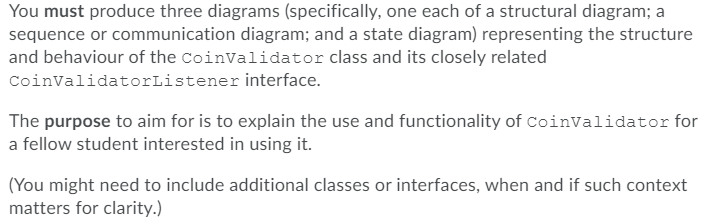
Just need state diagram.
Code as below:
package org.lsmr.selfcheckout.devices;
import java.math.BigDecimal; import java.util.Collections; import java.util.Currency; import java.util.HashMap; import java.util.HashSet; import java.util.List; import java.util.Map; import java.util.Random;
import org.lsmr.selfcheckout.Coin; import org.lsmr.selfcheckout.devices.listeners.CoinValidatorListener;
/** * Represents a device for optically and/or physically validating coins. Coins * deemed valid are moved to storage; coins deemed invalid are ejected. */ public final class CoinValidator extends AbstractDevice implements Acceptor { public final Currency currency; private List denominations; private UnidirectionalChannel rejectionSink, storageSink;
/** * Creates a coin validator that recognizes coins of the specified denominations * (i.e., values) and currency. * * @param currency * The kind of currency to accept. * @param denominations * An array of the valid coin denominations (like $0.05, $0.10, etc.) * to accept. Each value must be >0 and unique in this array. * @throws SimulationException * If either argument is null. * @throws SimulationException * If the denominations array does not contain at least one value. * @throws SimulationException * If any value in the denominations array is non-positive. * @throws SimulationException * If any value in the denominations array is non-unique. */ public CoinValidator(Currency currency, List denominations) { if(currency == null) throw new SimulationException(new NullPointerException("currency is null"));
if(denominations == null) throw new SimulationException(new NullPointerException("denominations is null"));
if(denominations.size()
this.currency = currency; Collections.sort(denominations);
HashSet checked = new HashSet();
for(BigDecimal denomination : denominations) { if(denomination == null) throw new SimulationException(new NullPointerException("A denomination is null"));
if(denomination.compareTo(BigDecimal.ZERO)
if(checked.contains(denomination)) throw new SimulationException(new IllegalArgumentException( "Each denomination must be unique, but " + denomination + " is repeated."));
checked.add(denomination); }
this.denominations = denominations; }
/** * Connects input and output channels to the coin slot. Causes no events. * * @param rejectionSink * The channel to which rejected coins are routed. * @param storageSink * The channel to which valid coins are routed for storage. * @throws SimulationException * If any argument is null. * @throws SimulationException * If the number of standard sinks differs from the number of * denominations. * @throws SimulationException * If any sink is used in more than one position. */ public void connect(UnidirectionalChannel rejectionSink, UnidirectionalChannel storageSink) { if(rejectionSink == null) throw new SimulationException(new NullPointerException("rejectionSink is null"));
if(storageSink == null) throw new SimulationException(new NullPointerException("storageSink is null"));
this.rejectionSink = rejectionSink; this.storageSink = storageSink;
HashSet> set = new HashSet();
set.add(rejectionSink);
if(set.contains(storageSink)) throw new SimulationException(new IllegalArgumentException("Each channel must be unique."));
this.storageSink = storageSink; }
private final Random pseudoRandomNumberGenerator = new Random(); private static final int PROBABILITY_OF_FALSE_REJECTION = 1; /* out of 100 */
private boolean isValid(Coin coin) { if(currency.equals(coin.getCurrency())) for(BigDecimal denomination : denominations) if(denomination.equals(coin.getValue())) return pseudoRandomNumberGenerator.nextInt(100) >= PROBABILITY_OF_FALSE_REJECTION;
return false; }
/** * Tells the coin validator that the indicated coin is being inserted. If the * coin is valid, a "validCoinDetected" event is announced to its listeners; * otherwise, an "invalidCoinDetected" event is announced to its listeners. *
* If there is space in the machine to store a valid coin, it is passed to the * sink channel corresponding to the denomination of the coin. *
*
* If there is no space in the machine to store it or the coin is invalid, the * coin is ejected to the source. *
* * @param coin * The coin to be added. Cannot be null. * @throws DisabledException * if the coin validator is currently disabled. * @throws SimulationException * If the coin is null. * @throws SimulationException * If the coin cannot be delivered. */ public void accept(Coin coin) throws DisabledException { if(isDisabled()) throw new DisabledException();
if(coin == null) throw new SimulationException(new NullPointerException("coin is null"));
if(isValid(coin)) { notifyValidCoinDetected(coin);
if(storageSink.hasSpace()) { try { storageSink.deliver(coin); } catch(OverloadException e) { // Should never happen throw new SimulationException(e); } } else throw new SimulationException(new OverloadException("Coin storage is full.")); } else { notifyInvalidCoinDetected(coin);
try { rejectionSink.deliver(coin); } catch(OverloadException e) { // Should never happen throw new SimulationException(e); } } }
@Override public boolean hasSpace() { return true; // Since we cannot know yet where a coin will route, assume that it is OK. }
private void notifyValidCoinDetected(Coin coin) { for(CoinValidatorListener listener : listeners) listener.validCoinDetected(this, coin.getValue()); }
private void notifyInvalidCoinDetected(Coin coin) { for(CoinValidatorListener listener : listeners) listener.invalidCoinDetected(this); } }
You must produce three diagrams (specifically, one each of a structural diagram; a sequence or communication diagram; and a state diagram) representing the structure and behaviour of the coinvalidator class and its closely related CoinvalidatorListener interface. The purpose to aim for is to explain the use and functionality of coinvalidator for a fellow student interested in using it. (You might need to include additional classes or interfaces, when and if such context matters for clarity.) You must produce three diagrams (specifically, one each of a structural diagram; a sequence or communication diagram; and a state diagram) representing the structure and behaviour of the coinvalidator class and its closely related CoinvalidatorListener interface. The purpose to aim for is to explain the use and functionality of coinvalidator for a fellow student interested in using it. (You might need to include additional classes or interfaces, when and if such context matters for clarity.)
Step by Step Solution
There are 3 Steps involved in it

Get step-by-step solutions from verified subject matter experts
 Study Help