







Question: Just part b please! full code, in parts, with output! The Bertrand model of oligopoly models a market situation in which firms (agents) compete solely
Just part b please! full code, in parts, with output!
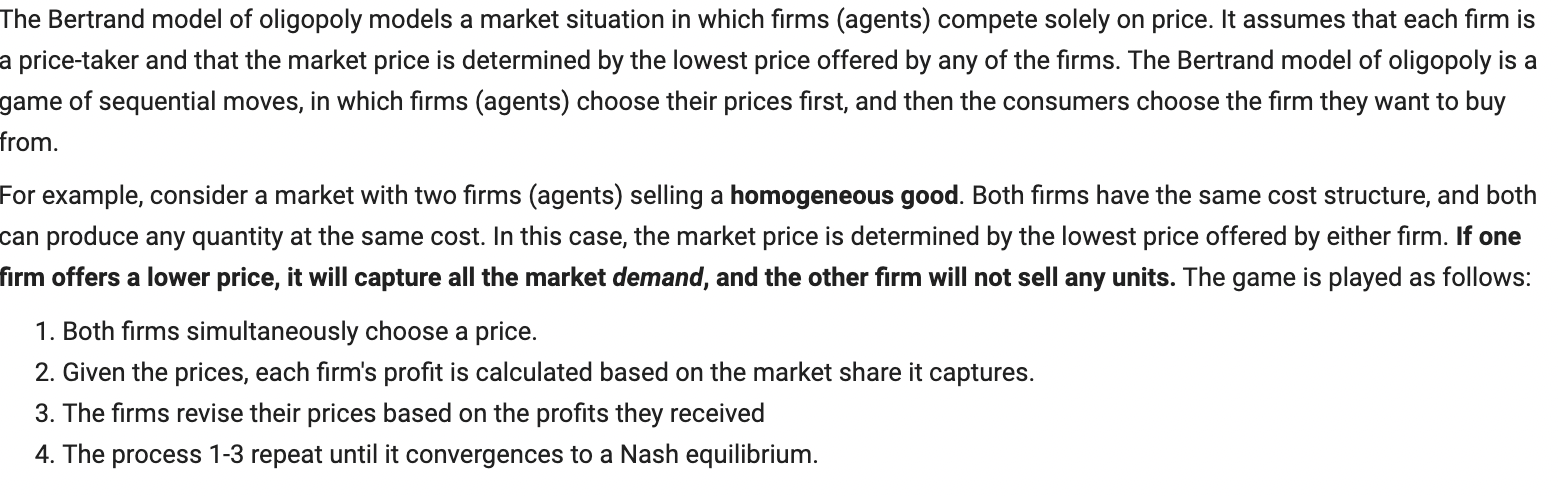
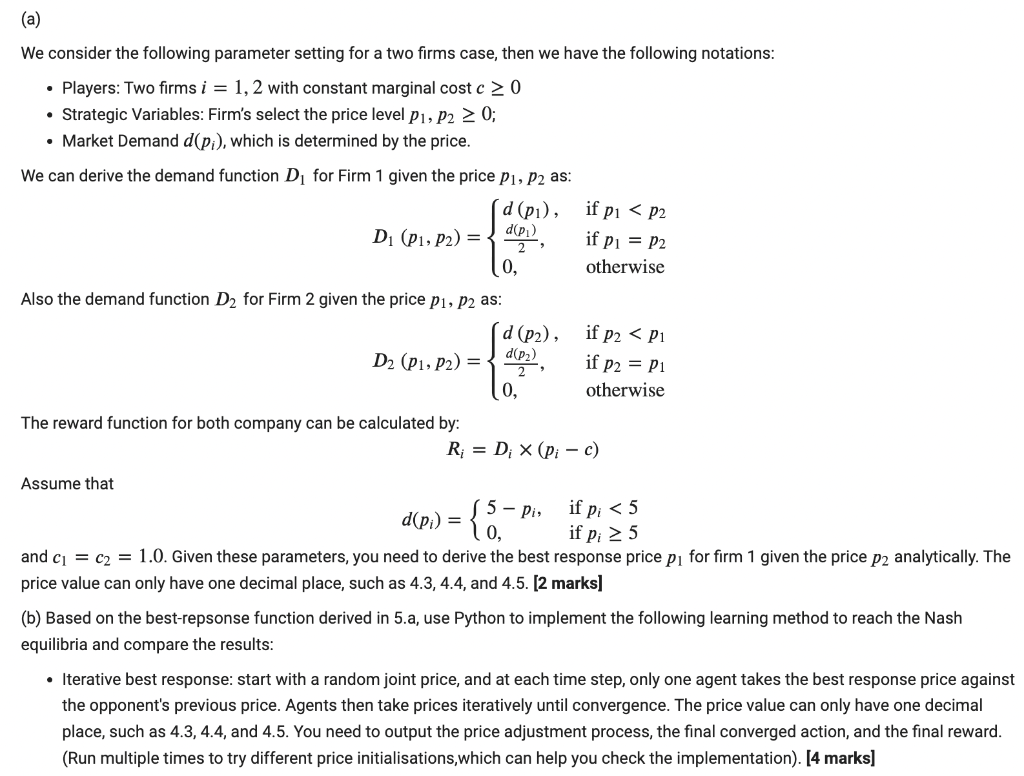
The Bertrand model of oligopoly models a market situation in which firms (agents) compete solely on price. It assumes that each firm is price-taker and that the market price is determined by the lowest price offered by any of the firms. The Bertrand model of oligopoly is a jame of sequential moves, in which firms (agents) choose their prices first, and then the consumers choose the firm they want to buy rom. For example, consider a market with two firms (agents) selling a homogeneous good. Both firms have the same cost structure, and both an produce any quantity at the same cost. In this case, the market price is determined by the lowest price offered by either firm. If one irm offers a lower price, it will capture all the market demand, and the other firm will not sell any units. The game is played as follows: 1. Both firms simultaneously choose a price. 2. Given the prices, each firm's profit is calculated based on the market share it captures. 3. The firms revise their prices based on the profits they received 4. The process 1-3 repeat until it convergences to a Nash equilibrium. We consider the following parameter setting for a two firms case, then we have the following notations: - Players: Two firms i=1,2 with constant marginal cost c0 - Strategic Variables: Firm's select the price level p1,p20; - Market Demand d(pi), which is determined by the price. We can derive the demand function D1 for Firm 1 given the price p1,p2 as: D1(p1,p2)=d(p1),2d(p1),0,ifp1
Step by Step Solution
There are 3 Steps involved in it

Get step-by-step solutions from verified subject matter experts
 Study Help