







Question: just part e The cryptographic relevance of this problem will become evident when we cover hash functions in class. For each question below, provide a

 just part e
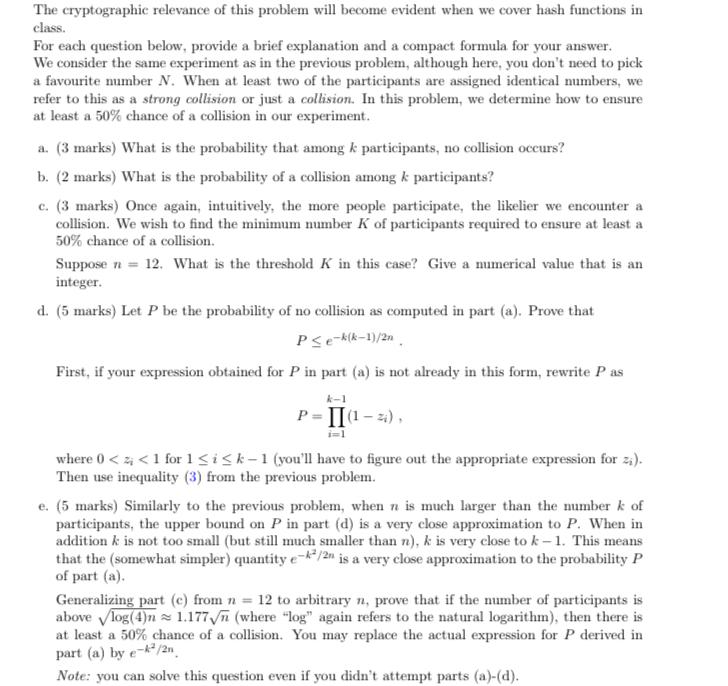
The cryptographic relevance of this problem will become evident when we cover hash functions in class. For each question below, provide a brief explanation and a compact formula for your answer. Let n be a positive integer. Consider an experiment involving a group of participants, where we assign each participant a number that is randomly chosen from the set {1,2,,n} (so all these assignments are independent events). Note that we allow for the possibility of assigning the same number to two different participants. The cryptographic relevance of this problem will become evident when we cover hash functions in class. For each question below, provide a brief explanation and a compact formula for your answer. We consider the same experiment as in the previous problem, although here, you don't need to pick a favourite number N. When at least two of the participants are assigned identical numbers, we refer to this as a strong collision or just a collision. In this problem, we determine how to ensure at least a 50% chance of a collision in our experiment. a. (3 marks) What is the probability that among k participants, no collision occurs? b. ( 2 marks) What is the probability of a collision among k participants? c. (3 marks) Once again, intuitively, the more people participate, the likelier we encounter a collision. We wish to find the minimum number K of participants required to ensure at least a 50% chance of a collision. Suppose n=12. What is the threshold K in this case? Give a numerical value that is an integer. d. (5 marks) Let P be the probability of no collision as computed in part (a). Prove that Pek(k1)/2n First, if your expression obtained for P in part (a) is not already in this form, rewrite P as P=i=1k1(1zi) where 0
Step by Step Solution
There are 3 Steps involved in it

Get step-by-step solutions from verified subject matter experts
 Study Help