







Question: Just problems 5-7, problems 1-4 have already been solved. #3 Questions - 1-2 island_names = [a,b,c,d,e] okina=uu02BB a = hawai + okina + i b
Just problems 5-7, problems 1-4 have already been solved.
#3 Questions - 1-2 island_names = [a,b,c,d,e] okina=u"\u02BB" a = "hawai" + okina + "i" b = "O" + okina + "ahu" c = "Maui" d = "Kaua" + okina + "i" e = "Ni" + okina + "ihau"
#3 Questions - 3 for i in island_names: print(i) #3 Questions - 4 def split(li): lis=[] for i in li: lis.append(i) return lis tup = (3,4,2) print(tup)
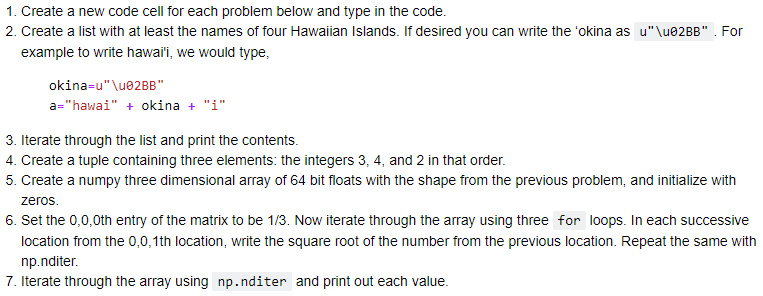
1. Create a new code cell for each problem below and type in the code. 2. Create a list with at least the names of four Hawaiian Islands. If desired you can write the 'okina as u"\u02BB". For example to write hawai'i, we would type, okina-u"\u02BB" a="hawai" + okina + "1" 3. Iterate through the list and print the contents. 4. Create a tuple containing three elements: the integers 3, 4, and 2 in that order. 5. Create a numpy three dimensional array of 64 bit floats with the shape from the previous problem, and initialize with zeros. 6. Set the 0,0,0th entry of the matrix to be 1/3. Now iterate through the array using three for loops. In each successive location from the 0,0,1th location, write the square root of the number from the previous location. Repeat the same with np.nditer. 7. Iterate through the array using np.nditer and print out each value. 1. Create a new code cell for each problem below and type in the code. 2. Create a list with at least the names of four Hawaiian Islands. If desired you can write the 'okina as u"\u02BB". For example to write hawai'i, we would type, okina-u"\u02BB" a="hawai" + okina + "1" 3. Iterate through the list and print the contents. 4. Create a tuple containing three elements: the integers 3, 4, and 2 in that order. 5. Create a numpy three dimensional array of 64 bit floats with the shape from the previous problem, and initialize with zeros. 6. Set the 0,0,0th entry of the matrix to be 1/3. Now iterate through the array using three for loops. In each successive location from the 0,0,1th location, write the square root of the number from the previous location. Repeat the same with np.nditer. 7. Iterate through the array using np.nditer and print out each value
Step by Step Solution
There are 3 Steps involved in it

Get step-by-step solutions from verified subject matter experts
 Study Help