







Question: Just T/F 1-10 A. True/False (40 pts) Note: You do not need to explain your answers in this section. 01. [T/F] (2pt) Suppose we have
Just T/F 1-10
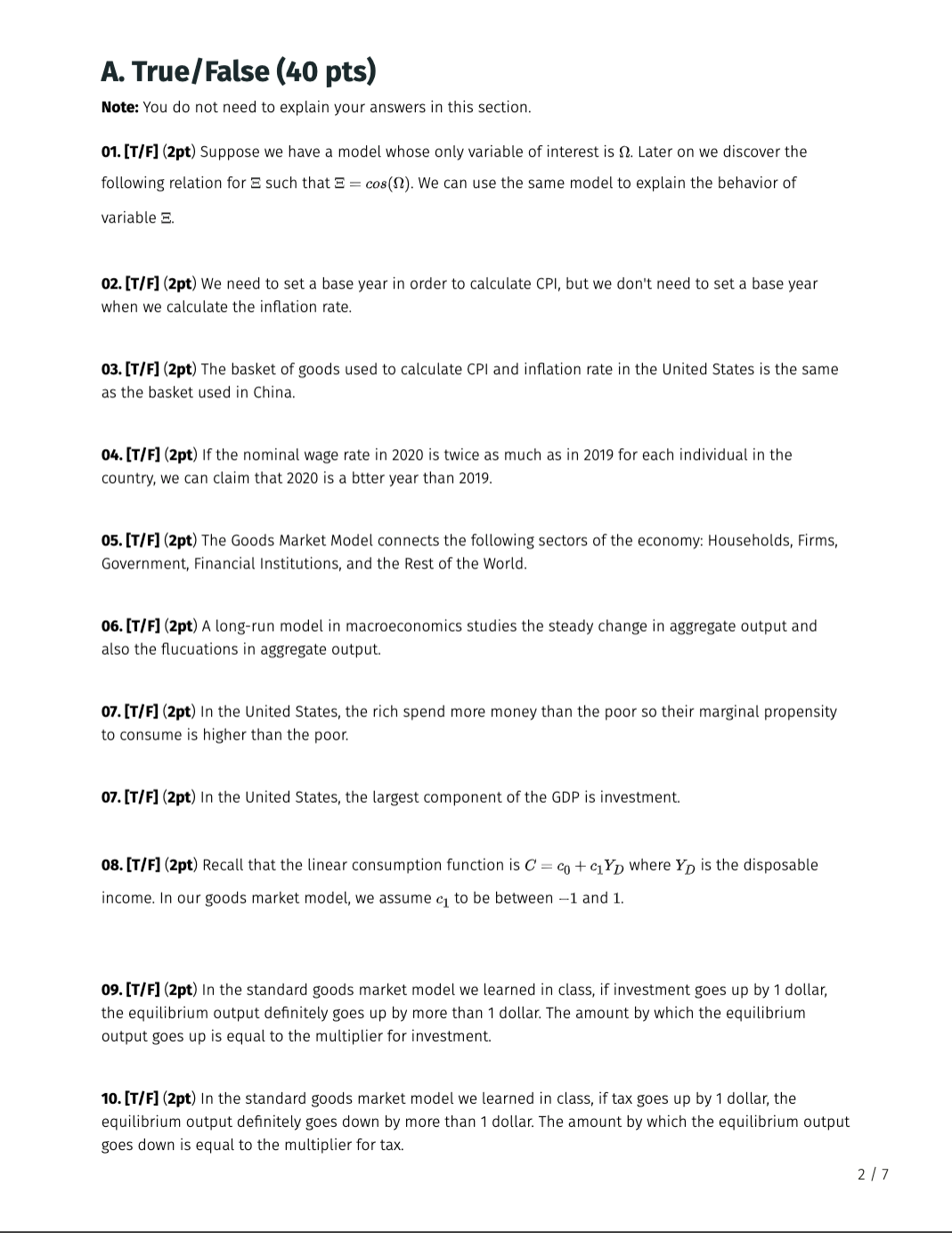
A. True/False (40 pts) Note: You do not need to explain your answers in this section. 01. [T/F] (2pt) Suppose we have a model whose only variable of interest is . Later on we discover the following relation for = such that = = cos(). We can use the same model to explain the behavior of variable E. 02. [T/F] (2pt) We need to set a base year in order to calculate CPI, but we don't need to set a base year when we calculate the inflation rate. 03. [T/F] (2pt) The basket of goods used to calculate CPI and inflation rate in the United States is the same as the basket used in China. 04. [T/F] (2pt) If the nominal wage rate in 2020 is twice as much as in 2019 for each individual in the country, we can claim that 2020 is a btter year than 2019. 05. [T/F] (2pt) The Goods Market Model connects the following sectors of the economy: Households, Firms, Government, Financial Institutions, and the Rest of the World. 06. [T/F] (2pt) A long-run model in macroeconomics studies the steady change in aggregate output and also the flucuations in aggregate output. 07. [T/F] (2pt) In the United States, the rich spend more money than the poor so their marginal propensity to consume is higher than the poor. 07. [T/F] (2pt) In the United States, the largest component of the GDP is investment. 08. [T/F] (2pt) Recall that the linear consumption function is C = co + c1Yp where Yp is the disposable income. In our goods market model, we assume c to be between -1 and 1. 09. [T/F] (2pt) In the standard goods market model we learned in class, if investment goes up by 1 dollar, the equilibrium output definitely goes up by more than 1 dollar. The amount by which the equilibrium output goes up is equal to the multiplier for investment. 10. [T/F] (2pt) In the standard goods market model we learned in class, if tax goes up by 1 dollar, the equilibrium output definitely goes down by more than 1 dollar. The amount by which the equilibrium output goes down is equal to the multiplier for tax. 2/7
Step by Step Solution
There are 3 Steps involved in it

Get step-by-step solutions from verified subject matter experts
 Study Help