







Question: Just the explanation Database Systems Consider the database schema with the following SQL relation declarations: CREATE TABLE R (A INT, B INT, C CHAR (30);
Just the explanation
Database Systems 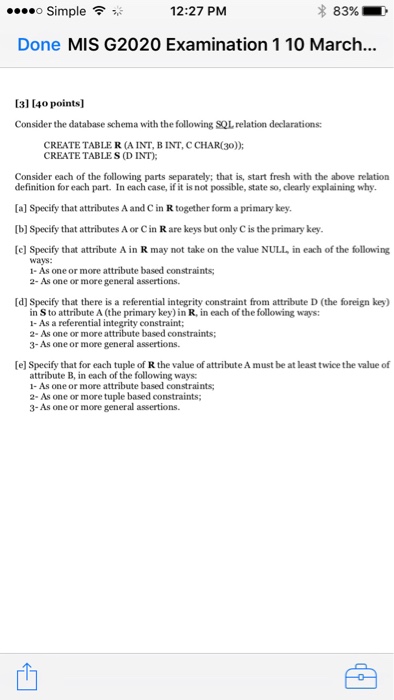
Consider the database schema with the following SQL relation declarations: CREATE TABLE R (A INT, B INT, C CHAR (30); CREATE TABLE S (D INT): Consider each of the following parts separately; that is, start fresh with the above relation definition for each part. in each case, if it is not possible, state so, clearly explaining why. Specify that attributes A and C in R together form a primary key. Specify that attributes A or C R are keys but only C is the primary key. Specify that attribute A in R may not take on the value NULL in each of the following ways: 1-As one or more attribute based constraints; 2- As one or more general assertions. Specify that there is a referential integrity constraint from attribute D (the foreign key) in S to attribute A (the primary key) in R, in each of the following ways: 1- As a referential integrity constraint; 2- As one or more attribute based constraints; 3- As one or more general assertions. Specify that for each of R the value of attribute A must be at least twice the value of attribute B, in each of the following ways: 1- As one or more attribute based constraints; 2- As one or more based constraints; 3-As one or more general assertions
Step by Step Solution
There are 3 Steps involved in it

Get step-by-step solutions from verified subject matter experts
 Study Help