





Question: K = carrying capacity N = Variable r = growth rate The population stock in ariver follows a logistic growth model with per capita annual
 K = carrying capacity N = Variable r = growth rate

K = carrying capacity

N = Variable

r = growth rate

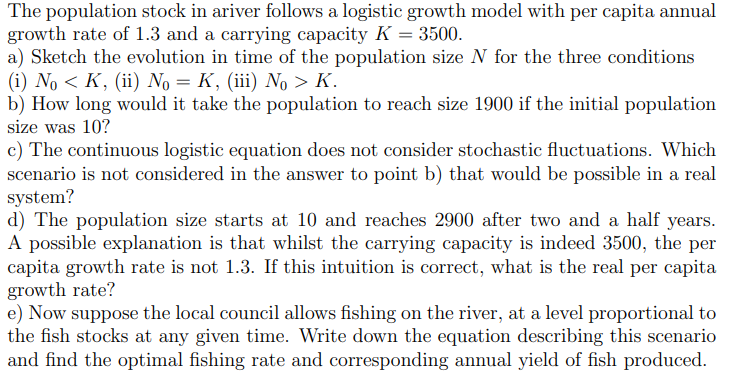
The population stock in ariver follows a logistic growth model with per capita annual growth rate of 1.3 and a carrying capacity K=3500. a) Sketch the evolution in time of the population size N for the three conditions (i) N0K. b) How long would it take the population to reach size 1900 if the initial population size was 10 ? c) The continuous logistic equation does not consider stochastic fluctuations. Which scenario is not considered in the answer to point b) that would be possible in a real system? d) The population size starts at 10 and reaches 2900 after two and a half years. A possible explanation is that whilst the carrying capacity is indeed 3500, the per capita growth rate is not 1.3. If this intuition is correct, what is the real per capita growth rate? e) Now suppose the local council allows fishing on the river, at a level proportional to the fish stocks at any given time. Write down the equation describing this scenario and find the optimal fishing rate and corresponding annual yield of fish produced. The population stock in ariver follows a logistic growth model with per capita annual growth rate of 1.3 and a carrying capacity K=3500. a) Sketch the evolution in time of the population size N for the three conditions (i) N0K. b) How long would it take the population to reach size 1900 if the initial population size was 10 ? c) The continuous logistic equation does not consider stochastic fluctuations. Which scenario is not considered in the answer to point b) that would be possible in a real system? d) The population size starts at 10 and reaches 2900 after two and a half years. A possible explanation is that whilst the carrying capacity is indeed 3500, the per capita growth rate is not 1.3. If this intuition is correct, what is the real per capita growth rate? e) Now suppose the local council allows fishing on the river, at a level proportional to the fish stocks at any given time. Write down the equation describing this scenario and find the optimal fishing rate and corresponding annual yield of fish produced

Step by Step Solution

There are 3 Steps involved in it

1 Expert Approved Answer
Step: 1 Unlock blur-text-image
Question Has Been Solved by an Expert!

Get step-by-step solutions from verified subject matter experts

Step: 2 Unlock
Step: 3 Unlock

Students Have Also Explored These Related Accounting Questions!