







Question: (k.k) 1 = { $2(09) + bx2({0}) [(*) + 2) = {}]} [ k 3 Fg,2(k1, k2; n) = b1 (n) F2 (k1, k2)
![(k.k) 1 = { $2(09) + bx2({0}) [(*) + 2) = {}]} [ k 3 Fg,2(k1, k2; n) = b1 (n) F2 (k1, k2) + b2(n) +bx(n)](https://dsd5zvtm8ll6.cloudfront.net/si.experts.images/questions/2022/03/6239a98944e17_1206239a988d8187.jpg)
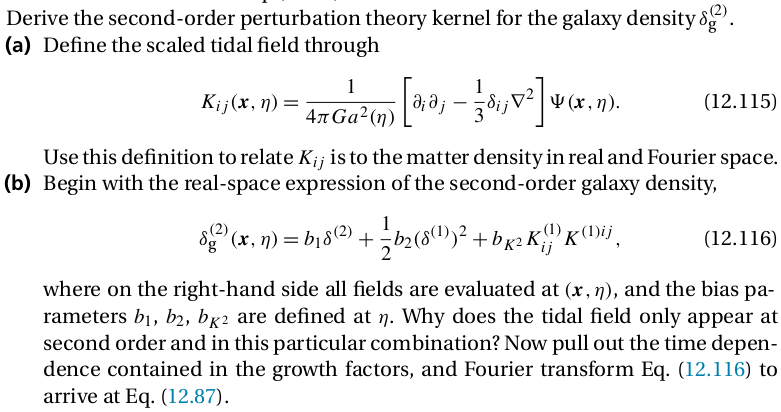
(k.k) 1 = { $2(09) + bx2({0}) [(*) + 2) = {}]} [ k 3 Fg,2(k1, k2; n) = b1 (n) F2 (k1, k2) + b2(n) +bx(n) (12.87) Derive the second-order perturbation theory kernel for the galaxy density). (a) Define the scaled tidal field through Kij (x, n) = 1 1 47 G(m) [2; ; - - 8i, ] v (x. n). aj di 4 3 (12.115) Use this definition to relate Kij is to the matter density in real and Fourier space. (b) Begin with the real-space expression of the second-order galaxy density, 8()(x, n) = b8 () +-b(8() +bkl (1) where on the right-hand side all fields are evaluated at (x, n), and the bias pa- rameters b,b2, bk2 are defined at n. Why does the tidal field only appear at second order and in this particular combination? Now pull out the time depen- dence contained in the growth factors, and Fourier transform Eq. (12.116) to arrive at Eq. (12.87). (12.116)
Step by Step Solution
There are 3 Steps involved in it
2 Derive the secondorder perturbation theory kernel for the galaxy ... View full answer

Get step-by-step solutions from verified subject matter experts
 Study Help