







Question: k . On Figure 1 , plot the new new AS curve. Indicate the new steady - state equilibrium with a dot and label 1
k On Figure plot the new new AS curve. Indicate the new steadystate equilibrium with a dot and label
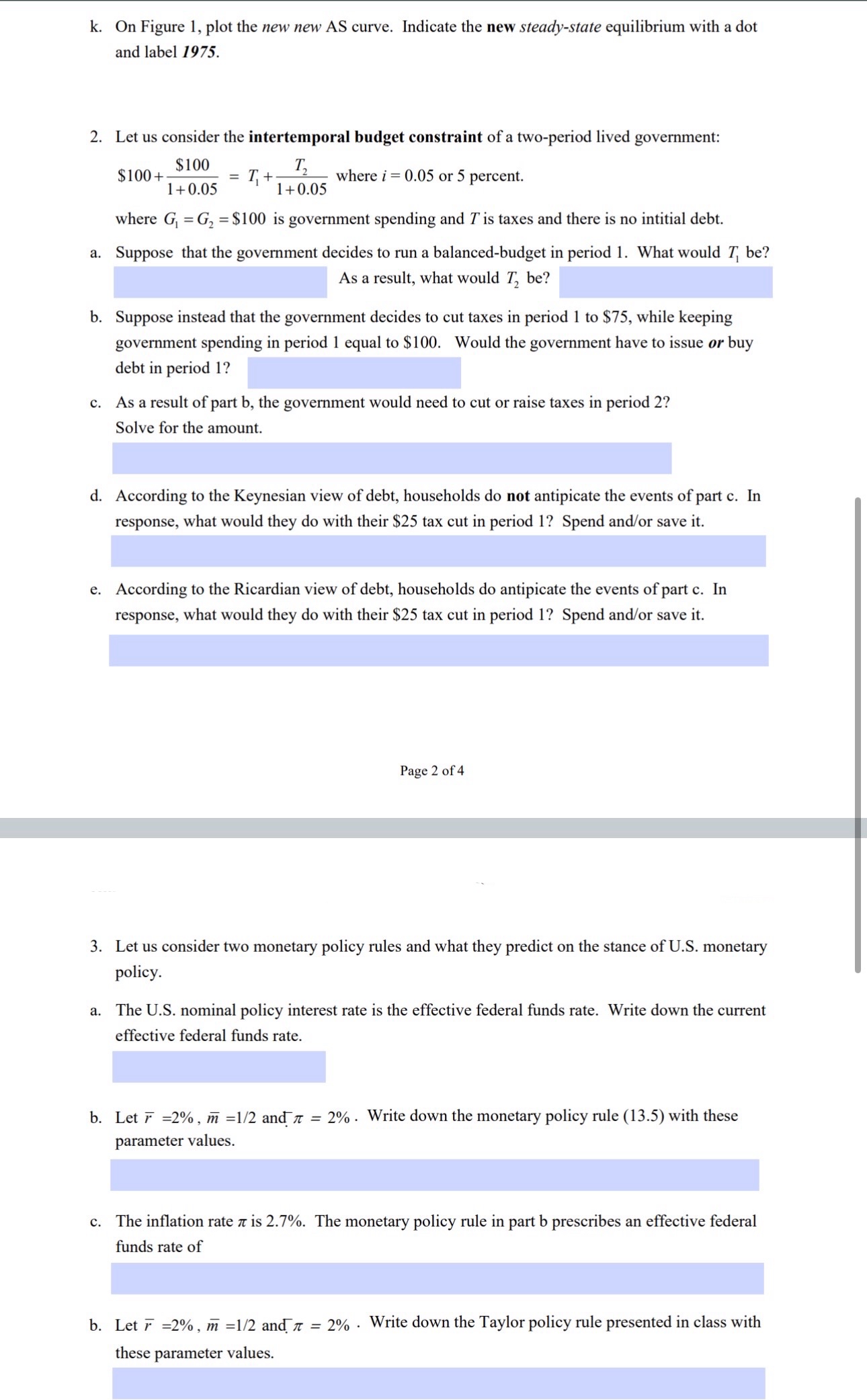
Let us consider the intertemporal budget constraint of a twoperiod lived government: $ where or percent.
where $ is government spending and is taxes and there is no intitial debt.
a Suppose that the government decides to run a balancedbudget in period What would be As a result, what would be
b Suppose instead that the government decides to cut taxes in period to $ while keeping government spending in period equal to $ Would the government have to issue or buy debt in period
c As a result of part b the government would need to cut or raise taxes in period Solve for the amount.
d According to the Keynesian view of debt, households do not antipicate the events of part c In response, what would they do with their $ tax cut in period Spend andor save it
e According to the Ricardian view of debt, households do antipicate the events of part c In response, what would they do with their $ tax cut in period Spend andor save it
Page of
Let us consider two monetary policy rules and what they predict on the stance of US monetary policy.
a The US nominal policy interest rate is the effective federal funds rate. Write down the current effective federal funds rate.
b Let and Write down the monetary policy rule with these parameter values.
c The inflation rate is The monetary policy rule in part b prescribes an effective federal funds rate of
b Let and Write down the Taylor policy rule presented in class with these parameter values.
Step by Step Solution
There are 3 Steps involved in it
1 Expert Approved Answer
Step: 1 Unlock

Question Has Been Solved by an Expert!
Get step-by-step solutions from verified subject matter experts
Step: 2 Unlock
Step: 3 Unlock
 Study Help