







Question: K-COLOR Given a graph G=(V.E), a k-coloring is a function c: V-> {1, 2, ..., k} such that c(u) + c(v) for every edge (u,v)
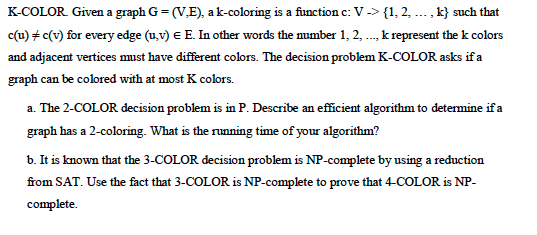
K-COLOR Given a graph G=(V.E), a k-coloring is a function c: V-> {1, 2, ..., k} such that c(u) + c(v) for every edge (u,v) E E. In other words the number 1, 2, ..., k represent the k colors and adjacent vertices must have different colors. The decision problem K-COLOR asks if a graph can be colored with at most K colors. a. The 2-COLOR decision problem is in P. Describe an efficient algorithm to determine if a graph has a 2-coloring. What is the running time of your algorithm? b. It is known that the 3-COLOR decision problem is NP-complete by using a reduction from SAT. Use the fact that 3-COLOR is NP-complete to prove that 4-COLOR is NP- complete
Step by Step Solution
There are 3 Steps involved in it

Get step-by-step solutions from verified subject matter experts
 Study Help