







Question: Key Issues for Discussion 1. Discuss how the processes designed into the Cambridge plant support the achievement of high product quality. What specific aspects of
Key Issues for Discussion
1. Discuss how the processes designed into the Cambridge plant support the achievement of high product quality. What specific aspects of the pro- cess relate to design, control, and improvement?
2. What lessons or best practices might be learned and applied to other companies (outside of the automotive industry)?
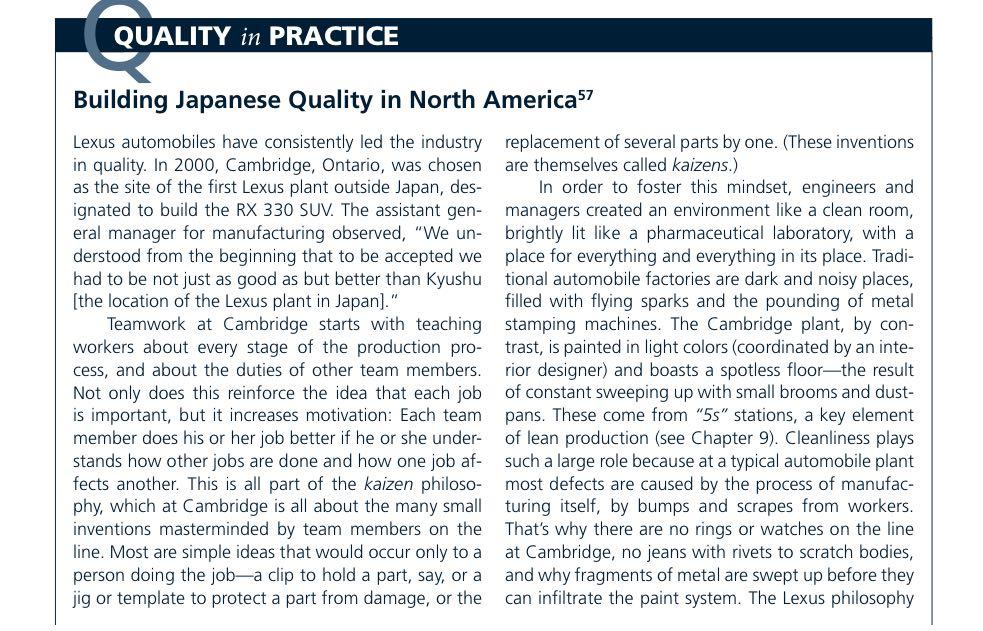
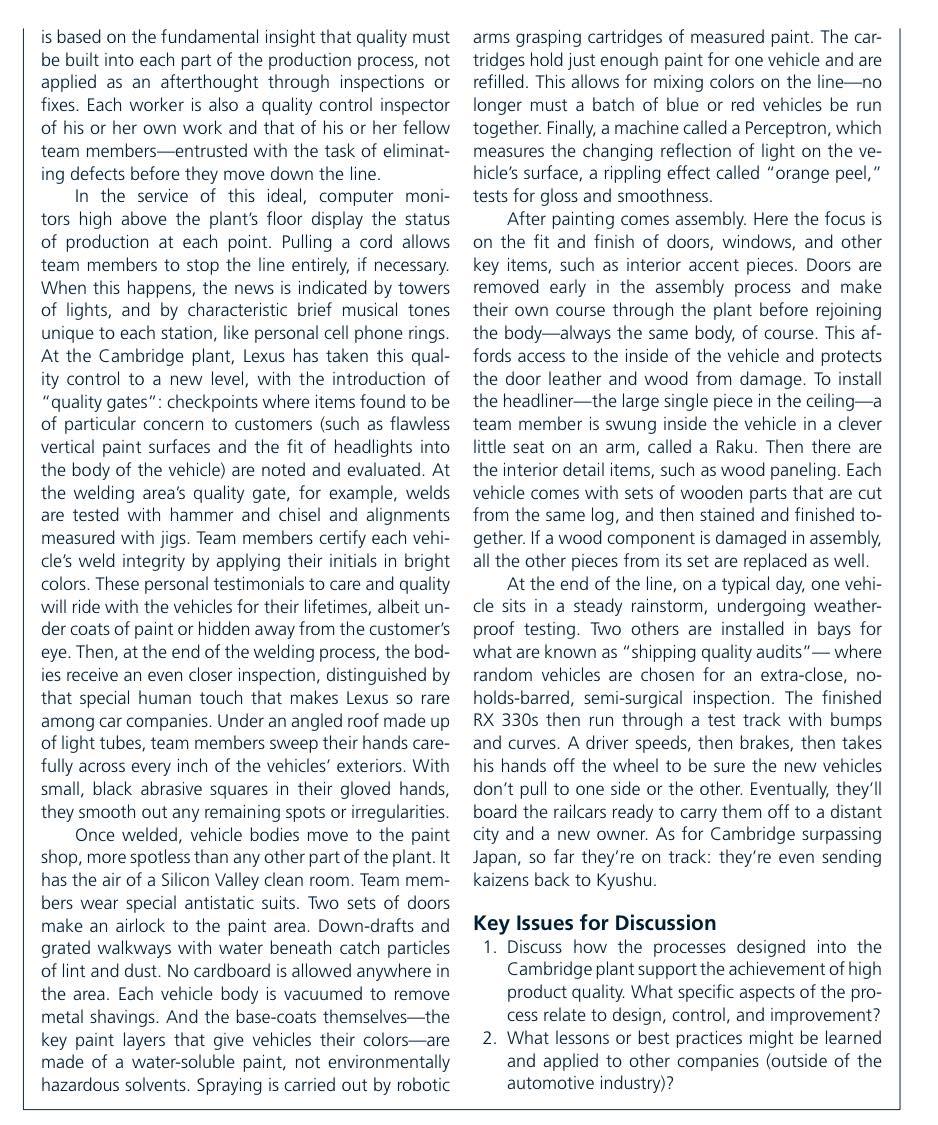
Building Japanese Quality in North America 57 Lexus automobiles have consistently led the industry replacement of several parts by one. (These inventions in quality. In 2000, Cambridge, Ontario, was chosen are themselves called kaizens.) as the site of the first Lexus plant outside Japan, des- In order to foster this mindset, engineers and ignated to build the RX 330 SUV. The assistant gen- managers created an environment like a clean room, eral manager for manufacturing observed, "We un- brightly lit like a pharmaceutical laboratory, with a derstood from the beginning that to be accepted we place for everything and everything in its place. Tradihad to be not just as good as but better than Kyushu tional automobile factories are dark and noisy places, [the location of the Lexus plant in Japan]." filled with flying sparks and the pounding of metal Teamwork at Cambridge starts with teaching stamping machines. The Cambridge plant, by conworkers about every stage of the production pro- trast, is painted in light colors (coordinated by an intecess, and about the duties of other team members. rior designer) and boasts a spotless floor-the result Not only does this reinforce the idea that each job of constant sweeping up with small brooms and dustis important, but it increases motivation: Each team pans. These come from "5s" stations, a key element memberdoeshisorherjobbetterifheorsheunder-standshowotherjobsaredoneandhowonejobaf-ofleanproduction(seeChapter9).Cleanlinessplayssuchalargerolebecauseatatypicalautomobileplant fects another. This is all part of the kaizen philoso- most defects are caused by the process of manufacphy, which at Cambridge is all about the many small turing itself, by bumps and scrapes from workers. inventions masterminded by team members on the That's why there are no rings or watches on the line line. Most are simple ideas that would occur only to a at Cambridge, no jeans with rivets to scratch bodies, person doing the job_a clip to hold a part, say, or a and why fragments of metal are swept up before they jig or template to protect a part from damage, or the can infiltrate the paint system. The Lexus philosophy is based on the fundamental insight that quality must arms grasping cartridges of measured paint. The carbe built into each part of the production process, not tridges hold just enough paint for one vehicle and are applied as an afterthought through inspections or refilled. This allows for mixing colors on the line-no fixes. Each worker is also a quality control inspector longer must a batch of blue or red vehicles be run of his or her own work and that of his or her fellow together. Finally, a machine called a Perceptron, which team members-entrusted with the task of eliminat- measures the changing reflection of light on the veing defects before they move down the line. hicle's surface, a rippling effect called "orange peel," In the service of this ideal, computer moni- tests for gloss and smoothness. tors high above the plant's floor display the status After painting comes assembly. Here the focus is of production at each point. Pulling a cord allows on the fit and finish of doors, windows, and other team members to stop the line entirely, if necessary. key items, such as interior accent pieces. Doors are When this happens, the news is indicated by towers removed early in the assembly process and make of lights, and by characteristic brief musical tones their own course through the plant before rejoining unique to each station, like personal cell phone rings. the bodyalways the same body, of course. This afAt the Cambridge plant, Lexus has taken this qual- fords access to the inside of the vehicle and protects ity control to a new level, with the introduction of the door leather and wood from damage. To install "quality gates": checkpoints where items found to be the headliner-the large single piece in the ceiling-a of particular concern to customers (such as flawless team member is swung inside the vehicle in a clever vertical paint surfaces and the fit of headlights into little seat on an arm, called a Raku. Then there are the body of the vehicle) are noted and evaluated. At the interior detail items, such as wood paneling. Each the welding area's quality gate, for example, welds vehicle comes with sets of wooden parts that are cut are tested with hammer and chisel and alignments from the same log, and then stained and finished tomeasured with jigs. Team members certify each vehi- gether. If a wood component is damaged in assembly, cle's weld integrity by applying their initials in bright all the other pieces from its set are replaced as well. colors. These personal testimonials to care and quality At the end of the line, on a typical day, one vehiwill ride with the vehicles for their lifetimes, albeit un- cle sits in a steady rainstorm, undergoing weatherder coats of paint or hidden away from the customer's proof testing. Two others are installed in bays for eye. Then, at the end of the welding process, the bod- what are known as "shipping quality audits"- where ies receive an even closer inspection, distinguished by random vehicles are chosen for an extra-close, nothat special human touch that makes Lexus so rare holds-barred, semi-surgical inspection. The finished among car companies. Under an angled roof made up RX 330s then run through a test track with bumps of light tubes, team members sweep their hands care- and curves. A driver speeds, then brakes, then takes fully across every inch of the vehicles' exteriors. With his hands off the wheel to be sure the new vehicles small, black abrasive squares in their gloved hands, don't pull to one side or the other. Eventually, they'll they smooth out any remaining spots or irregularities. board the railcars ready to carry them off to a distant Once welded, vehicle bodies move to the paint city and a new owner. As for Cambridge surpassing shop, more spotless than any other part of the plant. It Japan, so far they're on track: they're even sending has the air of a Silicon Valley clean room. Team mem- kaizens back to Kyushu. bers wear special antistatic suits. Two sets of doors make an airlock to the paint area. Down-drafts and Key Issues for Discussion grated walkways with water beneath catch particles 1. Discuss how the processes designed into the of lint and dust. No cardboard is allowed anywhere in Cambridge plant support the achievement of high the area. Each vehicle body is vacuumed to remove product quality. What specific aspects of the prometal shavings. And the base-coats themselves - cess relate to design, control, and improvement
Step by Step Solution
There are 3 Steps involved in it
1 Expert Approved Answer
Step: 1 Unlock

Question Has Been Solved by an Expert!
Get step-by-step solutions from verified subject matter experts
Step: 2 Unlock
Step: 3 Unlock
 Study Help